
Table of Contents
- What Breakthrough Energy Ventures Is and Why Gates Built It
- The 1% Rule: BEV's Hard Emissions Threshold
- The Five Sectors: Where BEV Deploys Capital
- $4 Billion in Play: Fund Size, the 20-Year Horizon and Why It Differs From Traditional VC
- The 2025-2026 Pivot: Policy Retreat, the Catalyst Pause and What Changed
- Where the Money Actually Went in 2025 and 2026
- What This Means If You Are Raising From BEV
- Frequently Asked Questions
- Limitations of This Analysis and Where to Verify It
- Conclusion
- References
Key Takeaway: How Breakthrough Energy Ventures Invests: The 1% Rule, Five Sectors and $4 Billion in Play describes a single, strict filter. Breakthrough Energy Ventures funds only technologies capable of cutting global greenhouse gas emissions by at least 1% — approximately 500 million tons of CO2-equivalent per year by 2050. The fund invests across exactly five sectors: electricity, manufacturing, agriculture, transportation and buildings. BEV manages approximately $4 billion across more than three funds on a 20-year horizon rather than the standard 10. Since March 2025, Breakthrough Energy has abandoned policy advocacy and concentrates purely on private-sector deals.
Breakthrough Energy Ventures (BEV) is Bill Gates’ climate technology venture fund, founded in 2015 and backed by a coalition of high-net-worth investors. It screens every deal against one quantitative emissions test — 1% of global greenhouse gas output — rather than against a market-size forecast. This matters more in 2026 than it did five years ago, because the March 2025 decision to dissolve Breakthrough Energy’s public policy units in the United States and Europe removed the organisation’s advocacy lever entirely. As a result, the venture arm is now the primary remaining instrument, which means BEV’s criteria determine where roughly $4 billion of patient climate capital lands. Founders, researchers and analysts assessing whether their technology clears that bar need the mechanics, not the mission statement. This article sets out How Breakthrough Energy Ventures Invests: The 1% Rule, Five Sectors and $4 Billion in Play, deal by deal and figure by figure.
About this analysis: Written for billgates.pk, which follows the money and the measurable outcome across the Gates Foundation and Breakthrough Energy — amounts, timelines, recipients and deadlines. This article separates the institutional position of Breakthrough Energy from the personal views of Bill Gates wherever the two diverge.
Transparency note: All figures are drawn from Breakthrough Energy’s organisational disclosures and dated press reporting through October 2026. BEV is a private fund; position sizes, valuations and fund-level returns are not disclosed publicly. See the limitations section for what cannot be verified.
What Breakthrough Energy Ventures Is and Why Gates Built It
Breakthrough Energy Ventures is a climate technology venture capital fund founded by Bill Gates in 2015 and backed by a coalition of high-net-worth investors, created to finance emissions reductions that government research budgets and conventional venture funds were not financing. Its mandate is the decarbonisation of the global economy, and it sits inside the wider Breakthrough Energy umbrella as a distinct vehicle — separate from the Catalyst initiative, which funded ready-to-scale infrastructure, and separate from the public policy arm dissolved in March 2025. The fund is run by a team of scientists, engineers and former ARPA-E leaders, including Executive Director Rodi Guidero and Chief Technical Officer Dr. Eric Toone.
The vehicle exists because of a structural financing gap. Hard-science energy technologies — fusion, advanced materials, novel catalysis — carry development timelines of 10 to 20 years, therefore a standard 10-year venture fund cannot hold them long enough to reach commercial scale. Federal agencies fund the earliest work: the U.S. Department of Energy supports clean energy research and demonstration programmes, and the National Science Foundation funds the fundamental science underneath them. Private growth capital arrives later, once revenue is predictable. The effect is a gap in the middle where technically promising companies stall, and this Bill Gates climate investment vehicle was structured specifically to fill it.
The 1% Rule: BEV’s Hard Emissions Threshold
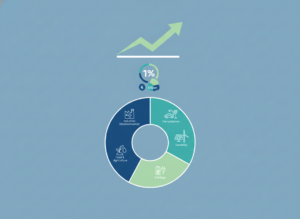
The 1% Rule means Breakthrough Energy Ventures will only invest in a company whose technology, at full scale, could remove at least 1% of global greenhouse gas emissions — approximately 500 million tons of CO2-equivalent per year by 2050. One percent of annual global emissions equates to roughly half a gigaton. Consequently, any technology that cannot plausibly reach half-a-gigaton scale is screened out before technical diligence begins, which keeps the fund away from incremental improvements and pointed at platform-scale breakthroughs.
For founders, the consequence is blunt. The rule rewards platform technologies over efficiency gains, which means an excellent product with a capped addressable market fails on physics rather than on business merit. Because BEV sizes impact in tons rather than dollars, total addressable market is effectively calculated in avoided emissions, and the denominator comes from sector-level greenhouse gas inventories of the kind the U.S. Environmental Protection Agency publishes annually. A company with strong unit economics and a 20-million-ton ceiling does not clear the bar; a company with uncertain economics and a half-gigaton ceiling does.
What the 1% Rule screens out
- Technologies with a hard ceiling below half a gigaton of annual CO2-equivalent abatement
- Incremental efficiency improvements to existing fossil infrastructure
- Consumer-facing products whose emissions impact depends on voluntary behaviour change at scale
- Business-model innovations without a defensible underlying hard-science advance
- Solutions confined to a single national market with no export pathway
That scientific diligence produces a second-order market effect. Because the review is conducted by scientists, engineers and former ARPA-E programme leaders rather than by generalist investors, industry analysts treat a BEV term sheet as independent technical validation. This is why BEV participation frequently pulls strategic co-investors such as Microsoft’s Climate Innovation Fund, Shell and Just Climate into the same round, resulting in a capital-raising dynamic where one commitment compresses the time needed to close the rest.
The Five Sectors: Where BEV Deploys Capital
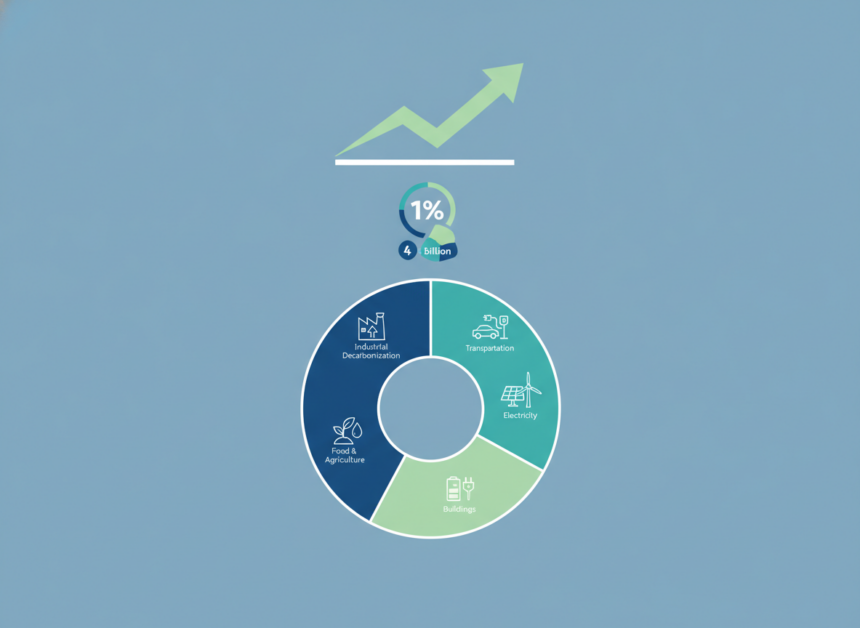
Breakthrough Energy Ventures organises every investment into five sectors — electricity, manufacturing, agriculture, transportation and buildings — because those five categories account for the whole of global greenhouse gas output. The taxonomy is derived from emissions accounting rather than from industry convention, which has a direct consequence for where attention goes. Electric vehicles and solar generation, the two categories that dominate investor interest, sit inside broader buckets alongside far less fashionable problems such as cement clinker and primary steelmaking. Because EPA sector emissions data weights industry and agriculture heavily, and because DOE clean energy research priorities span industrial heat and long-duration storage as well as power generation, manufacturing and agriculture receive attention from BEV that is disproportionate to their venture-market popularity.
| Sector | Core technology focus | Named BEV-backed example |
|---|---|---|
| Electricity | Zero-carbon generation, fusion, long-duration storage | Mantle8 — geologic hydrogen, €31M Series A, May 2026 |
| Manufacturing | Steel, cement, chemicals, critical minerals | Mariana Minerals — $310M Series B, August 2026 |
| Agriculture | Sustainable farming, alternative proteins, methane reduction | Rize — sustainable rice farming, $31M Series B, July 2026 |
| Transportation | Sustainable aviation fuel, shipping, EV infrastructure | Lydian — synthetic jet fuel, $43M Series A, July 2026 |
| Buildings | Efficiency, low-carbon heating and cooling, next-generation materials | Not stated |
One cross-sector pattern is visible across 2026. Capital is concentrating in sustainable aviation fuel, long-duration storage and critical minerals, because each of those three bottlenecks blocks decarbonisation in several sectors at once. Critical minerals constrain batteries, grid build-out and electrified industry simultaneously, which means a single minerals platform can clear the 1% threshold through volume alone rather than through any single application.
$4 Billion in Play: Fund Size, the 20-Year Horizon and Why It Differs From Traditional VC
As of early 2026, Breakthrough Energy Ventures manages approximately $4 billion across more than three primary funds, and it holds positions on a 20-year horizon rather than the 10-year term standard in venture capital. The causal chain behind that structure is straightforward. Nuclear fusion, geologic hydrogen and advanced materials typically require a decade or more to move from laboratory result to commercial deployment, therefore a 10-year fund life would force exits before technical risk has been retired, resulting in write-downs that misprice the underlying science rather than reflecting its progress. The 20-year structure removes that forced-exit pressure, which is the single largest operational difference between BEV and a conventional fund.
| Dimension | Breakthrough Energy Ventures | Conventional VC fund |
|---|---|---|
| Fund life | Approximately 20 years | Approximately 10 years |
| Primary screening test | 1% of global emissions (~500Mt CO2e/yr) | Market size and growth rate |
| Assets under management | Approximately $4 billion | Varies by fund |
| Sector scope | Five emissions-defined sectors | Thesis-driven or opportunistic |
| Diligence team | Scientists, engineers, ex-ARPA-E leaders | Finance and operating backgrounds |
| Return expectation | Competitive returns plus measured abatement | Financial return only |
The trade-off deserves stating plainly. Patient capital reduces timing pressure, but it concentrates risk and extends the path to distributions, which means limited partners accept years of illiquidity in exchange for exposure to technologies that cannot be underwritten on comparables. That exposure is also harder to inspect from outside. Gates-linked public-market holdings are verifiable through SEC filings, whereas private fund positions carry no equivalent disclosure obligation, so the $4 billion figure and the 20-year term rest on organisational statements rather than on regulatory filings.
The 2025-2026 Pivot: Policy Retreat, the Catalyst Pause and What Changed
In March 2025, Bill Gates dissolved Breakthrough Energy’s public policy units in the United States and Europe, and as a result the venture arm became the organisation’s main instrument for advancing climate technology. The cause was political arithmetic rather than financial strain. The returning Trump administration actively promoted fossil fuel development and dissolved federal programmes addressing climate change, therefore Gates concluded that lobbying was “not likely to have a significant effect in Washington.” The effect was a wholesale reallocation of organisational effort from advocacy to private-sector investment.
A second change followed in early 2026. Reports indicated that Breakthrough Energy was not pursuing additional capital for Catalyst, the separate vehicle that had previously raised $1.5 billion to finance ready-to-scale climate infrastructure projects. The consequence falls on project developers rather than on startups: first-of-a-kind deployment financing became scarcer, which pushes more scaling risk back onto venture-stage balance sheets and onto industrial partners.
The personal and institutional positions must be read separately. Gates signalled in a late-2025 memo that his personal philanthropic emphasis was shifting toward global health, where intervention priorities tracked by the World Health Organization offer measurable near-term outcomes. That is a statement of his own priorities and not a revision of BEV’s mandate, because BEV continued deploying capital across all five sectors throughout 2026.
Timeline of the Breakthrough Energy restructuring
- March 2025 — Breakthrough Energy dissolves its US and European public policy teams after Gates concludes lobbying will not move Washington.
- Mid-2025 — organisational focus narrows to private-sector clean energy technology investment.
- Late 2025 — a Gates memo signals a personal philanthropic shift toward global health.
- February 2026 — reports indicate Breakthrough Energy is not raising further capital for the $1.5 billion Catalyst initiative.
- Through 2026 — BEV continues leading and joining rounds across all five sectors, indicating the venture mandate is intact.
Where the Money Actually Went in 2025 and 2026
Between September 2025 and August 2026, Breakthrough Energy Ventures committed capital across sustainable aviation fuel, geologic hydrogen, critical minerals, orbital infrastructure and sustainable agriculture, with individual rounds ranging from €31 million to $310 million. The pattern beneath the figures is more informative than the figures themselves: aviation fuel and critical minerals absorbed the largest commitments because both are physical bottlenecks that no amount of grid electrification removes, therefore they clear the 1% threshold on volume alone. The September 2025 oneworld alliance partnership is the clearest structural innovation of the period, because bringing Alaska Airlines and American Airlines in as cornerstone investors built offtake demand directly into the capital structure rather than assuming it would appear later.
| Date | Company or vehicle | Sector | Round size | BEV role |
|---|---|---|---|---|
| September 2025 | oneworld SAF fund | Transportation | $150M | Partner |
| May 2026 | Mantle8 (geologic hydrogen) | Electricity / feedstock | €31M Series A | Participant |
| May 2026 | Cowboy (orbital data centre rockets) | Transportation / energy infrastructure | $275M | Participant |
| July 2026 | Lydian (synthetic jet fuel) | Transportation | $43M Series A | Lead |
| July 2026 | Rize (sustainable rice farming) | Agriculture | $31M Series B | Ecosystem participant |
| August 2026 | Mariana Minerals (critical minerals) | Manufacturing | $310M Series B | Participant |
The read-through for founders sits in the “BEV role” column. BEV led or anchored several of these rounds, and because its participation reliably attracts strategic co-investors, a lead commitment effectively de-risks the remainder of the raise for everyone who comes after it.
What This Means If You Are Raising From BEV
A pitch to Breakthrough Energy Ventures succeeds or fails on a quantified abatement model, because the fund’s first filter is tons of CO2-equivalent avoided at full scale rather than revenue projections. Diligence is run by scientists and former ARPA-E programme leaders, which means technical assumptions are tested directly against physics and published literature. An abatement model built on optimistic conversion efficiencies, generous capacity factors or unstated feedstock assumptions will not survive that review. Publish the assumptions, show sensitivity ranges, and state the point at which the model breaks.
Sequencing also matters. Non-dilutive federal funding through DOE programmes or NSF awards strengthens a BEV conversation because it supplies independent technical validation that BEV’s own team can interrogate, therefore grant-stage work is complementary to a venture raise rather than an alternative to it. Readers tracking this in more depth will find ongoing climate tech and AI health investing analysis useful alongside their own diligence.
How to prepare a BEV-ready case
- Model your technology’s maximum annual abatement in tons of CO2-equivalent and compare it against the half-gigaton threshold.
- State which of the five sectors you sit in, and name the specific emissions source you displace.
- Document the hard-science advance and the peer-reviewed or federally funded work behind it.
- Show a credible scaling pathway over 10 to 20 years, including the industrial partners required.
- Identify your offtake demand, following the oneworld model where buyers co-invest.
- Assemble independent technical validation — federal grant awards, national laboratory results or university partnerships such as those hosted at the University of Washington.
Frequently Asked Questions
What is Breakthrough Energy Ventures and how does it invest in climate technology?
Breakthrough Energy Ventures is a climate technology venture fund founded by Bill Gates in 2015 that manages approximately $4 billion. It invests only in technologies capable of cutting global greenhouse gas emissions by at least 1%, across five sectors, on a roughly 20-year horizon. That structure means BEV holds hard-science companies considerably longer than conventional funds, because fusion and advanced materials need a decade or more to reach commercial deployment.
What exactly is BEV’s 1% Rule?
The 1% Rule requires a technology to be capable of eliminating at least 1% of global greenhouse gas emissions — roughly 500 million tons of CO2-equivalent per year by 2050. Because the test is applied before financial diligence, incremental efficiency gains are screened out early, regardless of their unit economics. The threshold therefore functions as a scale filter rather than a profitability filter.
How does Bill Gates’ climate tech investment strategy differ from traditional venture capital?
It differs on two dimensions: time horizon and screening test. BEV runs an approximately 20-year fund life instead of 10 years, and it screens on abatement potential instead of market size and growth rate. Diligence is conducted by scientists, engineers and former ARPA-E leaders, therefore technical risk is assessed directly against the underlying science rather than priced through comparable transactions.
Which five sectors does Breakthrough Energy Ventures invest in?
Electricity, manufacturing, agriculture, transportation and buildings. The taxonomy is derived from global emissions accounting rather than from investment convention, which is why cement and steel decarbonisation receive the same structural weight as transport electrification. Each sector maps to a measurable share of annual global greenhouse gas output.
Did Bill Gates stop funding climate work in 2025 and 2026?
No — the venture arm continued investing, but the surrounding structure changed. Breakthrough Energy dissolved its US and European policy units in March 2025, reports in February 2026 indicated no further Catalyst fundraising, and a late-2025 memo signalled a personal shift toward global health. BEV nonetheless led Lydian’s $43 million Series A in July 2026 and joined Mariana Minerals’ $310 million round in August 2026.
How can a startup or researcher approach Breakthrough Energy Ventures for funding?
Lead with a quantified abatement model measured in tons of CO2-equivalent, not a revenue forecast. Name your sector, identify the specific emissions source you displace, and document the hard-science advance behind the claim. Independent validation such as DOE or NSF awards strengthens the case, because federal technical review gives BEV’s own diligence team a verified starting point.
What are the strategic priorities for Bill Gates’ philanthropic and investment endeavours as of 2026?
Global health has moved to the front of his personal philanthropy, while climate capital now flows through private investment rather than advocacy. The distinction is important: the late-2025 memo described Gates’ own emphasis, whereas Breakthrough Energy Ventures institutionally continued deploying capital across all five sectors throughout 2026. The two positions should not be read as one.
Limitations of This Analysis and Where to Verify It
Several things in this analysis are not publicly verifiable. BEV is a private fund, therefore individual position sizes, entry valuations and fund-level returns are not disclosed, and only publicly announced rounds are observable. The portfolio picture presented here is consequently partial rather than complete.
The approximately $4 billion AUM figure and the 20-year horizon are drawn from organisational disclosures and press reporting rather than from regulatory filings. By contrast, Gates-linked public-market holdings are verifiable through SEC filings, which is why the two categories of information carry different confidence levels. The 1% Rule itself is a screening heuristic applied with judgement, not a published formula, therefore abatement estimates for early-stage technologies carry wide uncertainty ranges in both directions.
Founders whose technology does not clear the threshold have other routes: DOE and ARPA-E programmes, NSF research funding, NIH programmes for health-adjacent AI work, university-hosted research partnerships such as those at the University of Washington, and sector-specific corporate venture funds. Following the preparation steps in this article improves the quality of a submission; it does not secure investment.
Conclusion
How Breakthrough Energy Ventures Invests: The 1% Rule, Five Sectors and $4 Billion in Play reduces to one filter applied over an unusually long holding period — half a gigaton of annual abatement potential, five emissions-defined sectors, and roughly 20 years to get there. Because the policy arm was dissolved in March 2025 and Catalyst fundraising was paused by February 2026, that filter now functions as one of the most consequential private screens on which decarbonisation technologies reach commercial scale. The fund’s 2026 concentration in sustainable aviation fuel, critical minerals and long-duration storage signals where it believes the binding physical constraints sit. Founders should therefore map their own abatement case directly onto those bottlenecks rather than onto broader market narratives. Read more analysis of Bill Gates’ climate technology and AI health investing at billgates.pk.
References
- U.S. Department of Energy — clean energy research, demonstration and deployment priorities: https://www.energy.gov/
- U.S. Environmental Protection Agency — greenhouse gas emissions inventories by sector: https://www.epa.gov/
- U.S. National Science Foundation — federal support for fundamental climate and computing science: https://www.nsf.gov/
- U.S. Securities and Exchange Commission — public-market holdings disclosure: https://www.sec.gov/
- World Health Organization — global health priorities: https://www.who.int/
- National Institutes of Health — health and AI health research funding programmes: https://www.nih.gov/
- University of Washington — university research partnerships and independent technical validation: https://www.washington.edu/