
Table of Contents
- What Is the Leonardo Supercomputer?
- Who Runs Leonardo: CINECA and the EuroHPC Joint Undertaking
- Why EuroHPC Controls Up to Half of Leonardo's Capacity
- How Access to the Leonardo Supercomputer Works
- Extreme Scale, Regular, AI for Science and Development Access
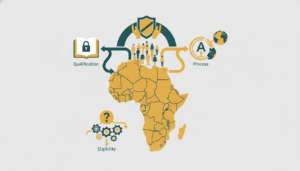
- Free Access for Open Science: Who Qualifies
- Commercial and Emergency Access
- How Leonardo Powers Climate Research
- Ocean Health: EDITO-Infra
- The Bologna Digital Twin
- Decarbonization Models via HPC Call4Innovators
- How Leonardo Powers Health and Biomedical Research
- Drug Discovery with Exscalate
- Genomic Data and the European Health Data Space
- The IT4LIA AI Factory and the Reimbursement Bottleneck
- 2026 Upgrades: LISA, Quantum Integration and Renewable Power
- Can US Researchers Use Leonardo? EuroHPC vs NSF ACCESS and DOE INCITE
- Why Europe Treats Public Compute as Strategic Infrastructure
- Frequently Asked Questions
- What is the Leonardo supercomputer?
- Who decides how Leonardo's computing time is allocated?
- How do researchers apply for access to Leonardo?
- Is access to the Leonardo supercomputer free?
- Can researchers in the United States use Leonardo?
- What climate research runs on Leonardo?
- How is Leonardo used in health and drug discovery?
- What does emergency access mean under EuroHPC rules?
- What changed on Leonardo in 2026?
- Why does Europe invest in public supercomputers instead of using commercial cloud?
- Limitations, Costs and Alternatives to Consider
- Conclusion
- References
Key Takeaway: The Leonardo supercomputer is a 250+ petaflop Tier-0 system operated by CINECA in Bologna, Italy. The EuroHPC Joint Undertaking allocates up to 50% of its capacity through peer-reviewed open calls, and CINECA and the Italian government allocate the rest. Access is free for academic, public-sector and SME researchers in EU and Horizon Europe associated countries who publish their results openly.
In June 2026, the EuroHPC Joint Undertaking (EuroHPC JU) and CINECA inaugurated LISA, an AI-optimized partition, and integrated SOL, a 140-qubit quantum computer built by Pasqal, into the Leonardo supercomputer in Bologna. These upgrades expand one of Europe’s largest publicly funded compute pools at a time when climate models and biomedical AI demand more GPU capacity every year.
Peer review, not price, rations time on Leonardo. Eligibility rules therefore determine which climate and health science gets done. This guide covers how allocation works, who qualifies for free access, which climate and health workloads run on the system, what changed in 2026, and how the European model compares with US programmes such as NSF ACCESS and DOE INCITE.
Transparency Note: This article is based on public information from the EuroHPC Joint Undertaking, CINECA, and US federal agencies, current as of October 23, 2026. billgates.pk has no commercial relationship with CINECA, EuroHPC JU, or any company named here. Call terms change, so check the official portals before applying.
What Is the Leonardo Supercomputer?
Leonardo is a pre-exascale Tier-0 supercomputer hosted at the Tecnopolo DAMA in Bologna, operated by the CINECA consortium, and co-funded by the EuroHPC Joint Undertaking and Italy’s Ministry of University and Research (MUR). According to CINECA’s infrastructure documentation, it delivers more than 250 petaflops and consistently ranks among the ten most powerful supercomputers in the world.
A few terms need defining:
- Petaflop: one quadrillion (10¹⁵) floating-point calculations per second.
- Tier-0: the top level of Europe’s computing pyramid. These machines serve pan-European research projects too large for national Tier-1 systems.
- Pre-exascale: a system below the exaflop threshold of 1,000 petaflops, built as Europe’s step toward exascale computing.
Leonardo’s defining feature is its GPU count. It has more than 13,800 Nvidia Ampere GPUs. Because GPUs run thousands of calculations in parallel, they make the system suited to AI training and molecular simulation, not only traditional physics simulation.
Most of the machine’s throughput comes from this GPU partition. As a result, Leonardo attracts AI-heavy climate and biomedical workloads that CPU-only systems cannot run at the same scale. Teams training neural weather emulators or screening chemical libraries apply here because the hardware matches their methods.
Leonardo at a Glance (October 2026)
| Specification | Figure |
|---|---|
| Peak performance | Over 250 petaflops |
| GPU accelerators installed | 13,800+ Nvidia Ampere GPUs |
| Host site | Tecnopolo DAMA, Bologna, Italy |
| Operator | CINECA consortium |
| Co-funders | EuroHPC JU and Italy’s MUR |
| Global performance ranking | Among the world’s top 10 |
| System class | Pre-exascale, Tier-0 |
Who Runs Leonardo: CINECA and the EuroHPC Joint Undertaking
CINECA operates the machine. The EuroHPC Joint Undertaking and Italy’s MUR decide who uses it. Applicants who understand this split know where to send a proposal and whose rules apply.
CINECA is a non-profit consortium of Italian universities and research institutions. Its members are academic bodies rather than a single ministry, so the consortium answers to the research community it serves. A consortium runs the hardware because operating a Tier-0 system takes specialist engineering staff, continuous user support and long-term data-centre management. Ministries do not keep those skills in-house. CINECA handles day-to-day operations: system administration, user accounts, software stacks, storage and technical support during allocations.
The EuroHPC Joint Undertaking is a public body that pools EU budget with contributions from participating states to buy and run world-class supercomputers. Its claim on Leonardo’s capacity comes from its share of the capital investment. In practice, Leonardo serves two allocation systems at once: a European one run through EuroHPC calls and an Italian one run by CINECA and the national government.
Why EuroHPC Controls Up to Half of Leonardo’s Capacity
Under the EuroHPC JU access policy, the Joint Undertaking controls up to 50% of Leonardo’s total capacity. CINECA and the Italian government manage the remaining share.
This follows from the funding arrangement. EuroHPC co-funded the acquisition, so its calls are open to researchers from all participating states. That is why a Slovak or Portuguese team can win time on an Italian machine.
National institutions also run their own calls for Leonardo time. For example, the Slovak Academy of Sciences ran a call for project proposals open to all fields of science. The deadline was 24 February 2025 and allocations began on 1 March 2025. Proposals were judged on scientific merit and efficient use of computational resources.
How Access to the Leonardo Supercomputer Works
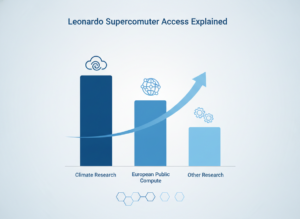
Leonardo’s publicly funded share is awarded through continuous EuroHPC access calls, not sold. Independent peer-review panels evaluate the proposals. There are four scientific tracks (Extreme Scale, Regular, AI for Science and Development/Benchmark), plus capped commercial and emergency routes. The EuroHPC JU access policy sets these mechanisms for all its hosted systems.
Two criteria decide most outcomes:
- Scientific merit: whether the research question justifies Tier-0 resources.
- Efficient use at scale: whether the code actually performs well on thousands of GPUs.
Panels weigh the second criterion heavily because idle or poorly scaling jobs waste a shared public resource. Proposals without benchmark or scaling evidence therefore score poorly. The Development and Benchmark track exists as a stepping stone, letting teams generate that evidence before competing for production time.
Extreme Scale, Regular, AI for Science and Development Access
The table below matches each route to project size and maturity.
EuroHPC Access Tracks on Leonardo Compared
| Access track | Intended applicant | Typical project scale | Cost | Call timing |
|---|---|---|---|---|
| Extreme Scale Access | Mature teams with proven scaling | Largest production allocations | Free for open science | Continuous open call |
| Regular Access | Established research groups | Mid-scale production runs | Free for open science | Continuous open call |
| AI for Science Access | AI and data-intensive research teams | AI training and inference workloads | Free for open science | Continuous open call |
| Development and Benchmark Access | First-time or code-porting teams | Small; testing and scaling | Free for open science | Continuous open call |
| Commercial pay-per-use | Commercial entities outside SME scope | Strictly capped by policy | Market prices | Not stated |
| Emergency / strategic access | EU-designated essential initiatives | Not stated | Not stated | Expedited, outside call calendar |
First-time applicants should start with Development and Benchmark Access. Larger tracks expect scaling data, and this track exists to produce it. Allocations are measured in GPU node-hours: one compute node (a server holding several GPUs) running for one hour. Requesting 10,000 GPU node-hours, for example, means asking for the equivalent of 10,000 node-hours of accelerated computing across the allocation period. Panels compare that figure with your benchmark results, so a precise, evidence-backed request is more credible than a large round number.
How to Apply for Time on Leonardo
- Choose the access track that matches your project scale and code maturity.
- Secure a benchmark or development allocation first if you have no scaling data.
- Register the principal investigator on the EuroHPC JU access portal.
- Prepare the technical case: requested GPU node-hours, storage and scaling evidence.
- Prepare the scientific case: objectives, methods and expected open-science outputs.
- Submit before the cut-off date of the current continuous call.
- Wait for the independent peer-review panel’s evaluation and allocation decision.
- Accept the allocation terms, including open publication of results, and begin the agreed allocation period.
Free Access for Open Science: Who Qualifies
Compute time on Leonardo carries no charge for eligible applicants. In return, results must be published under open science principles. According to EuroHPC JU’s access terms, eligibility covers academia, public research institutes and SMEs in EU member states and Horizon Europe associated countries.
Who Qualifies for Free Access
- Researchers at universities and public research institutes in EU member states
- Researchers in Horizon Europe associated countries
- Public-sector bodies conducting non-commercial research
- SMEs pursuing research whose results will be published openly
- Condition for all of the above: results published under open science principles
Because the subsidy depends on open publication, proprietary R&D goes to the paid commercial route instead. A pharmaceutical firm protecting a candidate molecule cannot use a free allocation to keep that work confidential.
Commercial and Emergency Access
Commercial entities outside the SME scope pay market prices on a pay-per-use basis, and their allocation is strictly capped. Dompé Farmaceutici was Leonardo’s first commercial user, running its Exscalate drug-discovery platform on the system.
The second route is emergency and strategic access. The EuroHPC access policy requires direct, expedited allocation for initiatives the EU considers essential for “health- or climate-related or other crucial emergency support.”
The commercial cap has a practical effect. Since industrial users cannot buy unlimited capacity, many reach public compute through partnership programmes such as HPC Call4Innovators rather than commercial contracts alone.
How Leonardo Powers Climate Research
Leonardo’s three flagship climate uses are ocean data infrastructure (EDITO-Infra), urban digital twins (the Bologna Digital Twin), and decarbonization modelling (HPC Call4Innovators).
Earth-system and supercomputer climate modeling workloads need large GPU allocations. Finer grid resolution and larger ensembles (many runs with varied inputs) both scale directly with available compute. Allocation size therefore sets the scientific ceiling for a project. A team awarded half the node-hours it requested must choose between coarser resolution and fewer ensemble members, and either choice weakens the regional detail policymakers need for adaptation planning. The policy relevance of this work tracks the greenhouse-gas inventories and climate indicators maintained by agencies such as the U.S. Environmental Protection Agency.
Ocean Health: EDITO-Infra
Leonardo provides compute for the EDITO-Infra project. EDITO-Infra combines public and private oceanographic datasets into a centralized Data Lake designed to meet FAIR standards (Findable, Accessible, Interoperable, Reusable).
Ocean data has historically been scattered across agencies, research vessels and commercial operators, each with its own format. Because the data lake standardizes these datasets, policymakers get comparable evidence on marine biodiversity and climate adaptation instead of disconnected snapshots. Running the infrastructure on Leonardo puts storage and analysis in the same place, so large datasets do not need to be moved before they can be modelled.
The Bologna Digital Twin
CINECA is the technical manager of the Bologna Digital Twin. This multidisciplinary project uses Leonardo to process urban data for urban regeneration and climate resilience planning.
A city-scale digital twin needs Tier-0 compute rather than a local cluster. It couples several data streams at once, such as building stock, mobility, microclimate and energy use, and simulating how they interact under heatwave or flood scenarios multiplies the computational load. Because CINECA operates both the machine and the project’s technical layer, the city’s data stays on publicly governed infrastructure throughout.
Decarbonization Models via HPC Call4Innovators
In mid-2025, CINECA partnered with Eni, AMD and HPE to launch HPC Call4Innovators. The programme gave startups and academic institutions direct access to HPC resources for building energy-transition and decarbonization models.
This is the template for a climate-tech startup to reach public compute without winning an academic peer-review call. The industrial partners lower the entry barrier, and CINECA supplies the infrastructure. Founders tracking these routes alongside private capital will find related climate tech and AI health investing analysis useful for comparing funding pathways.
How Leonardo Powers Health and Biomedical Research
Leonardo’s GPU capacity supports three kinds of health work: molecular simulation for supercomputer drug discovery, secure genomic processing under the European Health Data Space, and clinical AI development at the IT4LIA AI Factory.
Molecular docking and genomic pipelines are “embarrassingly parallel.” They split into thousands of independent calculations that do not need to communicate with each other. As a result, they turn extra GPUs into extra throughput almost linearly. That is why more than 13,800 accelerators changed what Italian life-science groups can attempt. Screens that once had to be narrowed to a shortlist can now cover far larger chemical or genomic search spaces.
Drug Discovery with Exscalate
Dompé Farmaceutici, Leonardo’s first commercial user, runs its Exscalate platform on the system to speed up drug discovery and molecular simulation.
Faster molecular screening shortens the computational phase of early discovery. Researchers can test far more candidate compounds against a target protein before moving to laboratory work. However, faster simulation does not mean faster approval. Laboratory validation, clinical trials and regulatory review still set most of the timeline for any medicine.
Genomic Data and the European Health Data Space
Leonardo provides a secure processing environment for cross-border genomic data sharing, aligned with the European Health Data Space (EHDS). It addresses both the legal and the computational challenges of multinational health research.
EHDS rules restrict where and how sensitive health data may be processed. Keeping that data on EU-operated hardware removes a legal barrier to cross-border studies. The scientific case for pooling is well established: the National Institutes of Health’s Genomic Data Sharing Policy holds that broad access to genomic data speeds biomedical discovery. The World Health Organization likewise supports standards-based health data sharing as a public-health priority.
The IT4LIA AI Factory and the Reimbursement Bottleneck
In April 2026, EuroHPC JU signed a procurement contract with E4 Computer Engineering and Dell Technologies to deploy next-generation AI and HPC infrastructure at CINECA. This established the IT4LIA AI Factory, which supports development of AI-based clinical tools.
There is a counterpoint. A May 2026 HealthAI report found that Italy still lacks a structured national fast-track reimbursement pathway for digital health applications comparable to Germany’s DiGA. World-class compute, then, does not by itself move clinical AI into Italy’s national health service (SSN). Reimbursement, not computation, is the binding constraint on deployment.
2026 Upgrades: LISA, Quantum Integration and Renewable Power
The LISA partition and the 140-qubit SOL quantum computer were both inaugurated in June 2026. Together with the April AI Factory contract and the October energy concession, they make 2026 Leonardo’s most significant year of upgrades since it entered service.
The Leonardo LISA partition (Leonardo Improved Supercomputing Architecture) is built for large language models and multi-modal generative AI. A dedicated partition was needed because LLM training runs hold thousands of GPUs for weeks. Placing them in general-purpose queues would push aside climate and physics simulations. Separating the workloads protects both communities.
SOL, Pasqal’s 140-qubit machine and the sixth EuroHPC quantum computer, is connected to Leonardo for hybrid classical-quantum workflows. Classical nodes handle data preparation and error-prone steps, while the quantum system takes on specific subproblems.
In October 2026, CINECA awarded a €73.5 million concession to Hera Group to build an agrivoltaic plant (solar panels installed over working farmland) at the Bologna Energy Park. The plant is designed to produce 30 GWh a year, enough to run Leonardo on 100% renewable energy and avoid an estimated 7,000 tonnes of CO2 annually. Energy matters here because the U.S. Department of Energy ranks data centres among the most energy-intensive building types. Emissions estimates like this one follow the greenhouse-gas accounting conventions documented by the EPA.
Leonardo Upgrade Milestones, April–October 2026
| Date | Milestone | Counterparty | Headline figure |
|---|---|---|---|
| April 2026 | IT4LIA AI Factory procurement contract | E4 Computer Engineering, Dell Technologies | Not stated |
| June 2026 | LISA AI partition inauguration | EuroHPC JU and CINECA | Built for LLM and multi-modal AI |
| June 2026 | SOL quantum computer integration | Pasqal | 140 qubits; 6th EuroHPC quantum system |
| October 2026 | Agrivoltaic power concession | Hera Group | €73.5M; 30 GWh/yr; 7,000 t CO2/yr avoided |
Can US Researchers Use Leonardo? EuroHPC vs NSF ACCESS and DOE INCITE
US-based principal investigators are not eligible to lead EuroHPC’s free open-science calls, but they can join an eligible European PI’s project as collaborators. Eligibility follows EU membership and Horizon Europe association. What decides access is where the lead institution is based and which public budget pays for the machine, not the researcher’s nationality.
US researchers have three practical routes onto Leonardo:
- Join a European-led consortium whose PI meets the eligibility rules.
- Apply through an EU-based host institution where they hold an affiliation.
- Buy capped commercial allocation, which conflicts with grant-funded open-science budgets for most teams.
For most US-based teams, domestic programmes are more direct. NSF ACCESS allocates time on National Science Foundation-supported resources to US researchers and educators. DOE INCITE awards large peer-reviewed allocations on the Department of Energy’s leadership-class systems. Public research universities such as the University of Washington, whose climate and global health programmes depend on shared computing, use these channels rather than European calls.
The structural difference is important. EuroHPC pools budgets from many participating states into jointly owned machines. US programmes allocate facilities owned by a single federal agency.
Leonardo (EuroHPC) vs NSF ACCESS vs DOE INCITE
| Programme | Allocating body | Who may apply | Cost to researcher | Call frequency |
|---|---|---|---|---|
| Leonardo open-science calls (EuroHPC JU) | EuroHPC Joint Undertaking | EU and Horizon Europe associated researchers | Free for open science | Continuous open calls |
| NSF ACCESS | U.S. National Science Foundation | US-based researchers and educators | No charge | Not stated |
| DOE INCITE | U.S. Department of Energy | Not stated | No charge | Annual call |
Why Europe Treats Public Compute as Strategic Infrastructure
Europe funds Leonardo publicly because sovereign AI infrastructure keeps sensitive health and climate data on EU-owned hardware instead of foreign hyperscalers (large commercial cloud providers). Experts describe Leonardo and the IT4LIA AI Factory as cornerstones of the EU’s digital-sovereignty strategy.
Public ownership means peer review and emergency policy can direct allocation, rather than ability to pay. A commercial cloud contract rations capacity by budget. EuroHPC rations it by scientific merit, which puts a well-designed ocean model from a small institute in the same queue as a large industrial project.
Industry leaders frame compute in similar terms. Roberto Cingolani is CEO of Leonardo, the aerospace and defence company that partners with CINECA and is separate from Leonardo the machine. In late 2024 he said:
“Per-capita computing and storage capacity are the indicators that today best define a nation’s level of development on a par with, or perhaps more than, the GDP.”
— Roberto Cingolani, CEO of Leonardo, late 2024
The clearest evidence of the policy came in June 2026. CINECA allocated GPU resources on Leonardo to African AI startups under the G7-endorsed AI Hub for Sustainable Development, supporting offline voice AI and healthcare applications for underserved populations. Public ownership makes this kind of capacity donation possible in a way a commercial contract does not.
Frequently Asked Questions
What is the Leonardo supercomputer?
Leonardo is a pre-exascale Tier-0 system at the Tecnopolo DAMA in Bologna, operated by CINECA and co-funded by the EuroHPC Joint Undertaking and Italy’s MUR. It delivers more than 250 petaflops and has more than 13,800 Nvidia Ampere GPUs. It consistently ranks among the world’s ten most powerful supercomputers and serves AI, climate and biomedical research.
Who decides how Leonardo’s computing time is allocated?
Allocation is split. The EuroHPC Joint Undertaking controls up to 50% of capacity through peer-reviewed calls, and CINECA and the Italian government allocate the remainder. Independent expert panels, not the host site, score proposals. Scientific merit and scaling efficiency, rather than institutional connections, therefore decide outcomes.
How do researchers apply for access to Leonardo?
Through continuous EuroHPC access calls on the JU access portal. Pick a track, then prepare technical and scientific cases with requested GPU node-hours and scaling evidence. Submit before the cut-off and wait for peer review. National institutions also run their own calls. For example, the Slovak Academy of Sciences had a 24 February 2025 deadline, with allocations starting 1 March 2025.
Is access to the Leonardo supercomputer free?
Yes, for eligible open-science users. Compute time is free for academics, public research institutes and SMEs in EU and Horizon Europe associated countries, on condition that results are published under open science principles. Commercial users outside that scope pay market prices on a pay-per-use basis, and that commercial share is strictly capped by EuroHPC policy.
Can researchers in the United States use Leonardo?
Not as the lead applicant on free open-science calls, because eligibility depends on EU and Horizon Europe association. US researchers can collaborate on a European PI’s project, work through an EU-based host institution, or buy capped commercial allocation. For domestic peer-reviewed alternatives, NSF ACCESS and DOE INCITE are the main US equivalents.
What climate research runs on Leonardo?
Three flagship efforts. EDITO-Infra’s FAIR-compliant ocean Data Lake produces evidence on marine biodiversity and adaptation. The Bologna Digital Twin supports urban regeneration and climate resilience, with CINECA as technical manager. Startups and academic groups build decarbonization and energy-transition models through the mid-2025 HPC Call4Innovators, run with Eni, AMD and HPE.
How is Leonardo used in health and drug discovery?
For molecular simulation, genomics and clinical AI. Dompé Farmaceutici, the first commercial user, runs its Exscalate drug-discovery platform on the system. Leonardo also hosts a secure processing environment for cross-border genomic data under the European Health Data Space. The IT4LIA AI Factory, established by the April 2026 procurement with E4 Computer Engineering and Dell Technologies, supports clinical AI development.
What does emergency access mean under EuroHPC rules?
The EuroHPC access policy requires direct, expedited allocation, outside the normal call calendar, for initiatives the EU considers essential for health-related, climate-related or other crucial emergency support. In practice, urgent public-interest work does not have to wait for the next scheduled cut-off, which matters most during fast-moving crises.
What changed on Leonardo in 2026?
Three milestones. In April 2026, EuroHPC JU contracted E4 Computer Engineering and Dell Technologies for the IT4LIA AI Factory. In June 2026, CINECA and EuroHPC JU inaugurated the LISA AI partition for LLM and multi-modal workloads, plus Pasqal’s 140-qubit SOL quantum system. In October 2026, CINECA awarded Hera Group a €73.5 million agrivoltaic concession designed to produce 30 GWh a year.
Why does Europe invest in public supercomputers instead of using commercial cloud?
To keep allocation and data under public control. Peer review, not price, decides who gets compute. Sovereign AI infrastructure keeps sensitive health and climate data on EU-operated hardware, in line with European Health Data Space rules. Public ownership also made the June 2026 donation of GPU capacity to African AI startups under the G7-endorsed AI Hub possible.
Limitations, Costs and Alternatives to Consider
Leonardo is not the right route for every project, for several reasons:
- Acceptance is competitive. Proposals that lack credible scaling evidence are a common reason for rejection, so plan a benchmark allocation before a production bid.
- Free access has conditions. The open-publication requirement makes it unsuitable for proprietary pipelines.
- Commercial allocation is capped by policy. Industrial users cannot buy unlimited capacity, even at market prices.
- Compute is not the bottleneck for clinical deployment. The May 2026 HealthAI report found Italy still lacks a DiGA-style fast-track reimbursement pathway for digital health tools.
- Timelines are rigid. Allocation periods are fixed and queue times vary, so project plans must fit the call calendar.
Alternatives: US-based PIs should look to NSF ACCESS and DOE INCITE. Smaller jobs fit national Tier-1 systems, and commercial cloud is an option where data-residency rules permit.
Figures and call conditions in this article were current as of October 23, 2026. Verify terms on the EuroHPC JU and CINECA portals before applying.
Conclusion
Allocation rules, more than hardware, determine which climate and health questions Europe’s public compute answers. Peer review rations capacity, open-science conditions shape who applies, and emergency mandates move urgent public-interest work to the front of the queue.
If you plan to apply for time on the Leonardo supercomputer, follow three steps. First, identify the access track that matches your project’s scale and code maturity. Second, secure a Development and Benchmark allocation to generate scaling evidence. Third, submit a precise GPU node-hour request to the current continuous call. With the LISA partition, SOL quantum integration and the planned agrivoltaic supply now in place, a system that already serves climate and health research is adding AI capacity, hybrid quantum workflows and a renewable power source.
Read more.
References
- EuroHPC Joint Undertaking. Access to Our Supercomputers: Access Policy and Calls (policy current as of October 2026). https://eurohpc-ju.europa.eu/
- CINECA. HPC Infrastructure and Leonardo, including the IT4LIA AI Factory, LISA and SOL (2026), and the Hera Group agrivoltaic concession (October 2026). https://www.cineca.it/
- U.S. National Science Foundation. NSF ACCESS and federally funded research computing allocation. https://www.nsf.gov/
- U.S. Department of Energy. INCITE leadership computing allocations and data-centre energy efficiency resources. https://www.energy.gov/
- National Institutes of Health. Genomic Data Sharing Policy. https://www.nih.gov/
- World Health Organization. Health data standards and data-sharing guidance. https://www.who.int/
- U.S. Environmental Protection Agency. Greenhouse gas accounting and climate indicators. https://www.epa.gov/
- University of Washington. Research computing and climate and global health programmes. https://www.washington.edu/