
Table of Contents
- Introduction
- Gavi 6.0 Funding at a Glance
- The $1.6 Billion Gates Foundation Pledge, Line by Line
- How the 6.0 Pledge Compares With Gavi 5.0
- Gates on Impact Per Dollar
- Inside the Brussels Replenishment: $9 Billion Against an $11.9 Billion Target
- Team Europe's EUR 2 Billion
- The UK's 25% Reduction
- The Withheld US $300 Million
- Brazil's $72 Million, November 2026
- Why the Malaria Vaccine Price Fell 40% in October 2026
- The EUR 5.50 Per Dose Number
- How IFFIm's Advance Payment Unlocked the Discount
- The GSK to Bharat Biotech Transfer and the 2028 Handover
- $50 Million in Savings, One Million More Children
- Where the Money Goes Next: The 2026-2030 Allocation Map
- 500 Million Children and 8-9 Million Deaths Averted
- Malaria Expansion Across 25 African Countries
- HPV and 1.5 Million Lives
- Climate and AMR-Relevant Vaccines
- 20% to Fragile and Conflict Settings
- AVMA and Sovereign African Supply
- How the Money Actually Moves: Pledges, Disbursements and Who Can Access It
- Country Co-Financing Tiers
- Where Applicants and Suppliers Fit In
- What Could Break the Plan
- Frequently Asked Questions
- Limitations of These Figures and What This Analysis Does Not Claim
- Conclusion
- References
Key Takeaway
>
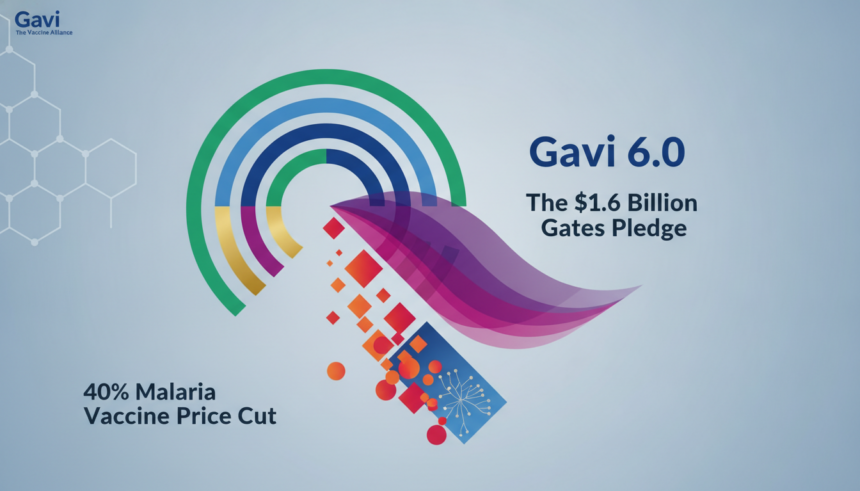
Gavi 6.0 funding covers the 2026–2030 strategic period and has raised over $9 billion of an $11.9 billion target, anchored by a $1.6 billion Bill & Melinda Gates Foundation pledge made at the Brussels summit in June 2025.
>
- $9bn+ pledged by 55 countries and donors at the June 2025 Brussels High-Level Pledging Summit (Gavi).
- $11.9bn replenishment target for 2026–2030 (Gavi investment opportunity).
- $1.6bn Gates Foundation pledge, flat in nominal terms versus Gavi 5.0 (Bill & Melinda Gates Foundation, June 2025).
- EUR 5.50 per dose malaria vaccine price from 22 October 2026, down roughly 40% (UNICEF and Gavi).
- $50m in projected savings across 2027–2029, funding up to 1 million more fully vaccinated children (UNICEF, October 2026).
- 500 million children and adolescents targeted, 8–9 million deaths averted by 2030 (Gavi modelling).
>
The single most consequential fact: a donor shortfall of roughly $2.9 billion means price reductions, not new pledges, are currently doing the heaviest lifting.
Introduction
Gavi 6.0 funding is the money raised to finance the Vaccine Alliance’s 2026–2030 strategic period, and the headline figures are a $1.6 billion Bill & Melinda Gates Foundation pledge inside a total of over $9 billion from 55 countries and donors. The clearest proof that this money is already converting into doses arrived on 22 October 2026, when UNICEF and Gavi announced an agreement cutting the RTS,S/AS01 malaria vaccine price by roughly 40% to EUR 5.50 per dose. That achievement matters because the replenishment did not hit its mark: $9 billion against an $11.9 billion target, with the United Kingdom reducing its pledge by around 25% and $300 million of US appropriations in each of FY2025 and FY2026 appropriated but not disbursed.
This analysis gives you the donor-by-donor numbers, the IFFIm financing mechanism that unlocked the malaria discount, the 2026–2030 allocation map across malaria, HPV, climate-sensitive disease and African manufacturing, and the procedural chain by which a pledge becomes a procurement contract — which is the part that matters most to implementers, suppliers and health ministries.
About this analysis
Written by the billgates.pk editorial team, which tracks Gates Foundation and Breakthrough Energy commitments by amount, recipient and deadline. Figures are current as of 14 November 2026 and are drawn from Gavi, UNICEF, IFFIm, KFF budget tracking and independent policy analysis.
Transparency note
billgates.pk is an independent publication. It is not affiliated with, funded by or endorsed by Gavi, the Bill & Melinda Gates Foundation, UNICEF or any manufacturer named in this article. Institutional positions of the Foundation are distinguished throughout from the personal statements of Bill Gates.
Gavi 6.0 Funding at a Glance
Gavi 6.0 funding finances the Alliance’s 2026–2030 strategic period, drawn from sovereign donors, the European Union, private foundations and bond-market financing through IFFIm. Because pledges landed roughly $2.9 billion short of the $11.9 billion target set out in Gavi’s own investment opportunity, the Alliance is relying on price negotiation and innovative finance rather than new money to protect its coverage targets.
| Metric | Figure | Date / Source |
|---|---|---|
| Strategic period covered | 2026–2030 | Gavi investment opportunity |
| Total pledged at Brussels summit | Over $9 billion, 55 countries and donors | June 2025, Gavi |
| Replenishment target | $11.9 billion | Gavi, 2026–2030 |
| Gates Foundation pledge | $1.6 billion | June 2025, Bill & Melinda Gates Foundation |
| Team Europe pledge | Over EUR 2 billion (about $2.33 billion) | June 2025, EU and member states |
| Malaria vaccine price per dose | EUR 5.50 (about $6.16) | 22 October 2026, UNICEF and Gavi |
| Projected malaria savings 2027–2029 | $50 million | October 2026, UNICEF |
| Children and adolescents to be vaccinated | 500 million | Gavi target, 2026–2030 |
| Deaths averted target | 8–9 million | Gavi modelling, by 2030 |
| Projected economic benefit | $100 billion | Gavi investment case, lower-income countries |
A pledge is a multi-year political commitment rather than cash in hand, which means disbursement timing matters as much as headline totals. The later section on how the money actually moves traces that distinction stage by stage, because it explains why an appropriated $300 million can sit unspent.
The $1.6 Billion Gates Foundation Pledge, Line by Line
The Bill & Melinda Gates Foundation pledged $1.6 billion to Gavi’s 2026–2030 strategic period at the High-Level Pledging Summit in Brussels in June 2025, an event the Foundation co-hosted alongside the European Union. The figure matches the Foundation’s nominal pledge to Gavi 5.0, making it the largest single private commitment in the replenishment.
Because the Foundation held its nominal commitment flat in a year when several sovereign donors reduced theirs, its relative share of the total rose without a dollar being added. That arithmetic is the core of the concentration risk in Gavi 6.0 funding: when the private anchor stays constant and the state base contracts, dependence on one funder deepens by default. Independent analysts at the Center for Global Development have made a similar point about donor concentration across the 2025–2026 replenishment round, and the consequence is practical rather than rhetorical — a single funder’s future decision now carries more weight over portfolio choices than it did in 2020.
It is worth separating two things that are frequently conflated. The $1.6 billion is an institutional funding decision taken by the Foundation. The claim that Gavi represents an exceptional return is a personal assessment by Bill Gates, Chair of the Foundation, offered in his own voice at the Brussels summit.
“I don’t know of anything with a higher impact per dollar in terms of saving and improving lives. Gavi is one of the best investments I’ve ever made.”
— Bill Gates, Chair, Bill & Melinda Gates Foundation, Brussels pledging summit, June 2025
How the 6.0 Pledge Compares With Gavi 5.0
| Dimension | Gavi 5.0 (2020–2025) | Gavi 6.0 (2026–2030) |
|---|---|---|
| Gates Foundation pledge | $1.6 billion | $1.6 billion |
| Pledge announced at | Gavi 5.0 replenishment | Brussels summit, June 2025 |
| Alliance replenishment target | Not stated | $11.9 billion |
| Total pledged by all donors | Not stated | Over $9 billion, 55 donors |
| Children to be vaccinated | Not stated | 500 million children and adolescents |
| Foundation role at summit | Not stated | Co-host with the European Union |
An identical headline figure across two cycles is not an identical commitment. Because consumer and pharmaceutical input prices rose materially between 2020 and 2026, the purchasing power behind $1.6 billion in the 6.0 period is lower than the same sum bought in 5.0, which means a flat nominal pledge functions as a real-terms reduction. That distinction is routinely lost in replenishment coverage, and it matters here because the Alliance’s cost base — doses, cold chain, delivery — is priced in the same inflated currency.
Gates on Impact Per Dollar
The impact-per-dollar argument rests on the Alliance’s own arithmetic: 500 million children and adolescents vaccinated, 8–9 million future deaths averted, and $100 billion in projected economic benefits for lower-income countries. Divide the $11.9 billion ask by the mortality target and the implied cost per death averted sits in the low thousands of dollars, which is why immunisation consistently ranks among the highest-yield interventions in global health portfolios. The same cost-per-outcome discipline runs through Gates’ wider portfolio, including the climate tech and AI health investing strategy tracked on billgates.pk, where returns are judged against measurable outcomes rather than exit multiples. These figures are modelled projections from Gavi’s investment case, not audited results.
Inside the Brussels Replenishment: $9 Billion Against an $11.9 Billion Target
Over $9 billion pledged against an $11.9 billion target leaves a gap of roughly $2.9 billion, or about 24% of the ask. That total came from 55 countries and donors at the High-Level Pledging Summit in Brussels in June 2025, co-hosted by the European Union and the Bill & Melinda Gates Foundation.
The gap exists because the replenishment ran into a contracting official development assistance environment across several OECD donors. Aid budgets were being reallocated toward domestic and defence priorities, and consequently the Alliance’s board has had to prioritise within the 6.0 portfolio rather than scale every programme uniformly. Independent analysis of the round has emphasised that this was a sector-wide contraction rather than a verdict on Gavi’s performance.
A 24% funding gap does not translate into a 24% coverage cut, however, and the reason is structural. Three buffers absorb part of the loss: negotiated price reductions that lower the cost of each dose, IFFIm front-loading that converts future pledges into present cash, and country co-financing that shifts a rising share of the bill to recipient governments as their incomes grow. The October 2026 malaria agreement is the clearest demonstration of the first buffer in action.
| Donor | Gavi 6.0 pledge | Change vs 5.0 | Status (Nov 2026) |
|---|---|---|---|
| Bill & Melinda Gates Foundation | $1.6 billion | Flat in nominal terms | Pledged June 2025 |
| Germany | EUR 600 million | Not stated | Pledged June 2025 |
| France | EUR 500 million | Not stated | Pledged June 2025 |
| European Commission | EUR 360 million | Not stated | Pledged June 2025 |
| Italy | EUR 250 million | Not stated | Pledged June 2025 |
| United Kingdom | GBP 1.25 billion | Down from GBP 1.6 billion (−25%) | Pledged |
| United States | $300m appropriated FY2025 and FY2026 | Not stated | Appropriated, disbursement halted 2026 |
| Brazil | $72 million | Not stated | Pledged November 2026 |
| All donors combined | Over $9 billion | Against $11.9bn target | Replenishment open |
Replenishment Timeline: June 2025 to November 2026
- June 2025 — the Brussels High-Level Pledging Summit, co-hosted by the EU and the Gates Foundation, secures over $9 billion from 55 countries and donors.
- June 2025 — the Gates Foundation confirms $1.6 billion, matching its nominal 5.0 commitment.
- 2025–2026 — the UK pledge is recorded at GBP 1.25 billion, down roughly 25% from GBP 1.6 billion.
- 2026 — US FY2025 and FY2026 appropriations of $300 million each remain undisbursed.
- 22 October 2026 — UNICEF and Gavi announce the roughly 40% malaria vaccine price cut to EUR 5.50 per dose.
- November 2026 — Brazil pledges $72 million, extending the replenishment beyond the summit.
Team Europe’s EUR 2 Billion
The European Union and its member states collectively pledged over EUR 2 billion, equivalent to around $2.33 billion, with Germany at EUR 600 million, France at EUR 500 million, the European Commission at EUR 360 million and Italy at EUR 250 million. Team Europe therefore became the anchor sovereign bloc of this cycle, a position it acquired partly by default: because the UK reduced and the US withheld, European money rose in relative weight without rising proportionally in absolute terms. Co-hosting the Brussels summit alongside the Gates Foundation reinforced that institutional ownership of the round.
The UK’s 25% Reduction
The United Kingdom pledged GBP 1.25 billion to Gavi 6.0, down from GBP 1.6 billion in Gavi 5.0 — a reduction of roughly 25%. The cut was driven by the broader reallocation of the UK aid budget rather than by any Gavi-specific policy dispute, and the consequence for the Alliance is a thinner sovereign donor base at precisely the moment when portfolio ambitions widened to include adolescent HPV programmes and regional manufacturing support.
The Withheld US $300 Million
The United States Congress appropriated $300 million for Gavi in both FY2025 and FY2026, but disbursement of those funds was halted in 2026, with the administration citing vaccine safety concerns as its stated rationale. The distinction matters technically: an appropriation is a legislative authorisation to spend, while a disbursement is the actual transfer of cash to the recipient. As independent budget tracking by KFF illustrates, the two steps are separated by executive discretion over timing and release. The practical effect is $600 million authorised but not transferred, which the Alliance cannot procure against.
Brazil’s $72 Million, November 2026
Brazil pledged $72 million in November 2026, months after the Brussels summit closed. The pledge demonstrates two things: the replenishment remains open, and the contributor base is broadening beyond traditional OECD donors into middle-income economies that were themselves Gavi-supported within living memory. Consequently the $9 billion figure should be read as a floor rather than a final total, although closing a $2.9 billion gap through pledges of this scale would require many more of them.
Why the Malaria Vaccine Price Fell 40% in October 2026
On 22 October 2026, UNICEF and Gavi announced an agreement cutting the price of the RTS,S/AS01 malaria vaccine by approximately 40%, bringing the cost down to EUR 5.50 per dose, or about $6.16. The agreement is projected to generate $50 million in savings between 2027 and 2029 and to fund the full four-dose course for up to one million additional children.
The discount was unlocked because an advance payment structured through the International Finance Facility for Immunisation gave the manufacturer guaranteed, front-loaded revenue. That changes the production calculus entirely: the manufacturer can scale output against contracted demand rather than speculative orders, which removes the risk premium previously embedded in the unit price. It is the classic volume-for-price trade, executed with borrowed certainty rather than borrowed money alone.
The second lever is structural. Production of the vaccine is being transferred from GSK to Bharat Biotech in India under a long-term technology transfer, with full handover expected by 2028. Because Indian manufacturing carries a materially lower cost base than European production for the same product specification, the EUR 5.50 price behaves as a durable floor rather than a one-off concession — the saving is built into the cost structure instead of being absorbed as a discount.
The impact flows directly into coverage rather than back to donors. The $50 million saved across 2027–2029 is recycled into procurement, which means the same budget line buys more doses. At four doses per fully immunised child under the schedule recommended by the World Health Organization, that recycled saving translates into up to one million more children completing the course.
“This agreement is an important step towards protecting more children from malaria by expanding access to life-saving vaccines where they are needed most.”
— Leila Pakkala, Director, UNICEF Supply Division, October 2026
| Measure | Before Oct 2026 | From 22 Oct 2026 |
|---|---|---|
| Price per dose (EUR) | Approximately EUR 9.17 (implied) | EUR 5.50 |
| Price per dose (USD equivalent) | Not stated | About $6.16 |
| Approximate cost per four-dose course | Not stated | About EUR 22.00 (about $24.64) |
| Percentage change | — | Down approximately 40% |
| Projected savings 2027–2029 | — | $50 million |
| Additional children fully vaccinated | — | Up to 1 million |
| Primary manufacturer | GSK | Bharat Biotech (full handover by 2028) |
The EUR 5.50 Per Dose Number
EUR 5.50, approximately $6.16, is the price per single dose agreed by the UNICEF Supply Division and Gavi on 22 October 2026. Because the RTS,S schedule runs to four doses, the cost of fully immunising one child against malaria now sits at roughly EUR 22, or about $24.64, in vaccine procurement alone. That figure excludes delivery, cold chain and health-worker time, which in practice add substantially to the total cost per immunised child and which the price cut does not touch.
How IFFIm’s Advance Payment Unlocked the Discount
IFFIm, the International Finance Facility for Immunisation, is a bond-market instrument: it issues debt against long-dated sovereign pledges and converts those future commitments into cash available now. That capability is what made the advance payment possible. A manufacturer facing uncertain multi-year demand prices that uncertainty into every dose; a manufacturer holding a front-loaded payment does not. Consequently the risk premium falls out of the unit price. The mechanism is also why the Alliance can run a 24% pledge shortfall without an immediate 24% procurement shortfall — though front-loading borrows against pledges that must ultimately be honoured.
The GSK to Bharat Biotech Transfer and the 2028 Handover
The RTS,S technology transfer moves production from GSK to Bharat Biotech in India, with the Indian manufacturer expected to take over production fully by 2028. Dr Krishna Ella, Executive Chairman of Bharat Biotech, described the arrangement as a “far-reaching commitment” to sustainable and affordable access to malaria vaccines. The economics are straightforward: Indian manufacturing capacity operates at a lower cost base for comparable biologics output, therefore unit costs fall structurally once the handover completes rather than depending on renegotiated goodwill. The handover date is also the main execution risk attached to the EUR 5.50 price.
$50 Million in Savings, One Million More Children
The arithmetic is explicit and worth stating plainly: a roughly 40% price cut on a four-dose vaccine produces $50 million in procurement savings across 2027–2029, and because that saving is reinvested in doses rather than returned to donors, it funds the complete four-dose course for up to one million additional children. The saving buys coverage without a single new pledge — which is why this agreement outweighs most individual donor announcements in the 6.0 cycle.
Where the Money Goes Next: The 2026-2030 Allocation Map
Gavi 6.0 funding is directed at four headline targets for 2026–2030: vaccinating 500 million children and adolescents, averting 8–9 million future deaths, unlocking $100 billion in economic benefits for lower-income countries, and ring-fencing 20% of support for fragile, conflict-affected and humanitarian settings.
Because the replenishment fell roughly $2.9 billion short of the $11.9 billion ask, allocation is weighted toward the interventions with the highest deaths-averted-per-dollar ratio rather than spread evenly. That prioritisation is why malaria and HPV absorb a disproportionate share of incremental spend: both have recently improved unit economics, malaria through the October 2026 price cut and HPV through single-dose schedule evidence and expanded supply.
The portfolio logic extends past present burden. More than half the vaccines in the 6.0 portfolio address disease burden that is climate-sensitive or relevant to antimicrobial resistance, driven by shifting vector ranges and rising treatment failure rates documented by the World Health Organization. The vaccine mix is therefore being selected against projected future epidemiology rather than historical burden alone — a deliberate bet that prevention bought now is cheaper than treatment bought in 2035.
| Priority | Target figure | Expected outcome by 2030 |
|---|---|---|
| Core immunisation scale-up | 500 million children and adolescents | 8–9 million deaths averted |
| Malaria vaccine expansion | EUR 5.50 per dose; 25 African countries integrated | Up to 1 million more children fully vaccinated |
| HPV vaccination | 1.5 million of lives saved attributed to HPV | Reduced future cervical cancer mortality |
| Climate and AMR-relevant vaccines | Over half the 6.0 portfolio | Adaptation to shifting disease burden |
| Fragile and conflict settings | 20% of total Gavi support | Coverage in humanitarian contexts |
| African Vaccine Manufacturing Accelerator | Financial pull mechanism for African producers | Expanded regional manufacturing capacity |
500 Million Children and 8-9 Million Deaths Averted
The coverage target is 500 million children and adolescents immunised between 2026 and 2030, with 8–9 million future deaths averted and $100 billion in economic benefits projected for lower-income countries. The economic figure is derived from avoided treatment costs and retained productivity among populations that stay healthy, which means it is a modelled projection from Gavi’s investment case rather than an observed return.
Malaria Expansion Across 25 African Countries
As of early 2026, 25 African countries had integrated the malaria vaccine into routine immunisation programmes. The EUR 5.50 price accelerates the next tranche of introductions for a dual reason: it lowers Gavi’s procurement bill and simultaneously reduces each government’s co-financing contribution, because co-financing is calculated as a share of vaccine cost. Consequently the fiscal barrier to a national introduction decision drops in every income band at once.
HPV and 1.5 Million Lives
HPV vaccination accounts for 1.5 million of the 8–9 million lives the Alliance projects saving during the 6.0 period. The timing of that benefit is unusual among immunisation programmes: adolescents vaccinated in 2027 avoid cervical cancers that would otherwise present in their forties and fifties, so the mortality benefit is realised decades after the spend. That lag makes HPV politically harder to fund and analytically harder to verify, which is precisely why a multi-year replenishment structure suits it.
Climate and AMR-Relevant Vaccines
Over half the 6.0 portfolio supports adaptation to climate-driven disease shifts and antimicrobial resistance. Warming and changing rainfall patterns are expanding the geographic range of vector-borne disease, while the World Health Organization has repeatedly flagged rising resistance to first-line antibiotics. Vaccines sit upstream of both problems, because a prevented infection requires no antibiotic and generates no resistance pressure.
20% to Fragile and Conflict Settings
Gavi has ring-fenced 20% of its 6.0 support for fragile, conflict-affected and humanitarian settings, where routine systems are weakest and zero-dose children concentrate. The trade-off is explicit: cost per child delivered is substantially higher in these contexts because supply chains, security and workforce retention all degrade. Accepting a worse unit cost here is a deliberate equity choice rather than an efficiency one.
AVMA and Sovereign African Supply
The African Vaccine Manufacturing Accelerator operates as a pull mechanism — it offers financial incentives to African manufacturers that reach specific production milestones, rather than funding factories upfront. The rationale is supply resilience: regional capacity shortens supply chains and reduces exposure to export restrictions during outbreaks. Paying a modest premium for that capacity is therefore an insurance purchase, priced against the delivery failures the continent experienced during previous global supply shocks.
How the Money Actually Moves: Pledges, Disbursements and Who Can Access It
A pledge is a political commitment to provide funds over a defined period; a disbursement is the transfer of cash. Gavi can only procure against disbursed or IFFIm-financed funds, which is why the withheld US money is accurately described as appropriated-but-undisbursed rather than cancelled — the $600 million across FY2025 and FY2026 remains legislatively authorised, but no contract can be written against it until it is released.
Country co-financing is the second mechanism that governs flow. Recipient governments pay a rising share of vaccine cost as gross national income per capita increases, graduating eventually to fully self-financing status. Because co-financing is calculated as a proportion of the procurement price, the EUR 5.50 malaria dose reduces the domestic bill in every co-financing tier simultaneously, which accelerates introduction decisions in finance ministries as much as in health ministries.
On access, the plain answer is that Gavi does not run an open grant competition for individual researchers or small organisations. Money flows to eligible countries through national immunisation programmes, to manufacturers through UNICEF Supply Division procurement, and to named Alliance partners. Researchers and startups looking for direct funding should examine the Gates Foundation’s own grant channels and the climate tech and AI health investing coverage on billgates.pk instead, where eligibility criteria and application routes are the explicit subject.
From Pledge to Injected Dose: The Six Stages
- Donor pledge — a multi-year political commitment announced at a replenishment summit.
- Appropriation or budget line — the donor’s own legislature or executive authorises the funds.
- Disbursement — cash transferred to Gavi, or front-loaded against future pledges via IFFIm bonds.
- Country application and approval — eligible governments apply for specific vaccine support through national immunisation programmes.
- Procurement — UNICEF Supply Division contracts manufacturers at negotiated prices such as EUR 5.50 per malaria dose.
- Delivery and co-financing — doses reach clinics, with recipient governments paying their income-banded share.
Country Co-Financing Tiers
Co-financing obligations are set by income band: the lowest-income countries pay a nominal share per dose, and that share rises as GNI per capita crosses defined thresholds, until a country transitions out of Gavi support entirely and self-finances its full vaccine bill. Transition timing is the principal fiscal risk for middle-income countries, because a country can cross an income threshold on paper while its health budget has not yet grown enough to absorb the handover. Consequently price reductions of the kind agreed in October 2026 matter most to countries closest to transition.
Where Applicants and Suppliers Fit In
There are three practical entry routes, and they serve different parties. National immunisation programme applications run through country health ministries, which means an implementing NGO works as a partner to a government rather than as a direct Gavi grantee. Manufacturers enter through UNICEF Supply Division tenders, where price, volume commitment and prequalification status determine awards. African producers can additionally access AVMA incentives tied to production milestones. Individual researchers fit none of these routes and should pursue foundation or academic funding instead.
What Could Break the Plan
The largest risk is the roughly $2.9 billion gap between the over $9 billion pledged and the $11.9 billion target. Being 24% short means the Alliance must either narrow the portfolio or depend further on price reductions, and price reductions have a hard floor set by manufacturing cost. A 40% cut on RTS,S was available because the product was previously priced with a European cost base and demand uncertainty; most of the portfolio has already been squeezed, therefore a second round of comparable savings across other antigens is improbable.
The second risk is donor concentration combined with disbursement timing. The UK’s 25% reduction thinned the sovereign base, and $600 million of US appropriations across FY2025 and FY2026 sits undisbursed. A further withholding cycle would force in-year reprioritisation, because IFFIm front-loading borrows against pledges that must ultimately be honoured — the facility converts timing risk into debt service, it does not remove the obligation. Meanwhile the Gates Foundation’s flat $1.6 billion now represents a larger share of a smaller pool, which concentrates influence as a side effect of other donors’ retreat.
The third risk is delivery rather than finance, and in my assessment it is the one most likely to undercut the headline numbers. The 20% of support directed to fragile and conflict-affected settings carries a higher cost per child and lower completion rates for four-dose schedules. The one-million-additional-children figure derived from the malaria saving assumes those children complete all four doses, not merely that the doses are purchased. Finance gaps can be closed with another pledge; a child who received two doses in a displacement camp cannot be retrospectively completed. Delivery, not money, is where this plan is most exposed.
Frequently Asked Questions
What is Gavi 6.0 and what years does it cover?
Gavi 6.0 is the Vaccine Alliance’s strategic period running from 2026 to 2030. It was funded primarily at the High-Level Pledging Summit in Brussels in June 2025, co-hosted by the European Union and the Bill & Melinda Gates Foundation, with a target of $11.9 billion and over $9 billion pledged by 55 countries and donors.
How much did the Gates Foundation pledge to Gavi 6.0?
$1.6 billion. The commitment was announced in June 2025 in Brussels and matches the Foundation’s nominal Gavi 5.0 pledge, which means it represents a real-terms reduction after inflation. Its relative share of total pledges nonetheless rose, because several sovereign donors cut their contributions in the same round.
Why was the malaria vaccine price cut by 40%?
Because an IFFIm-financed advance payment gave the manufacturer guaranteed front-loaded revenue, combined with the long-term GSK-to-Bharat Biotech technology transfer. UNICEF and Gavi announced the agreement on 22 October 2026, cutting RTS,S/AS01 to EUR 5.50 per dose. Guaranteed revenue removes the demand-uncertainty premium, and Indian production lowers the underlying cost base.
How much does the malaria vaccine cost per child now?
EUR 5.50, about $6.16, per dose from 22 October 2026. The schedule is four doses, so full immunisation costs roughly EUR 22 (about $24.64) in vaccine procurement per child. Recipient governments pay only their income-banded co-financing share of that amount, with Gavi covering the balance.
How much money did Gavi raise for 2026-2030?
Over $9 billion from 55 countries and donors. That total stands against an $11.9 billion target, leaving a gap of roughly $2.9 billion in Gavi 6.0 funding. Brazil’s $72 million pledge in November 2026 indicates the replenishment remains open, so the $9 billion figure is a floor rather than a final total.
Is the United States still funding Gavi?
Congress appropriated $300 million for Gavi in both FY2025 and FY2026, but disbursement was halted in 2026. An appropriation authorises spending; a disbursement transfers the cash. The administration cited vaccine safety concerns as its stated rationale. The consequence is $600 million authorised but not transferred, which Gavi cannot procure against.
Which countries give the malaria vaccine as part of routine immunisation?
As of early 2026, 25 African countries had integrated the malaria vaccine into routine immunisation programmes. The EUR 5.50 price accelerates the next tranche of introductions, because it lowers both Gavi’s procurement bill and each government’s co-financing share simultaneously, reducing the fiscal barrier to a national introduction decision.
What does Gavi plan to spend the money on between 2026 and 2030?
Vaccinating 500 million children and adolescents to avert 8–9 million future deaths. Spending concentrates on malaria expansion at the new EUR 5.50 price, HPV vaccination (1.5 million of the projected lives saved), climate and AMR-relevant vaccines covering over half the portfolio, 20% ring-fenced for fragile settings, and AVMA support for African manufacturing.
What is IFFIm and how does it make vaccines cheaper?
IFFIm is the International Finance Facility for Immunisation, which issues bonds against long-dated donor pledges to convert them into immediate cash. Because that cash funds advance payments to manufacturers, it removes demand uncertainty from their pricing calculation. This mechanism contributed directly to the RTS,S price falling to EUR 5.50 per dose in October 2026.
Why does Bill Gates call Gavi his best investment?
Because he judges immunisation to deliver the highest measurable impact per dollar of any intervention he has funded. At the June 2025 summit he said: “I don’t know of anything with a higher impact per dollar in terms of saving and improving lives. Gavi is one of the best investments I’ve ever made.” Gavi’s own investment case projects $100 billion in economic benefits. This is his personal assessment, not an audited return.
Limitations of These Figures and What This Analysis Does Not Claim
Pledges are commitments, not cash. The over $9 billion total includes multi-year sovereign pledges subject to future budget decisions, which means the figure could fall as well as rise before 2030.
Currency effects move the totals. Team Europe’s EUR 2 billion and the UK’s GBP 1.25 billion convert at fluctuating rates, therefore dollar-denominated comparisons between Gavi 5.0 and 6.0 carry a margin of error independent of any policy change. The implied pre-cut malaria dose price shown in the comparison table is derived arithmetically from the stated 40% reduction rather than quoted directly by UNICEF.
Modelled outcomes are projections. The 8–9 million deaths averted, the 1.5 million HPV lives and the $100 billion economic benefit are model outputs from the Alliance’s own investment case, not observed results, and they assume full funding and delivery completion. Researchers at the University of Washington and elsewhere have documented how sensitive deaths-averted estimates are to coverage and baseline-burden assumptions.
Price does not equal access. EUR 5.50 per dose lowers procurement cost, but completion of the four-dose schedule depends on delivery systems, particularly in the fragile settings receiving 20% of support.
Alternatives and complements exist. Vaccination sits alongside bed nets, seasonal chemoprevention and vector control in malaria strategy, and a price cut on one tool does not establish it as the most cost-effective use of a marginal dollar in every setting.
Figures are current as of 14 November 2026. The replenishment remains open and the US disbursement position is unresolved, so readers should verify totals against gavi.org before citing them.
Conclusion
Gavi 6.0 funding is running roughly $2.9 billion behind its $11.9 billion target, and that shortfall is precisely why the October 2026 malaria price cut matters more than any single pledge announced in Brussels: it buys additional coverage for up to one million children without a dollar of new money. A 40% reduction achieved through negotiation outperformed most donor cheques in the same cycle.
The mechanism generalises. IFFIm front-loading combined with technology transfer to lower-cost manufacturers is the template the Alliance will apply to further antigens, driven by donor contraction rather than by preference.
Three things are worth watching between now and 2030. Whether the $600 million of US appropriations across FY2025 and FY2026 is ever disbursed. Whether Bharat Biotech completes the full production handover by 2028, which determines whether EUR 5.50 holds. And whether four-dose completion rates survive contact with the fragile settings receiving a fifth of Gavi’s support.
For anyone seeking to access this money, the structural point is unchanged: funding flows through country health ministries, UNICEF Supply Division tenders and AVMA milestone incentives — not open grant calls. Read more on how Gates Foundation funding is awarded and who qualifies.
References
- Gavi, the Vaccine Alliance — 6.0 strategic period dates, $11.9 billion replenishment target, over $9 billion pledged by 55 countries and donors, 500 million children and 8–9 million deaths averted targets, 20% fragile-settings allocation, AVMA description. https://www.gavi.org/
- Bill & Melinda Gates Foundation — the $1.6 billion pledge, co-host role at the June 2025 Brussels summit, Bill Gates’ verbatim impact-per-dollar statement. https://www.gatesfoundation.org/
- UNICEF Supply Division — the 22 October 2026 RTS,S price agreement, EUR 5.50 per dose, Leila Pakkala quotation, procurement mechanics. https://www.unicef.org/supply/
- International Finance Facility for Immunisation (IFFIm) — bond issuance against donor pledges and the advance payment that contributed to the malaria discount. https://iffim.org/
- World Health Organization — malaria and HPV disease burden, the RTS,S four-dose schedule, antimicrobial resistance and climate-sensitive disease framing. https://www.who.int/
- KFF — US appropriations of $300 million for Gavi in FY2025 and FY2026 and the 2026 disbursement halt; donor aid budget trends. https://www.kff.org/
- Center for Global Development — analysis of the replenishment shortfall, the UK’s 25% pledge reduction, donor concentration risk and real-terms versus nominal pledge comparison. https://www.cgdev.org/
- University of Washington, Institute for Health Metrics and Evaluation — deaths-averted modelling methodology and the limits of projected mortality estimates. https://www.washington.edu/