
Table of Contents
- What the Gates Foundation's $400 Million AI Education Pledge Covers
- Why Now: The 2045 Closure Deadline and the Market-Failure Argument
- Who Gets the Money: Named Grantees, Amounts and Deadlines
- AI Transforming Learning Grants: $150,000–$200,000 for Up to Eight Broad-Access Institutions
- The Bronx Pilot and the Achievement Network Result
- Sub-Saharan Africa: The ADQ-Anchored EdTech and AI Fund and the $4 Million Fab AI Foundation Grant
- AI Literacy Curricula: aiEDU and Youth-Facing Programmes
- Who Gets Left Out: Infrastructure, Capacity and the Grant-Writing Gap
- The Track Record Problem: Previous Gates Education Bets That Were Rolled Back
- What the Data Says So Far: Usage, Guidance and Academic Integrity
- How to Apply for Gates Foundation AI Education Funding
- Frequently Asked Questions
- Limitations of This Analysis and Alternative Funding Routes
- Conclusion
- References
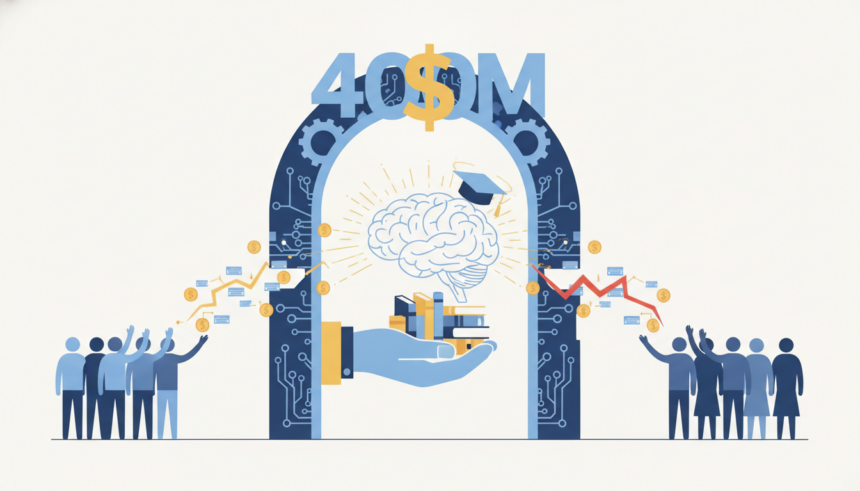
The Gates Foundation AI education commitment is $400 million — 40% of a $1 billion, two-year AI access pledge announced in September 2026. Spending is compressed because the Foundation closes permanently in 2045, therefore grants are being deployed in two-year cycles rather than decade-long programmes. Named vehicles so far: AI Transforming Learning Grants ($150,000–$200,000 each, up to eight broad-access higher education institutions), the ADQ-anchored EdTech and AI Fund for Sub-Saharan Africa, a roughly $4 million grant to the Fab AI Foundation (July 2026), and AI literacy funding to aiEDU. The core dispute: Imagi CEO Dora Palfi argues affluent districts are moving fastest, while the Achievement Network reports every student in a Bronx pilot class showed academic growth.
The Gates Foundation AI education allocation is $400 million over two years, carved out of the $1 billion artificial intelligence access pledge the Bill & Melinda Gates Foundation announced in September 2026. Education and health each take 40% of that total. The spending window is short because the Foundation has committed to closing permanently in 2045, which converts endowment dollars into deadline dollars and pushes programme teams toward two-year grants with fast outcome reporting.
The money is already generating opposing evidence. Dora Palfi, CEO and co-founder of the edtech platform Imagi, argued in Fortune that affluent districts are moving fastest to capture the funding. Michelle Odemwingie, CEO of the Achievement Network, reported that in a Bronx pilot classroom every single student showed academic growth by year’s end.
This article covers the allocation, the named grantees, the award amounts, the application routes, the eligibility conditions and the documented criticism.
About this analysis: billgates.pk follows Gates Foundation and Breakthrough Energy funding by amount, recipient, timeline and deadline. Throughout this piece, institutional Foundation positions are kept separate from Bill Gates’ personal commentary in the Goalkeepers report.
Transparency note: Figures reflect announcements publicly available as of 11 November 2026. No independent evaluation of any 2026 AI education grant had been published at the time of writing, so outcome statements are limited to what grantees and reporters have stated.
What the Gates Foundation’s $400 Million AI Education Pledge Covers
The Gates Foundation AI education allocation is $400 million over two years, drawn from the $1 billion AI access pledge announced in September 2026. It funds AI tutoring systems, personalised learning tools and AI literacy curricula aimed at low-income students and under-resourced communities, both in United States classrooms and in international education systems.
What the money buys matters as much as the headline figure. The education tranche funds tool deployment, classroom pilots, curriculum development and fund anchoring. It does not function as a hardware procurement programme, and broadband construction sits outside it except through the separate 10% digital infrastructure slice. The consequence is structural: a school without reliable in-classroom connectivity cannot draw on the education tranche to fix that, because connectivity funding lives in the smaller $100 million infrastructure allocation and is aimed at model access foundations rather than district wiring projects.
| Sector | Share of pledge | Dollar amount | Primary use of funds |
|---|---|---|---|
| Education | 40% | $400 million | AI tutoring, personalised learning, AI literacy |
| Health | 40% | $400 million | AI diagnostics and frontline health worker tools |
| Agriculture | 10% | $100 million | Advisory tools for smallholder farmers |
| Digital infrastructure | 10% | $100 million | Connectivity and model access foundations |
| Total pledge | 100% | $1 billion | Two-year window, 2026–2028 |
Education and health are matched at 40% each because the Bill & Melinda Gates Foundation treats both as sectors where commercial AI development skips low-income users by default. The reasoning is parallel in each case: diagnostic tools and tutoring systems both have paying institutional buyers elsewhere, therefore the poorest users are served last unless a funder intervenes. Readers tracking the matching $400 million on the health side will find the sector breakdown in our Gates Foundation climate tech and AI health investing analysis.
The clock is the design constraint. The pledge covers 2026 to 2028, which means grant decisions are being taken on compressed timelines rather than through multi-year planning cycles, and applicants are being assessed partly on how quickly they can deploy and report. GeekWire’s coverage of the 2026 Goalkeepers announcement corroborates both the pledge size and the two-year deployment window.
Why Now: The 2045 Closure Deadline and the Market-Failure Argument
The Foundation is spending quickly because it has committed to closing permanently in 2045. That deadline converts every endowment dollar into a dollar with an expiry date, and consequently programme teams favour two-year commitments with measurable outputs over open-ended research agendas.
The intellectual case for the education tranche comes from Bill Gates personally, set out in the Foundation’s 2026 Goalkeepers report. His position is that left entirely to market forces, the most advanced AI tools will be built for institutions and consumers who can afford them, therefore low-income learners receive the technology late and in degraded form. He frames the $400 million as a correction to that market failure. This is Gates’ own framing in the Goalkeepers report and should be read as distinct from the Foundation’s published grant criteria, which are set per initiative.
“Left entirely to market forces, the most advanced AI tools will be developed exclusively for institutions and consumers who can afford them.”
— Bill Gates, paraphrasing his argument in the 2026 Goalkeepers report
The two-year window has a predictable distributional effect on the AI digital divide in education. Short cycles reward organisations with existing distribution — established school networks, universities, and investment funds — because they can absorb capital and file outcome reports inside the grant period. That mechanism is precisely what critics point to later in this analysis, and it is a consequence of the payout schedule rather than of any stated preference for well-resourced recipients.
Who Gets the Money: Named Grantees, Amounts and Deadlines
Disclosed recipients to date are up to eight broad-access higher education institutions under the AI Transforming Learning Grants, the ADQ-anchored EdTech and AI Fund for Sub-Saharan Africa, the Fab AI Foundation in Switzerland, and The AI Education Project (aiEDU). A Bronx classroom pilot delivered with the Achievement Network has also been reported, though its funding figure has not been itemised publicly.
| Recipient or vehicle | Amount | Date | Purpose | Geography |
|---|---|---|---|---|
| AI Transforming Learning Grants | $150,000–$200,000 per institution | Late 2026 | Study AI-enabled transformative learning | US broad-access institutions |
| EdTech and AI Fund (anchored with ADQ) | Anchor commitment, size not stated | 2026 | Scale proven AI learning tools | Sub-Saharan Africa |
| Fab AI Foundation (Switzerland) | Approx. $4 million | July 2026 | Fine-tune open-source small models for classrooms | Africa |
| The AI Education Project (aiEDU) | Not stated | 2026 | Youth AI literacy curriculum | United States |
| Bronx classroom pilot via Achievement Network | Not stated | 2026 | Real-time identification of struggling students | New York City |
AI Transforming Learning Grants: $150,000–$200,000 for Up to Eight Broad-Access Institutions
The award band is $150,000 to $200,000 per institution, capped at up to eight recipients. Eligibility is restricted to broad-access higher education institutions because those campuses enrol high shares of low-income and first-generation students, which makes them the Foundation’s test bed for whether AI improves completion rather than simply enrolment. The grant size has a direct scoping consequence: $150,000 to $200,000 funds a defined study and a contained pilot, not an institution-wide deployment. Applicants who propose campus-scale rollouts are therefore proposing something the award cannot fund, and narrow scoping is the stronger strategy.
The Bronx Pilot and the Achievement Network Result
The mechanism in the Bronx pilot was speed of signal. The Chronicle of Philanthropy reported that an AI tool flagged struggling students within minutes, which allowed the teacher to intervene during the same lesson rather than after a unit test.
“For the first time in his career, every single student in that class showed academic growth.”
— Michelle Odemwingie, CEO, Achievement Network, reported by The Chronicle of Philanthropy
The limitation belongs in the same breath as the result: this is one classroom, over one year, with the intervention mediated by a teacher who acted on the flags. It is a promising signal about teacher-supported tooling, not evidence of a scaled effect.
Sub-Saharan Africa: The ADQ-Anchored EdTech and AI Fund and the $4 Million Fab AI Foundation Grant
The Foundation partnered with ADQ to anchor a new multi-investor EdTech and AI Fund aimed at scaling proven AI solutions across Sub-Saharan Africa. The structure is deliberate: an anchor commitment is designed to attract commercial co-investment, which means the Foundation’s capital does more work as a risk buffer than as direct programme funding. Separately, a grant of nearly $4 million went to the Fab AI Foundation in Switzerland in July 2026 to fine-tune open-source small AI models for classroom use in Africa. Small fine-tuned models matter because they run on cheaper hardware and tolerate intermittent connectivity, which is the binding constraint in most African classrooms rather than model quality. One routing point disqualifies many hopeful applicants: the fund takes companies and ventures as investees, not schools as grantees.
AI Literacy Curricula: aiEDU and Youth-Facing Programmes
Funding to The AI Education Project (aiEDU) buys youth-facing curriculum that teaches students how to use AI safely and responsibly, delivered through schools and youth organisations. The gap this addresses is documented rather than hypothetical: 70% of American teenagers already use AI for schoolwork while only 27% report that a teacher has discussed safe use, which is why curriculum grants sit inside the same $400 million as tool deployment grants.
Who Gets Left Out: Infrastructure, Capacity and the Grant-Writing Gap
The schools least able to win Gates Foundation AI education money are those without reliable classroom connectivity, maintained device fleets, dedicated technology staff or grant-writing capacity — which is substantially the same population the $400 million is intended to serve. The exclusion is procedural rather than intentional, and that makes it harder to fix.
The mechanism runs through the application process itself. Competitive grant rounds reward proposal quality, baseline data availability and a demonstrated history of outcome reporting. Districts with grant offices and existing foundation relationships therefore submit faster and stronger applications, while districts where the superintendent writes the proposal between budget meetings submit late or not at all. Palfi’s Fortune commentary makes exactly this point: the districts moving fastest to secure the funding are the affluent ones already best placed to use it.
“They often tell me they have to fix literacy and numeracy first.”
— Dora Palfi, CEO and co-founder, Imagi, writing in Fortune
Her sequencing argument has a measurable consequence. A school where a substantial share of students read below grade level gains little from an AI tutor that assumes reading fluency, because the tool’s instructions are themselves a reading task. Deploying software into that setting without remediation capacity produces no measurable gain, which then reads in an evaluation as tool failure rather than as a sequencing error.
- Connectivity: sustained in-classroom bandwidth, not building-level access
- Devices: a one-to-one or near one-to-one ratio that survives a school year
- Staff capacity: at least one person whose job includes technology integration and data review
- Grant infrastructure: someone who can write the proposal and file the outcome reporting a grant requires
The human-mentorship concern follows from the same logic. Experts covering the pilots stress that the Bronx result came from AI supporting a teacher’s judgement, not replacing it. Where staffing is thin and class sizes are large, the identical tool substitutes for mentorship instead of extending it, which produces a different outcome from the Bronx class and raises the risk that students lean on AI output in place of their own critical thinking.
The asymmetry is the honest conclusion. The pledge is well designed to correct a market failure in how AI tools get built. It does not correct the capacity failure in how schools absorb them, and no amount of tool funding substitutes for bandwidth, devices and staff.
The Track Record Problem: Previous Gates Education Bets That Were Rolled Back
The Foundation has funded several large education initiatives that were later scaled back or abandoned, which is why Stephanie Beasley, senior writer at The Chronicle of Philanthropy, reports that education researchers describe the AI pledge as a familiar pattern. The déjà vu is evidentiary, not rhetorical.
- Small schools initiative (early 2000s): breaking large high schools into smaller units; wound down after achievement gains failed to appear consistently
- Common Core standards support (2009 onward): large-scale advocacy and implementation funding; the Foundation later acknowledged slower and weaker results than projected
- Measures of Effective Teaching and teacher-evaluation partnerships (2009–2016): district-level evaluation redesign; independent evaluation found no reliable student-achievement gains and the model was retired
- InBloom student data infrastructure (2013–2014): shared data platform shut down within roughly a year after parent and state privacy objections
- AI education pledge (2026–2028): the current two-year commitment; outcome status is pending, with no independent evaluation published to date
The common failure mode is more instructive than the individual histories. Each initiative was designed centrally, measured against a narrow metric, and deployed into districts with uneven capacity. Results therefore fragmented at scale even where individual pilots performed well, because the pilot sites had conditions the average district did not. Independent evaluation design is what separated the initiatives that were honestly retired from those that lingered, which is one reason academic partners such as the University of Washington have hosted Gates-funded measurement work.
Applied to 2026, the position is straightforward rather than speculative. The $400 million repeats the pilot-to-scale structure, and the two-year window gives evaluators less time to detect fragmentation than the decade-long programmes did. Consequently, how the evaluations are designed matters more to the eventual outcome than the size of the headline figure.
What the Data Says So Far: Usage, Guidance and Academic Integrity
Some 70% of American teenagers already use AI for schoolwork while only 27% report that a teacher has discussed how to use it safely, according to Common Sense Media’s 2026 survey. The adoption problem in most US classrooms is therefore a guidance gap rather than an access gap, and that distinction reshapes what the funding should buy.
| Measure | Figure | Population | Source and year |
|---|---|---|---|
| Teens using AI for schoolwork | 70% | US teenagers | Common Sense Media, 2026 |
| Teens reporting teacher guidance on safe AI use | 27% | US teenagers | Common Sense Media, 2026 |
| Students reporting academic dishonesty in prior month | 72% | 4,300+ high school students | 2026 academic integrity study |
| Share of $1B pledge allocated to education | 40% ($400M) | Global programme | Gates Foundation, September 2026 |
The 43-point spread between use and guidance explains why aiEDU-style curriculum grants sit alongside tool deployment grants inside the same $400 million. Students have already adopted the technology; the funding is chasing the instruction that did not arrive with it.
The academic integrity figure needs context rather than alarm. A 2026 study of more than 4,300 high school students found 72% reported academically dishonest behaviour in the previous month — a self-reported baseline measuring a behaviour that long predates generative AI. The defensible reading is that AI changed the tools available rather than creating the underlying incentive, which is why integrity instruction belongs inside AI literacy curricula rather than in a separate disciplinary track.
On outcomes, the evidence limit should be stated plainly. The strongest published result remains teacher-mediated, single-classroom pilot data such as the Bronx cohort. No large-scale, peer-reviewed effect size exists yet for AI tutoring among low-income students, and federal research programmes at the National Science Foundation are still funding the studies that would produce one. Claims that AI tutoring delivers achievement gains at scale are therefore premature.
How to Apply for Gates Foundation AI Education Funding
Most Gates Foundation AI education money is awarded through invited or request-for-proposal processes rather than open applications, which means the practical route is registering interest, matching a named initiative such as the AI Transforming Learning Grants, and submitting inside the posted RFP window. Unsolicited proposals to a general inbox rarely enter a review cycle.
Routing comes before drafting. US higher education institutions pursue the AI Transforming Learning Grants. African edtech ventures approach the ADQ-anchored EdTech and AI Fund as investees rather than grantees. Curriculum and literacy organisations pursue programme grants of the kind aiEDU received. Applying to the wrong vehicle is the most common disqualifier, because eligibility is defined by organisation type and geography rather than by topic — a school district writing to an investment fund is rejected on structure before anyone reads the idea.
- Identify the correct vehicle: AI Transforming Learning Grants (US broad-access institutions), EdTech and AI Fund (African edtech ventures), or direct programme grants (curriculum and literacy organisations)
- Confirm eligibility against the initiative’s published criteria, including organisation type, legal status, geography and student-population requirements
- Register your organisation in the Foundation’s grant portal and complete the letter of inquiry or expression of interest where the initiative requires one
- Scope the proposal to the award band: $150,000–$200,000 funds a defined pilot and study, so specify the cohort size, baseline measure and reporting cadence
- Submit before the posted RFP deadline and prepare for diligence: budget detail, data-privacy handling for student information, and a named evaluation partner
Run the following checks before investing drafting time:
- Is your organisation a recognised legal entity with audited or reviewable financials?
- Does your institution qualify as broad-access, or does your venture operate in a target geography?
- Do you serve a documented share of low-income, first-generation or under-resourced learners?
- Can you supply baseline student data and a named evaluation method before the grant starts?
- Do you have a student data-privacy policy that covers third-party AI tools?
- Can you deliver outcome reporting within a two-year grant window?
One verification instruction overrides everything above. Deadlines for the 2026–2028 cycle are posted per initiative on gatesfoundation.org and change between rounds, therefore applicants must confirm the current RFP date at the source rather than relying on any secondary summary, including this one.
Frequently Asked Questions
What is the Gates Foundation’s $400 million AI education commitment?
It is $400 million over two years — 40% of the $1 billion AI access pledge announced in September 2026. The money funds AI tutoring systems, personalised learning tools and AI literacy curricula for low-income and under-resourced learners. The window runs 2026 to 2028 because the Foundation closes permanently in 2045, which compresses every payout schedule.
Who receives funding from the Gates Foundation’s AI education programme?
Disclosed recipients include up to eight US broad-access higher education institutions via AI Transforming Learning Grants, the ADQ-anchored EdTech and AI Fund in Sub-Saharan Africa, the Fab AI Foundation (approx. $4 million, July 2026) and aiEDU for AI literacy curriculum. A Bronx classroom pilot with the Achievement Network has also been reported, with its funding amount not stated publicly.
How do I apply for a Gates Foundation AI education grant?
Most Gates Foundation AI education awards come through invited RFPs rather than open applications. Register your organisation in the grant portal, match the correct initiative by organisation type and geography, submit a letter of inquiry where required, and confirm the current deadline on gatesfoundation.org, because posted dates change between rounds.
Why does the Gates Foundation say AI could widen inequality?
Because commercial developers build for paying institutions first, which means low-income learners receive frontier tools last and in weaker form. Bill Gates framed this as a market failure in the 2026 Goalkeepers report, and the $400 million is designed as a corrective to that dynamic rather than as a forecast of what will happen.
Which schools get left out of Gates Foundation AI funding?
Schools without reliable classroom connectivity, maintained device fleets, technology staff or grant-writing capacity. Dora Palfi of Imagi argued in Fortune that affluent districts are moving fastest to secure the funding, and that under-resourced schools tell her they have to fix literacy and numeracy first before adding AI tools.
How much of the Gates Foundation’s $1 billion AI pledge goes to each sector?
Education takes 40% ($400 million), health 40% ($400 million), agriculture 10% ($100 million) and digital infrastructure 10% ($100 million). Education and health are matched because the Foundation treats both as sectors where commercial AI development skips low-income users, therefore parallel allocations were set rather than a single priority sector.
Does AI tutoring actually improve student outcomes?
The evidence is early and pilot-scale. The strongest documented result is the Bronx classroom where the Achievement Network reported every student showed academic growth, but that is one teacher-mediated class over one year. No large peer-reviewed effect size yet exists for AI tutoring among low-income students, so scaled claims are premature.
Has the Gates Foundation backed failed education technology before?
Yes. The small schools initiative, Common Core implementation funding, the teacher-evaluation partnerships and the InBloom data platform were each scaled back or shut down. The Chronicle of Philanthropy reports that education researchers see the AI pledge following the same pilot-to-scale pattern, which is why evaluation design draws scrutiny.
How many students already use AI for schoolwork?
70% of American teenagers use AI for schoolwork, according to Common Sense Media’s 2026 survey, while only 27% say a teacher has discussed safe use. That 43-point gap is the documented reason curriculum and literacy grants sit alongside tool deployment grants inside the same $400 million allocation.
Why is the Gates Foundation spending so fast on AI?
Because the Foundation will close permanently in 2045, which shortens every programme’s payout horizon. The AI pledge is structured as a two-year commitment covering 2026 to 2028, therefore grant decisions favour organisations that can deploy tools and file outcome reporting quickly rather than over a decade.
Limitations of This Analysis and Alternative Funding Routes
Several figures remain undisclosed. Individual grant amounts for aiEDU and the Bronx pilot have not been publicly itemised, the EdTech and AI Fund’s anchor commitment size has not been stated, and no independent evaluation of any 2026 AI education grant has been published. Outcome statements in this article are therefore restricted to what grantees and reporters have said, and none of them should be read as verified effect sizes.
Scope is bounded by date. Figures reflect announcements available as of 11 November 2026, and the two-year pledge window runs to 2028, which means allocations, grantee lists and deadlines will change during the cycle. Applicants should treat gatesfoundation.org as the authority over any secondary summary.
Alternative routes matter because the Foundation’s AI education grants are narrow by design and heavily competitive, consequently most schools and most organisations will not receive one.
- National Science Foundation education and AI research programmes, for institutions with a research component
- US Department of Education federal and state formula or discretionary grants covering technology and instructional support
- State-level digital equity and connectivity funds, which address the infrastructure gap the Foundation’s education tranche does not
- Regional and community foundations, which fund smaller deployments with lighter reporting requirements
- Open-source and no-cost AI literacy curricula, including aiEDU materials, where capital rather than content is the constraint
Conclusion
The Gates Foundation AI education pledge solves a supply problem and leaves a demand problem untouched. The load-bearing facts are simple: $400 million of a $1 billion commitment, deployed across 2026 to 2028, with the pace driven by the Foundation’s planned closure in 2045. The pledge corrects a tool-development failure, because capital is now flowing to tutoring systems, small open-source models and literacy curricula that commercial developers would have built for paying customers first. It does not correct the absorption failure in schools lacking connectivity, devices and technology staff, therefore distribution will skew toward organisations with existing capacity unless eligibility is weighted against that tendency.
For applicants, the sequence is unchanged: identify the correct vehicle by organisation type, confirm the current RFP deadline on gatesfoundation.org, and scope the proposal to the $150,000–$200,000 band.
References
- Bill & Melinda Gates Foundation — gatesfoundation.org. Primary source for the $1 billion AI access pledge announced September 2026, the 40/40/10/10 sector split, the AI Transforming Learning Grants award band and current eligibility pages.
- Gates Foundation 2026 Goalkeepers report (Bill Gates) — gatesfoundation.org/goalkeepers. Source for the market-failure framing and the 2045 closure rationale; presented as Bill Gates’ personal commentary.
- Common Sense Media, 2026 teen AI survey — commonsensemedia.org/research. Source for 70% of US teenagers using AI for schoolwork and 27% reporting teacher guidance on safe use.
- Fortune — Dora Palfi, CEO and co-founder, Imagi — fortune.com. Source of the quotation on literacy and numeracy sequencing and the claim that affluent districts are moving fastest.
- The Chronicle of Philanthropy — Stephanie Beasley — philanthropy.com. Source for the Bronx pilot, the Michelle Odemwingie quotation, and reporting that researchers see a familiar pattern in Gates-funded school technology bets.
- U.S. National Science Foundation — nsf.gov. Cited for federal AI and education research funding priorities and as an alternative funding route.
- University of Washington — washington.edu. Cited as an example of an academic institution hosting Gates-funded evaluation and measurement work.
- GeekWire — 2026 Goalkeepers coverage — geekwire.com. Independent reporting corroborating the pledge size, timing and two-year deployment window.