
Table of Contents
- The Gates Foundation and R21: How the Money Moved From Vaccine Development to Delivery
- From Trial Data to Rollout: The 2023–2026 Timeline That Forced the Pivot
- The Gavi Replenishment: Why $9 Billion Matters More to R21 Than Any Single Grant
- The $2.99 Dose: How Price Negotiation Became a Public Health Intervention
- Where the 2026 Money Actually Went: MAVILDE, AVERT and the Country Rollouts
- What the Shift Means for Researchers and Implementers Seeking Gates Funding
- Frequently Asked Questions
- Limitations of This Analysis — and the Alternatives to a Vaccine-Led Strategy
- Conclusion
- References
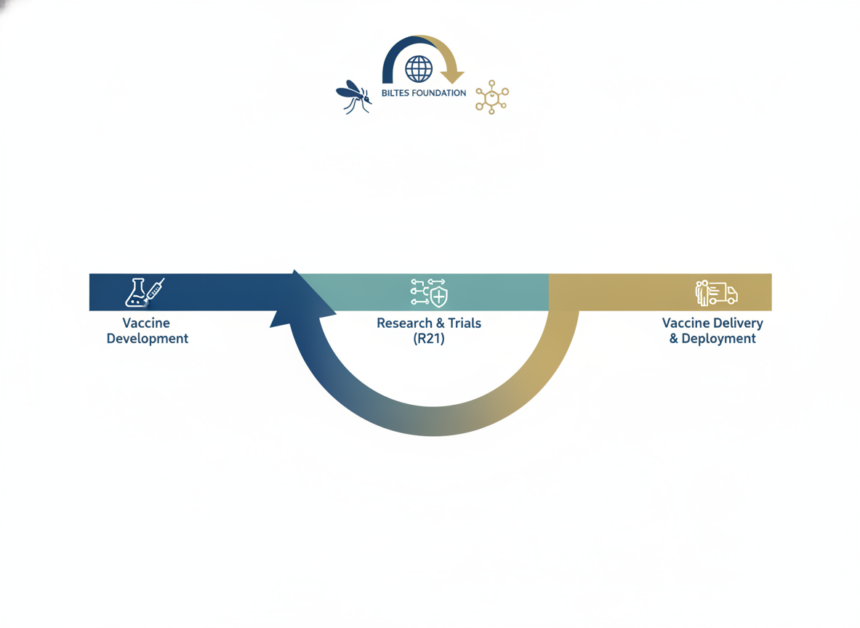
Key Takeaway: The Gates Foundation and R21: How the Money Moved From Vaccine Development to Delivery describes a pivot completed between 2023 and 2026 — the Foundation stopped acting primarily as an R21 research funder and became a delivery funder. Three mechanisms carried the money: co-hosting the June 2025 Brussels pledging summit with the European Union to mobilise at least $9 billion for Gavi’s 2026–2030 period, the main purchasing channel for R21 across Africa; the late-2025 Gavi/UNICEF pricing agreement cutting R21/Matrix-M from roughly $4.00 to $2.99 per dose, projected to unlock 30 million additional doses before 2030; and direct delivery-science grants, including MAVILDE in Ethiopia (July 2026) and the AVERT effectiveness study (Grant INV-097482, launched July 2026) in Burkina Faso and Uganda.
The Gates Foundation and R21: How the Money Moved From Vaccine Development to Delivery is, at root, a story about a constraint changing position. World Health Organization recommendation and prequalification of R21/Matrix-M settled the science question, which means the binding constraint moved to price, logistics and field evidence. Two numbers anchor the shift: the at-least-$9-billion target set for Gavi’s 2026–2030 replenishment at the June 2025 Brussels summit that the Foundation co-hosted with the European Union, and the $2.99 per-dose price that Gavi and UNICEF secured in late 2025, down from approximately $4.00.
The consequence for anyone seeking Foundation money is concrete. Grant-seekers should expect delivery-science, market-shaping and health-systems work to dominate the malaria vaccine portfolio rather than vaccine discovery, because an approved, prequalified, low-cost product already exists. This article sets out the timeline that forced the pivot, the channels the money travels through, the named 2025–2026 programmes and their implementing institutions, and the limits of what public records actually establish.
About this analysis: Written by the billgates.pk editorial team, which tracks Gates Foundation and Breakthrough Energy funding flows by amount, recipient, timeline and measurable outcome. Institutional Foundation positions are reported separately from the personal statements of Bill Gates.
Transparency note: This is independent editorial analysis. billgates.pk is not affiliated with, endorsed by or funded by the Bill & Melinda Gates Foundation, Gavi, UNICEF or any organisation named here. All figures are drawn from the cited public sources and are current as of October 2026.
The Gates Foundation and R21: How the Money Moved From Vaccine Development to Delivery
The Gates Foundation and R21: How the Money Moved From Vaccine Development to Delivery is answered simply: Foundation spending moved from clinical development into purchase subsidy, price negotiation and implementation evidence. That happened because WHO recommendation and prequalification removed the regulatory bottleneck, which means the remaining obstacle became cost per fully immunised child and the mechanics of reaching that child, not vaccine efficacy. The money therefore follows operational questions rather than immunological ones.
The mechanism difference matters more than the headline. Development capital flowed to laboratories — the University of Oxford, which co-developed R21/Matrix-M, and the Serum Institute of India, which manufactures it. Delivery capital flows through Gavi as the pooled procurement entity, through UNICEF as the price negotiator and supply manager, and through direct implementation-research grants to country institutions. As a result the recipient profile changed from research laboratories to ministries of health, procurement bodies and local research institutes. For readers assembling a proposal, that reclassification is the single most actionable fact in this article, because it determines who the credible applicant now is. Burden estimates that justify this spending — including malaria’s standing as a leading killer of African children — come largely from measurement infrastructure such as the Institute for Health Metrics and Evaluation at the University of Washington, whose modelled estimates carry uncertainty intervals and should be read accordingly.
The four channels Gates Foundation R21 money now travels through
- Gavi core contributions — the pooled-procurement channel that buys and ships R21 doses to eligible countries
- Market shaping with UNICEF — negotiating the per-dose price down to widen volume at a fixed budget
- Delivery-science grants — country-level learning and documentation projects such as MAVILDE in Ethiopia
- Real-world effectiveness studies — observational research such as AVERT (Grant INV-097482) in Burkina Faso and Uganda
- Residual R&D support — next-generation tools, including monoclonal antibodies and transmission-blocking approaches
From Trial Data to Rollout: The 2023–2026 Timeline That Forced the Pivot
The pivot was driven by regulatory and procurement events rather than by a change of philanthropic philosophy. WHO recommendation and prequalification of R21/Matrix-M converted the vaccine into a procurable product for malaria-endemic countries, and prequalification is the specific step that permits UN agency purchase. Therefore the binding constraint moved downstream in a single administrative motion — from whether the vaccine worked to whether supply, price and administration could keep pace.
How R21 moved from recommendation to mass rollout
- WHO recommendation and prequalification of R21/Matrix-M establish it as a procurable vaccine for malaria-endemic countries
- The Serum Institute of India commits to high-volume, lower-cost manufacturing, making large national introductions financially plausible
- April 2025 — Uganda launches the largest malaria vaccine introduction to date, targeting 1.1 million children across 105 districts
- 2025 — Mali distributes 927,800 R21 doses across 19 priority regions using a hybrid delivery approach
- June 2025 — the Gates Foundation and the European Union co-host the Brussels pledging summit to mobilise at least $9 billion for Gavi’s 2026–2030 period
- Late 2025 — Gavi and UNICEF secure a price reduction from approximately $4.00 to $2.99 per dose
- July 2026 — MAVILDE launches in Ethiopia as R21 rolls out across 57 high-burden districts, and the AVERT effectiveness study begins in Burkina Faso and Uganda
Once doses existed and were purchasable, the dominant failure mode changed shape: a stalled rollout replaced a failed trial as the thing most likely to waste the investment. Consequently the Foundation redirected grant capital toward the questions that determine whether a four-dose schedule — administered at roughly 6, 7, 8 and 18 months under WHO guidance — actually reaches children in districts with irregular transmission, thin cold-chain capacity and overstretched health workers. That is a logistics and measurement problem, and it is now where the marginal dollar sits.
The Gavi Replenishment: Why $9 Billion Matters More to R21 Than Any Single Grant
The largest single lever on R21 delivery is not a Foundation grant to any laboratory — it is the Foundation’s contribution to, and mobilisation of, Gavi’s replenishment, because Gavi is the purchasing entity for low- and middle-income countries. In June 2025 the Foundation co-hosted a high-level pledging summit in Brussels with the European Union, aimed at mobilising at least $9 billion for Gavi’s 2026–2030 strategic period. That $9 billion is a replenishment target rather than confirmed receipts, and the distinction is material: pledges convert into doses only when they are paid.
The leverage mechanism explains why the Foundation routes money this way. A dollar passed through pooled procurement commands volume discounts and multi-year demand forecasts, which means a manufacturer such as the Serum Institute of India can commit production capacity against predictable orders rather than speculative ones. Consequently Foundation money functions as demand certainty rather than as project funding, and the effect of that certainty shows up in the dose price instead of in a new research programme. This is the same portfolio logic visible in the Foundation’s climate tech and AI health investing analysis — crowding in commercial capacity by de-risking demand rather than funding invention indefinitely.
The concentration risk deserves stating plainly. Because so much delivery capacity depends on one procurement channel, a replenishment shortfall translates directly into unpurchased doses. The Foundation’s delivery strategy is therefore exposed to donor-government budget decisions it does not control, and no amount of grant-making compensates for a sovereign pledge that is not honoured.
R21 delivery economics: the figures that drive volume
| Metric | Figure | Source / date | Why it matters |
|---|---|---|---|
| Gavi replenishment target, 2026–2030 | At least $9 billion | Brussels summit, June 2025 | Primary purchasing budget for R21 in Africa |
| R21/Matrix-M price before the deal | ~$4.00 per dose | Pre-late-2025 | Baseline for the negotiated reduction |
| R21/Matrix-M price after the deal | $2.99 per dose | Gavi/UNICEF, late 2025 | Lowers cost per fully immunised child |
| Additional doses projected before 2030 | 30 million | Analyst projection, 2025 | Volume gain at unchanged donor spending |
| Additional children projected protected | ~7 million | Analyst projection, 2025 | Modelled outcome, not observed result |
| All-in cost to fully vaccinate a child, poorest countries | Under $7 | Gavi, all antigens plus delivery | Shows vaccine price is a minority of cost |
The $2.99 Dose: How Price Negotiation Became a Public Health Intervention
The late-2025 Gavi/UNICEF agreement cut R21/Matrix-M from approximately $4.00 to $2.99 per dose, and because the vaccine requires four doses, the roughly $1.01 saving compounds to about $4 per fully immunised child. As a result, analysts project 30 million additional doses before 2030, protecting an estimated 7 million more children at unchanged donor spending. No laboratory result published in that window moved the coverage numbers as far as a negotiated price did.
The mechanism is straightforward procurement economics. Guaranteed multi-year volume, combined with a manufacturer holding large-scale capacity, supports a lower unit price, which means market shaping converted the same budget into materially more protected children. Attribution should be precise: UNICEF negotiates supply and price, Gavi purchases and allocates, and the Foundation’s role sits on the demand side — funding and co-ordinating the pooled demand that makes the negotiation credible. Separating those three functions matters for applicants, because each institution answers a different kind of proposal.
One qualification keeps this in proportion. The dose price is a minority of total cost: delivery, cold chain, health worker time and community mobilisation keep the all-in figure for fully vaccinating a child in the poorest countries under $7 across the full childhood schedule. Therefore the next tranche of gains depends on logistics and coverage rather than on further price reductions.
What the $2.99 price covers — and what it does not
- Covered: the vaccine vial itself, at Gavi-negotiated terms for eligible countries
- Not covered: cold chain capacity, transport to last-mile facilities and fuel
- Not covered: health worker time for a four-dose schedule at roughly 6, 7, 8 and 18 months
- Not covered: community mobilisation and defaulter tracing to secure the fourth dose
- Not covered: monitoring and evaluation — the gap that the MAVILDE and AVERT grants are designed to fill
Where the 2026 Money Actually Went: MAVILDE, AVERT and the Country Rollouts
The Foundation’s 2026 R21 grants fund learning, not discovery. Both flagship awards exist because trial efficacy does not predict field performance — a methodological distinction that research bodies including the National Institutes of Health treat as fundamental, since randomised efficacy and routine-conditions effectiveness measure different things. Ministries therefore needed localised evidence before committing to scale.
MAVILDE — the Malaria Vaccine Learning Documentation in Ethiopia project — launched in July 2026, implemented by Project HOPE with the Armauer Hansen Research Institute and funded directly by the Gates Foundation. It generates real-time, localised evidence as Ethiopia introduces R21 across 57 high-burden districts. The drivers are specific: diverse transmission patterns and emerging antimalarial drug resistance mean a single uniform national protocol underperforms in a predictable way, therefore district-level documentation changes how the Ministry of Health allocates doses, staff and supervision.
“Through MAVILDE, we are collaborating with the Ministry of Health with the locally generated evidence needed to guide strategic investments, optimize vaccine deployment, and accelerate progress toward malaria elimination.”
— Dr. Frehiwot Nigatu, Senior Director of Programs, Project HOPE (July 2026)
AVERT carries Gates Foundation Grant INV-097482 with co-funding from GiveWell. Begun in July 2026, it is a prospective observational study of real-world R21 effectiveness among children under five in Burkina Faso and Uganda, with registry details recorded on ClinicalTrials.gov; results had not been published as of October 2026. Its importance is quantitative: Phase 3 data showed roughly a 75% reduction in malaria cases during the first year, and AVERT tests whether performance of that order holds under routine delivery conditions. Future procurement volumes rest partly on that answer, which means AVERT is a market-shaping instrument disguised as an epidemiological study.
“The introduction of the R21/Matrix-M vaccine marks an important milestone in Ethiopia’s fight against malaria, but sustainable impact depends on generating local evidence that reflects the country’s unique epidemiological context.”
— Alemseged Abdissa, PhD, Deputy Director General, Armauer Hansen Research Institute (2026)
Gates Foundation-funded R21 delivery programmes, 2025–2026
| Programme | Implementers | Countries / scope | Launched | Funding role |
|---|---|---|---|---|
| MAVILDE | Project HOPE, Armauer Hansen Research Institute | Ethiopia, 57 high-burden districts | July 2026 | Direct Gates Foundation grant |
| AVERT (Grant INV-097482) | Study investigators per registry record | Burkina Faso and Uganda, children under 5 | July 2026 | Gates Foundation with GiveWell |
| Uganda national R21 introduction | Ministry of Health with Gavi support | 105 districts, 1.1 million children targeted | April 2025 | Gavi-backed procurement |
| Mali R21 introduction | Ministry of Health with Gavi support | 19 priority regions, 927,800 doses | 2025 | Gavi-backed procurement |
| Ethiopia national R21 introduction | Ministry of Health with Gavi support | 57 high-burden districts | 2026 | Gavi-backed procurement |
The pattern for applicants is unambiguous. Recipients are country research institutes, implementing NGOs and ministries of health — not vaccine developers. Consequently the competitive 2026 proposal offers delivery data, equity measurement or health-systems integration. The operating conditions justify that emphasis: Apac District in Uganda, a primary rollout target, reports the highest recorded number of mosquito bites per person globally, at over 1,500 bites per person annually, which means delivery designs built for moderate transmission settings will not transfer.
What the Shift Means for Researchers and Implementers Seeking Gates Funding
Proposals aligned with the Foundation’s current R21 posture measure delivery performance, cost per fully immunised child, or equity of coverage, because those are the open questions. Pitching a new malaria vaccine candidate now competes against an approved, prequalified product selling at $2.99 per dose with committed manufacturing capacity behind it, which means the evidentiary bar for displacement is extremely high. A candidate would need to demonstrate materially better protection, a shorter schedule, or a lower all-in cost per protected child to justify the switching cost.
Reading the funding signal is a documentary exercise rather than a guessing game. Grant IDs such as INV-097482 appear in public records; co-funding alongside GiveWell indicates appetite for explicit cost-effectiveness evidence; and partnerships with country institutions such as AHRI and national ministries indicate that local co-principal investigators strengthen a submission. Therefore applicants based outside endemic countries should structure proposals around a named local institutional partner with ethics approval capacity and existing data-collection systems, not add one late as a formality.
One boundary is worth stating. The Foundation publishes awarded grants but does not run open calls across every programme area, so monitoring awarded-grant records alongside Gavi programme documents is the practical route to understanding what will be funded next.
Proposal characteristics that match the Foundation’s 2026 R21 posture
- A named in-country institutional partner with ethics approval and data-collection capacity
- An outcome measured in coverage, dropout between doses, or cost per fully immunised child
- Evidence that findings will reach a ministry of health decision, not only a journal
- A design that works in high-transmission districts with weak cold chain and drug-resistance pressure
- Explicit cost-effectiveness reporting, reflecting the GiveWell co-funding pattern
Frequently Asked Questions
How did the Gates Foundation’s R21 funding change after WHO recommendation?
It moved from clinical development toward procurement subsidy, price negotiation and implementation research. WHO recommendation and prequalification made R21 purchasable through Gavi, therefore the binding constraint became delivery cost and coverage rather than efficacy. The two clearest 2026 examples are MAVILDE in Ethiopia and the AVERT effectiveness study in Burkina Faso and Uganda, both of which measure field performance rather than develop a product.
How much does the R21/Matrix-M vaccine cost per dose in 2026?
Approximately $2.99 per dose for Gavi-eligible countries, down from roughly $4.00 following the late-2025 Gavi/UNICEF agreement. Because R21 uses four doses, the saving compounds per child, which analysts project will unlock 30 million additional doses before 2030. The all-in cost of fully vaccinating a child in the poorest countries, across all antigens and including delivery, remains under $7.
What is the MAVILDE project and who funds it?
MAVILDE is the Malaria Vaccine Learning Documentation in Ethiopia project, launched in July 2026 by Project HOPE with the Armauer Hansen Research Institute and funded directly by the Gates Foundation. Its purpose is generating real-time district-level evidence as Ethiopia introduces R21 across 57 high-burden districts, because diverse transmission patterns and emerging antimalarial drug resistance make a single uniform national protocol inefficient.
What is the AVERT study and what does it measure?
AVERT is a prospective observational study of real-world R21 effectiveness in children under five in Burkina Faso and Uganda, begun July 2026 under Gates Foundation Grant INV-097482 with GiveWell co-funding. Phase 3 trials showed roughly a 75% reduction in cases in year one; AVERT tests whether comparable performance holds under routine delivery, which determines procurement confidence. Results were unpublished as of October 2026.
How effective is the R21 vaccine and how many doses are required?
R21/Matrix-M uses a four-dose schedule, typically at 6, 7, 8 and 18 months, and reduced malaria cases by about 75% during the first year in Phase 3 trials. The operational consequence is significant: the fourth dose arrives roughly ten months after the third, therefore dropout between doses is the principal delivery risk and a central reason effectiveness studies such as AVERT were funded.
How can organizations secure Gates Foundation funding for malaria vaccine delivery work?
By proposing delivery and implementation evidence with a named in-country institutional partner, rather than new vaccine candidates. The 2026 award pattern shows recipients are country research institutes, implementing NGOs and ministries of health. Because the Foundation publishes awarded grants with identifiers such as INV-097482, monitoring awarded-grant records alongside Gavi programme documents is the practical way to identify live priorities before drafting.
Why does the Gates Foundation route R21 money through Gavi instead of funding countries directly?
Because Gavi pools demand across many countries, which secures volume pricing and the multi-year forecasts manufacturers need before committing capacity. The June 2025 Brussels summit targeted at least $9 billion for 2026–2030, and that demand certainty is what made the $2.99 price achievable. The accompanying risk is concentration: a replenishment shortfall translates directly into unpurchased doses.
Is the Gates Foundation still funding malaria vaccine research and development?
Yes, but R&D is no longer the centre of gravity for R21-related spending. Residual research support targets next-generation tools — monoclonal antibodies, transmission-blocking approaches and schedule improvements — because an approved, prequalified, low-cost vaccine already exists, which means the marginal return on investment now sits in delivery performance and in complementary interventions rather than in another first-generation candidate.
What are the biggest risks to the R21 rollout between now and 2030?
Donor replenishment shortfalls, dropout before the fourth dose, and antimalarial drug resistance interacting with vaccine coverage. A funding gap means unpurchased doses; incomplete schedules mean reduced protection per child; rising resistance means vaccination carries more of the control burden. These are precisely the uncertainties MAVILDE and AVERT were funded to measure, which is why their outputs matter beyond their study countries.
Limitations of This Analysis — and the Alternatives to a Vaccine-Led Strategy
The Gates Foundation and R21: How the Money Moved From Vaccine Development to Delivery can be traced through public records, but those records have real gaps. Individual 2026 award amounts are not uniformly itemised, Gavi contributions are not attributable to a single antigen, and the projections of 30 million additional doses and roughly 7 million additional children protected are analyst models rather than observed outcomes, which means they should be read as planning figures and not as results.
Balance also requires naming the alternatives, because vaccination is one layer of malaria control rather than the whole of it. Insecticide-treated nets, seasonal malaria chemoprevention, indoor residual spraying, prompt case management and emerging monoclonal antibodies all compete for the same constrained budget, and WHO guidance positions R21 as an addition to existing control measures rather than a replacement for them. Therefore a portfolio weighted heavily toward vaccination carries concentration risk if real-world coverage or effectiveness falls short of trial conditions — a risk that cost-effectiveness comparisons across interventions, not vaccine data alone, are needed to quantify.
Stated plainly: no vaccine schedule guarantees protection for an individual child, and eradication timelines remain contingent on financing continuity, resistance dynamics and health-system capacity rather than on the performance of any single product.
Conclusion
The question changed between 2023 and 2026 — from whether an effective malaria vaccine could be built to how cheaply and how completely it can be delivered — and the Foundation’s money followed that change rather than leading it. Three levers carry measurable figures: the at-least-$9-billion Gavi replenishment target set at the June 2025 Brussels summit, the $2.99 per-dose price agreed in late 2025, and the named delivery-science grants MAVILDE and AVERT launched in July 2026.
Two concrete data points will show whether the delivery strategy worked. The first is AVERT’s reported real-world effectiveness in children under five, measured against the roughly 75% first-year case reduction seen in Phase 3 trials. The second is the realised Gavi replenishment total against the $9 billion target, because unpaid pledges become unpurchased doses. Track both and the verdict becomes arithmetic rather than opinion. The Gates Foundation and R21: How the Money Moved From Vaccine Development to Delivery will continue to be updated as those figures land — for more, see our ongoing coverage of Gates Foundation funding flows.
References
- World Health Organization — R21/Matrix-M recommendation, prequalification, dosing schedule and malaria control guidance: https://www.who.int/
- Gavi, the Vaccine Alliance — 2026–2030 replenishment target, June 2025 Brussels pledging summit, pooled procurement mechanics: https://www.gavi.org/
- UNICEF Supply Division — late-2025 R21/Matrix-M pricing agreement and projected additional dose volumes: https://www.unicef.org/supply/
- Project HOPE — July 2026 MAVILDE launch, 57 high-burden Ethiopian districts, Dr. Frehiwot Nigatu statement: https://www.projecthope.org/
- Armauer Hansen Research Institute (Ethiopia) — institutional role in MAVILDE and Alemseged Abdissa statement: https://www.ahri.gov.et/
- ClinicalTrials.gov, U.S. National Library of Medicine — AVERT prospective observational study registry record (Grant INV-097482): https://clinicaltrials.gov/
- National Institutes of Health — malaria immunology background and the distinction between randomised efficacy and real-world effectiveness: https://www.nih.gov/
- Institute for Health Metrics and Evaluation, University of Washington — malaria burden and child mortality estimates with uncertainty intervals: https://www.washington.edu/