
Table of Contents
- What Is Fervo Energy?
- Following the Money: What Breakthrough Energy Actually Funded
- The 2019 Series A: Venture Risk Before Proof
- The 2025 Catalyst Financing: Bridging the "Valley of Death"
- Inside the $1.89 Billion IPO
- Two Valuations, Both Correct
- How Enhanced Geothermal Systems Work
- Why Drilling Costs Fell by Nearly Half
- Cape Station Utah: First Power and What It Demonstrates
- The Fervo Google Deal, Nvidia, and Data Center Demand
- Google's 396-MW Commitment
- The Nvidia "EGS-Twin" Partnership
- What Bill Gates Says About Geothermal
- 2027–2028: The Execution Risks Ahead
- Lessons for Climate Tech Founders Seeking Breakthrough Energy Funding
- Frequently Asked Questions
- What is Fervo Energy?
- How much did Fervo Energy raise in its IPO?
- Did Bill Gates invest $1.89 billion in Fervo Energy?
- How does enhanced geothermal work?
- Where is Cape Station?
- What is the Fervo Google deal?
- What is Fervo's partnership with Nvidia?
- How much does geothermal energy cost?
- Is geothermal better than solar?
- Is Fervo Energy stock a good investment?
- Limitations of This Analysis
- Conclusion
- References
Key Takeaways
>
- The Fervo Energy IPO raised $1.89 billion on May 13, 2026 (Nasdaq: FRVO) by selling 70 million shares at $27. The deal was upsized because demand from AI-driven power buyers outran the original target.
- Bill Gates did not invest the $1.89 billion. Breakthrough Energy Ventures led Fervo’s $11 million Series A in 2019. Breakthrough Energy Catalyst committed $100 million of a $206 million project financing in 2025.
- Cape Station in Beaver County, Utah, reached First Power on September 24, 2026. It is widely reported as the first utility-scale enhanced geothermal plant to export power to the grid.
- Per-well drilling costs fell from $9.4 million to $4.8 million because Fervo adapted oil-and-gas horizontal drilling. The company now targets about $5,500 per kilowatt installed.
- Google agreed in September 2026 to buy 396 MW from Cape Station starting in 2028. The next tests are GeoBlocks 2 and 3 in early 2027 and a 400-MW Phase II by 2028.
Fervo Energy turned a 2019 bet by Bill Gates’s Breakthrough Energy Ventures into a $1.89 billion Nasdaq IPO in May 2026. On September 24, 2026, it turned that bet into grid power from Cape Station in Utah. The timing has a clear cause. AI data centers need carbon-free electricity around the clock, and that demand moved geothermal from a niche, geography-bound resource into a bankable asset class. As a result, underwriters upsized the IPO and Google signed for 396 MW.
This analysis covers four things:
- What Breakthrough Energy actually funded, kept separate from the IPO money
- How enhanced geothermal works and why its costs fell
- The execution risks for 2027 and 2028
- What climate tech founders can learn from Fervo’s capital stack
About the Author
Written by the billgates.pk Climate Finance Desk. The desk covers Breakthrough Energy portfolio companies, clean energy project finance and the capital flows behind Bill Gates’s climate investments.
Last updated: October 26, 2026. Figures were checked against company announcements, Gates Notes and published IPO reporting.
Transparency Disclosure
billgates.pk is an independent analysis site. It is not affiliated with or endorsed by Bill Gates, the Gates Foundation or Breakthrough Energy. The author holds no position in FRVO. This article is not investment advice. Forward-looking figures, including capacity targets, capex and delivery dates, are company projections and not assured outcomes. Bill Gates’s quoted views are his personal opinions, not Gates Foundation positions.
What Is Fervo Energy?
Fervo is a Houston-based geothermal developer that commercialized enhanced geothermal systems (EGS). It did so by adapting horizontal drilling and hydraulic fracturing from the oil and gas industry to reach heat deep underground. Conventional geothermal depends on rare sites where hot water and permeable rock occur together. Fervo’s approach engineers that permeability instead, which means it can develop heat resources in places traditional geothermal cannot reach.
That distinction explains the company’s trajectory. Conventional geothermal stayed a small share of the U.S. power mix because few sites have suitable hydrothermal reservoirs. Fervo’s thesis holds that hot rock is far more common than hot water. If a company can create reservoirs on demand, geothermal becomes a scalable industry rather than a resource tied to a handful of locations.
In 2026, Fervo reached two milestones that tested this thesis. The first was its Nasdaq debut under the ticker FRVO in May. The second was First Power at Cape Station in September, which industry reporting describes as the world’s first utility-scale EGS deployment. The rest of this analysis traces how the capital arrived and what it built.
Following the Money: What Breakthrough Energy Actually Funded
Breakthrough Energy’s documented exposure to Fervo comes through two vehicles: an $11 million Series A in 2019 and $100 million of project financing in 2025. Neither vehicle is the Gates Foundation. Breakthrough Energy is Bill Gates’s climate investment platform, while the Foundation runs his philanthropy. Readers looking for grant funding should keep the two separate, because their criteria and structures differ.
The 2019 Series A: Venture Risk Before Proof
Breakthrough Energy Ventures led Fervo’s $11 million Series A in 2019. At that stage, the company had no utility-scale plant and no proof that oil-field techniques would cut geothermal costs. The round fits Breakthrough Energy Ventures’ stated thesis: fund technologies that could cut large volumes of emissions, and accept long development timelines that conventional venture funds avoid. You can find more coverage of this philosophy in billgates.pk’s analysis of climate tech and AI health investing.
The 2025 Catalyst Financing: Bridging the “Valley of Death”
The second commitment came in 2025. Breakthrough Energy Catalyst provided $100 million in project-level financing as part of a $206 million package, according to the company’s 2025 announcement. This money served a different purpose from the Series A. Venture capital funds technology risk. Project finance funds steel, rigs and turbines. First-of-a-kind plants often fail to get built because commercial lenders want operating history that pioneers do not have. Catalyst exists to fill that gap.
Other backers rounded out the capital stack. Shale producer Devon Energy brought oil-field credibility, and Alphabet (Google) brought a strategic link to future power demand. As a result, Fervo entered its IPO with drilling expertise, a committed offtaker and project-finance validation already in place.
Inside the $1.89 Billion IPO
Fervo sold 70 million shares at $27 each on May 13, 2026, raising $1.89 billion in its base offering. After underwriters exercised their over-allotment option, total gross proceeds reached about $2.17 billion to $2.2 billion. These are two separate figures. The $1.89 billion is the headline deal, while the larger number reflects the extra shares sold under the option.
The offering grew because demand grew. Fervo first targeted a smaller raise but upsized it as Wall Street interest climbed. Market coverage from May 2026 linked that demand to the AI data center boom and the scarcity of 24/7 clean baseload power.
Two Valuations, Both Correct
Reports cite two different valuations, and both are accurate. At the $27 IPO price, Fervo was valued at about $7.66 billion. Shares then opened at $36, about 33% above the offer price, which implied a valuation of roughly $10.21 billion, according to May 2026 reporting. The gap reflects the first-day price jump, not a disagreement between sources. This article does not state a current share price, because the research behind it contains no verified post-debut figure.
The debut also changed what investors expect from Fervo. Public shareholders measure progress every quarter, which means construction delays at Cape Station now carry market consequences that a private company would not face.
How Enhanced Geothermal Systems Work
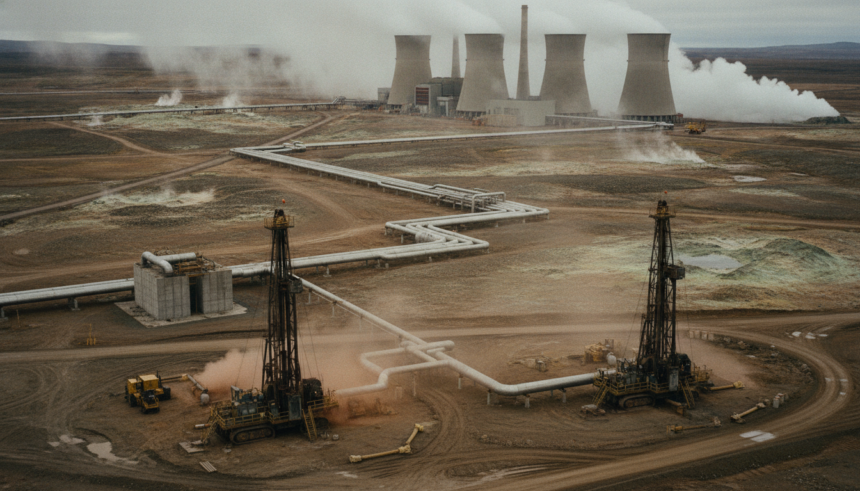
Enhanced geothermal systems create artificial reservoirs in hot, dry rock, circulate water through them, and use the heated fluid to drive turbines. Fervo drills paired horizontal wells deep into hot formations. It then uses hydraulic stimulation to open fractures that connect the wells. Water pumped down one well absorbs heat while flowing through the fractures and returns up the other well to generate electricity.
The water stays inside the system. Bill Gates singled out Fervo’s closed-loop water recirculation design after touring Cape Station. Water scarcity constrains energy development across the arid West, so a closed loop removes a common source of permitting friction.
Why Drilling Costs Fell by Nearly Half
Per-well drilling costs at Fervo fell from $9.4 million to $4.8 million, a reduction of about 49%, according to Society of Petroleum Engineers coverage. The cause is repetition. The shale industry cut its own costs by drilling standardized wells at scale, and Fervo applied that same learning curve to geothermal. Each well taught crews something that made the next one faster.
Drilling makes up a large share of geothermal project cost, so this decline flows directly into plant economics. The company now targets an all-in installed cost of about $5,500 per kilowatt. That figure is a Fervo target, not an audited result. This article does not compare it with solar, wind or nuclear costs, because the research behind it contains no verified figures for those technologies.
Cape Station Utah: First Power and What It Demonstrates
Cape Station synchronized to the grid and exported electricity on September 24, 2026. Fervo’s First Power announcement describes the project as the first utility-scale enhanced geothermal development to reach that milestone.
Cape Station sits in Beaver County, Utah, and is designed as a multi-gigawatt development. Phase I comprises roughly 100 MW from three 33-MW units that Fervo calls “GeoBlocks.” The first GeoBlock is ramping up, and commercial operations have begun supplying carbon-free electricity to Shell Energy.
First Power matters because it moves EGS from pilot data to grid operation. Lenders and utilities price risk based on operating history. A plant exporting power under contract therefore lowers the risk premium on every later project. CEO Tim Latimer framed the moment in sweeping terms, saying the milestone “establishes EGS as the defining new power generation technology of our time.”
That claim is ambitious. One GeoBlock ramping up does not yet show long-term reservoir performance. The meaningful evidence will come from sustained output over several years, because a declining reservoir would undercut the economics that the drilling cost reductions created.
The Fervo Google Deal, Nvidia, and Data Center Demand
Data center demand turned Fervo’s round-the-clock output into its most valuable feature. AI workloads run continuously, and the growth of data centers has strained the U.S. grid. Hyperscalers therefore pay a premium for clean power that does not depend on weather. Geothermal provides that dispatchable profile, while solar and wind need storage to match it.
Google’s 396-MW Commitment
In early September 2026, Fervo announced an agreement to supply Google with 396 MW from Cape Station for a potential data center in Utah. Deliveries are slated to begin in 2028. The deal builds on a March 2026 Geothermal Framework Agreement between the two companies, which covers up to 3 gigawatts of geothermal capacity by 2033. The September contract converts part of that framework into a specific, dated commitment. For Fervo, a creditworthy buyer of this size strengthens the case for financing later phases.
The Nvidia “EGS-Twin” Partnership
In June 2026, Fervo partnered with Nvidia and the Pacific Northwest National Laboratory (PNNL) to develop “EGS-Twin.” The platform is an AI-powered digital model that combines physics-based simulations with live field data to optimize drilling operations. The logic connects directly to costs. Better subsurface prediction means fewer wasted wells, so the tool targets the same learning curve that already cut per-well costs nearly in half.
What Bill Gates Says About Geothermal
Bill Gates has publicly raised his estimate of geothermal’s potential, and these are his personal views. He toured Cape Station alongside Utah Senator John Curtis and then wrote about the visit on Gates Notes:
“I used to think that geothermal would never be more than 5 percent of the global energy mix. But now I believe it could eventually supply up to 20 percent of the world’s electricity.”
— Bill Gates, Gates Notes
The revision is significant because Gates rarely moves a forecast by a factor of four. His reasoning follows the evidence covered above: falling drilling costs and the closed-loop water design address the two constraints that historically limited geothermal. Readers should treat the 20% figure as a long-range personal estimate. It is not a Breakthrough Energy projection or a Gates Foundation position.
2027–2028: The Execution Risks Ahead
Fervo’s next two years will test whether a single successful plant can become a repeatable manufacturing process. The company expects total capital expenditures of about $1.2 billion through Q1 2027. That spending is funded largely by IPO proceeds, which means the upsized raise directly sets the pace of construction.
The company has published three key milestones:
- GeoBlocks 2 and 3: expected to reach initial power in early 2027, completing Phase I
- Phase II: 400 MW across eight 50-MW GeoBlocks by 2028
- Google deliveries: the 396-MW supply begins in 2028
Phase II relies on Fervo’s “3.0 well design,” which the company says supports larger GeoBlocks. This adds technical risk. Scaling from 33-MW to 50-MW units depends on the new wells performing as designed.
Timing risk compounds technical risk. The Google contract and Phase II share a 2028 horizon. Delays in drilling, interconnection or supply chains would therefore pressure both the revenue schedule and public-market sentiment at once. The reservoir question noted earlier also persists: sustained output, not First Power alone, will determine whether the $5,500-per-kilowatt target holds up.
Lessons for Climate Tech Founders Seeking Breakthrough Energy Funding
Fervo’s capital stack shows that each stage of funding matched a specific type of risk. Founders who study the sequence can align their pitches more precisely.
First, the 2019 Series A funded technology risk. Breakthrough Energy Ventures backed an unproven method because it targeted a large emissions category and adapted tools that already worked in another industry. Second, the 2025 Catalyst financing funded deployment risk at a point when commercial lenders would not yet commit. Third, strategic investors such as Devon and Google brought operating expertise and demand, which made the later project finance easier to secure. Finally, public markets funded scale only after those earlier layers had reduced the uncertainty.
The lesson for founders like the persona researcher building energy storage is clear. Breakthrough Energy Ventures assesses technical potential and emissions scale, while Catalyst assesses project readiness. A pitch that confuses those two stages misreads how the platform invests.
Frequently Asked Questions
What is Fervo Energy?
It is a Houston-based developer of enhanced geothermal systems that went public on Nasdaq as FRVO in May 2026. The company adapts horizontal drilling and hydraulic fracturing from oil and gas to create reservoirs in hot rock. Its Cape Station project in Utah reached First Power on September 24, 2026.
How much did Fervo Energy raise in its IPO?
The base offering raised $1.89 billion by selling 70 million shares at $27 each on May 13, 2026. After underwriters exercised their over-allotment option, gross proceeds reached about $2.17 billion to $2.2 billion. The offering was upsized because demand linked to AI data center power needs exceeded the original target.
Did Bill Gates invest $1.89 billion in Fervo Energy?
No. The $1.89 billion came from IPO buyers, not from Bill Gates. His documented exposure runs through Breakthrough Energy Ventures, which led an $11 million Series A in 2019, and Breakthrough Energy Catalyst, which provided $100 million of a $206 million project financing in 2025. Neither investment came from the Gates Foundation.
How does enhanced geothermal work?
Enhanced geothermal drills paired wells into hot rock and stimulates fractures between them. Water then circulates through those fractures, picks up heat and returns to the surface to drive turbines. Fervo uses a closed-loop design that recirculates the water, which reduces water consumption in arid regions such as Utah.
Where is Cape Station?
Cape Station is in Beaver County, Utah. It is designed as a multi-gigawatt development. Phase I totals roughly 100 MW from three 33-MW GeoBlocks, and the first unit is now supplying Shell Energy. Fervo plans to add 400 MW in Phase II by 2028.
What is the Fervo Google deal?
In September 2026, Google agreed to buy 396 MW from Cape Station for a potential Utah data center, with deliveries starting in 2028. The contract builds on a March 2026 framework agreement covering up to 3 gigawatts of geothermal capacity by 2033. Google’s parent company, Alphabet, is also an investor in Fervo.
What is Fervo’s partnership with Nvidia?
In June 2026, Fervo partnered with Nvidia and the Pacific Northwest National Laboratory to build “EGS-Twin.” The AI-powered digital platform combines physics-based simulations with live field data to optimize drilling. Its purpose is to reduce wasted wells and extend the drilling cost reductions Fervo has already achieved.
How much does geothermal energy cost?
Fervo targets an all-in installed cost of about $5,500 per kilowatt. That target rests on per-well drilling costs falling from $9.4 million to $4.8 million. It is a company target, not an audited result. This article does not cite comparable figures for other technologies because no verified figures were available.
Is geothermal better than solar?
Geothermal and solar serve different roles. Geothermal produces power around the clock regardless of weather, which is why data center buyers value it. Solar generates only during daylight and needs storage to supply power continuously. A direct cost comparison requires verified figures that this article does not include.
Is Fervo Energy stock a good investment?
This article does not offer investment advice, and the right answer depends on your own risk tolerance. FRVO opened at $36 against a $27 IPO price. Its prospects depend on GeoBlocks 2 and 3 in early 2027, Phase II by 2028 and long-term reservoir performance. Consult a licensed financial advisor before investing.
Limitations of This Analysis
Research limitations: This analysis relies on company announcements, Gates Notes and financial and industry reporting from 2025 and 2026. None of these sources are peer-reviewed journals. Capacity targets, capex estimates and delivery dates are company projections. No verified post-debut share price was available, so none is stated. Long-term reservoir performance data does not yet exist, because Cape Station only began exporting power in September 2026.
Alternative approaches: Readers who want independent cost benchmarks should consult U.S. Department of Energy geothermal resources and technical papers presented at industry workshops. Comparing those sources with Fervo’s targets gives a fuller picture than company figures alone.
Professional consultation: Investors should speak with a licensed financial advisor before buying FRVO or other geothermal energy stocks. Founders seeking Breakthrough Energy funding should review the platform’s own published criteria, which are separate from Gates Foundation grant programs.
Conclusion
Fervo’s path from an $11 million Series A to a $1.89 billion IPO and grid-connected power followed a clear chain of cause and effect. Breakthrough Energy Ventures funded the technology risk, and Breakthrough Energy Catalyst funded the first deployment. Oil-field drilling methods cut per-well costs nearly in half. AI data center demand then turned 24/7 clean power into a premium product, which is why public markets and Google committed at scale.
The proof Fervo still needs is operational rather than financial. GeoBlocks 2 and 3 in early 2027, the 3.0 well design in Phase II and sustained reservoir output will show whether Cape Station marks the start of a scalable industry or remains a single success. For anyone tracking Bill Gates’s climate investments, Fervo is the clearest current case study of how staged, risk-matched capital can carry a technology from concept to the grid.
Read more of billgates.pk’s analysis of Breakthrough Energy’s portfolio and Bill Gates’s climate investment strategy.
References
- Fervo. (2025). Project financing announcement covering the $206 million package, including $100 million from Breakthrough Energy Catalyst. fervoenergy.com
- Fervo. (September 2026). Cape Station First Power announcement. fervoenergy.com
- Gates, B. (2026). Cape Station visit and geothermal outlook. Gates Notes. gatesnotes.com
- Society of Petroleum Engineers. (2025–2026). Industry coverage of geothermal drilling cost reductions. spe.org
- The Motley Fool. (May 2026). Market coverage of the FRVO IPO. fool.com
- The Economic Times. (May 2026). Reporting on the FRVO Nasdaq debut and valuation. economictimes.com
- Canary Media. (2026). Coverage of the Cape Station enhanced geothermal development. canarymedia.com