
Table of Contents
- Introduction: The Reading List That Signals a Strategy Change
- The 2026 Bill Gates Book Recommendations: Three Books and One Essay
- Culpability by Bruce Holsinger: AI Liability as Fiction
- 1929 by Andrew Ross Sorkin: Reading Systemic Collapse
- Gray Matters by Theodore Schwartz: Infrastructure Thinking
- "The Turbulent AI Era Is Here": The Essay Analysts Call Required Reading
- What Are "Credentials of Value"? The Definition and the 10-Million Target
- Why the Focus Shifted: AI, Degree ROI and a Closing Endowment
- Driver One: AI Removed the Entry-Level Stepping Stone
- Driver Two: Output Replaced Input as the Measure of a School
- Driver Three: The 2045 Deadline Forced Faster, Narrower Bets
- The $1 Billion AI Pledge and the $400 Million Tutoring Bet
- Micro-Credentials vs Degrees: What the Hiring Market Now Rewards
- How Gates Reads: The Method Behind the Recommendations
- What the Credentials Pivot Means for Grant Seekers and Institutions
- Frequently Asked Questions
- Limitations, Counterarguments and Alternative Views
- The Reading List Is the Strategy
- References
Key Takeaway
>
The 2026 bill gates book recommendations are three titles — Culpability by Bruce Holsinger, 1929 by Andrew Ross Sorkin and Gray Matters by Theodore Schwartz — published on his Summer 2026 reading list on July 17, 2026. His 6,000-word essay of August 26, 2026, “The turbulent AI era is here. The choices we make now are critical,” functions as a fourth recommendation. Meanwhile his education philanthropy has moved from four-year degree enrollment to “credentials of value,” with a North Star of 10 million learners aged 18–34 credentialed by 2045 and $400 million of a $1 billion AI pledge directed at AI tutoring.
[Image: Bill Gates book recommendations for 2026 shown as a three-title reading list covering AI ethics, financial history and medical science]
Introduction: The Reading List That Signals a Strategy Change
In 2026 Bill Gates recommended three books — Culpability, 1929 and Gray Matters — because each maps onto the forces now reshaping entry-level work. The bill gates book recommendations published on Gates Notes on July 17, 2026 came from Bruce Holsinger, Andrew Ross Sorkin and Theodore Schwartz respectively, and they landed in the same year his foundation replaced degree-enrollment goals with credential-attainment goals.
That convergence is the story. Because generative AI now performs the routine knowledge work that once justified hiring a graduate — slide decks, report formatting, first-draft analysis — the junior rung of the knowledge-work ladder has thinned, and a diploma alone no longer buys access to it. Gates’ reading choices and his funding choices therefore arrive at the same conclusion from different directions: verifiable skills are displacing generic degrees as the hiring signal employers trust. This article covers what the bill gates reading list 2026 actually contains, what “credentials of value” means in precise terms, where the money is going, and what the shift means for colleges, nonprofits and researchers who want a share of it. The gatesnotes book list is not a side hobby here. It is a readable preview of a funding thesis.
About this analysis
>
This article separates the institutional positions of the Bill & Melinda Gates Foundation from the personal views and reading preferences of Bill Gates, because the two are frequently conflated in coverage and only one of them governs grant decisions. All dates, dollar figures and named sources are attributed in the body text and listed in the References section.
Transparency note
>
billgates.pk is an independent publication. It is not affiliated with, endorsed by or funded by Bill Gates, the Gates Foundation or Breakthrough Energy. Funding amounts, eligibility terms and announced deadlines change; verify current details against the Foundation’s own published guidance before relying on them for an application.
The 2026 Bill Gates Book Recommendations: Three Books and One Essay
The Summer 2026 bill gates book recommendations ran to three titles, published on Gates Notes on July 17, 2026, extending a run of more than 240 books he has recommended publicly across roughly two decades of lists.
| Title | Author | Category | Why Gates picked it | Date recommended |
|---|---|---|---|---|
| Culpability | Bruce Holsinger | Fiction | AI liability and blame | July 17, 2026 |
| 1929 | Andrew Ross Sorkin | Nonfiction / financial history | How systems collapse | July 17, 2026 |
| Gray Matters | Theodore Schwartz | Nonfiction / medicine | Scientific infrastructure | July 17, 2026 |
| “The turbulent AI era is here” (essay) | Bill Gates | Essay, 6,000 words | AI and entry-level work | August 26, 2026 |
Culpability by Bruce Holsinger: AI Liability as Fiction
Gates named Culpability his top fiction pick for 2026 because the novel poses the liability question the next cohort of technology workers will be paid to answer. The plot turns on a fatal accident involving a self-driving car, and the book then refuses to let any single party off the hook — not the human in the seat, not the manufacturer, not the engineering team that shipped the software. Any Culpability Bruce Holsinger review that treats it purely as a family drama understates why Gates flagged it. He selected it as an ethics problem set in narrative form, which means students reading it are rehearsing a dispute that courts, regulators and insurers have not resolved.
1929 by Andrew Ross Sorkin: Reading Systemic Collapse
1929: Inside the Greatest Crash in Wall Street History—And How It Shattered a Nation took the top nonfiction slot, and the reasoning is defensive rather than historical. Students entering an AI-disrupted labour market need a working model of how interconnected systems fail — how leverage, optimism and institutional blind spots compound until a correction becomes a collapse. Because the mechanisms repeat even when the instruments change, Sorkin’s account functions as risk literacy rather than nostalgia. The effect of reading it alongside the AI essay is to make volatility legible as a pattern instead of a surprise.
Gray Matters by Theodore Schwartz: Infrastructure Thinking
Theodore Schwartz is a neurosurgeon, and Gray Matters is his account of what it actually takes to operate on a brain — the training, the equipment, the institutions and the handoffs. That is squarely inside Gates’ long-running preoccupation with delivery systems. The book rewards readers who want to understand how expertise, capital and process combine to produce an outcome, which is the same lens the Foundation applies to health and education programmes and the same lens that federal research bodies such as the National Institutes of Health use when funding clinical infrastructure rather than isolated discoveries.
“The Turbulent AI Era Is Here”: The Essay Analysts Call Required Reading
The fourth item is not a book. Gates published a 6,000-word essay, “The turbulent AI era is here. The choices we make now are critical,” on Gates Notes on August 26, 2026, and education analysts have treated it as required reading for students because it states the labour-market thesis directly. The bill gates ai essay introduces “Human Reserved” jobs — roles he argues should be deliberately protected for human judgement and presence — and cites the Stanford Digital Economy Lab’s payroll finding on young workers as the evidence that the disruption has already begun rather than merely approaching. That argument runs straight into the micro-credentials question examined further down this page.
What Are “Credentials of Value”? The Definition and the 10-Million Target
A credential of value is a degree, certificate or industry certification that demonstrably raises a learner’s earnings and is recognised by employers in a specific labour market. The Gates Foundation applies measurable wage gain — not completion alone — as the test, which is what distinguishes the term from the broader category of post-secondary certificates.
Allan Golston, president of the Foundation’s U.S. Program, announced the new North Star in July 2026: 10 million learners aged 18 to 34 earning credentials of value by 2045, as reported by Inside Higher Ed. Reaching that figure requires roughly doubling the current rate of credential growth. The consequence for the Foundation’s portfolio is structural: doubling a national rate cannot be achieved through a portfolio of individual campus pilots, therefore the gates foundation education strategy must now favour delivery models that replicate cheaply across institutions.
What qualifies a credential as a “credential of value”
- Demonstrable wage gain for completers against a comparable non-credentialed cohort
- Explicit employer recognition in a named industry or occupation
- Completion within a time and cost envelope that avoids heavy debt
- Verifiable outcome data the issuing institution can report
- A delivery model that can scale beyond a single campus or cohort
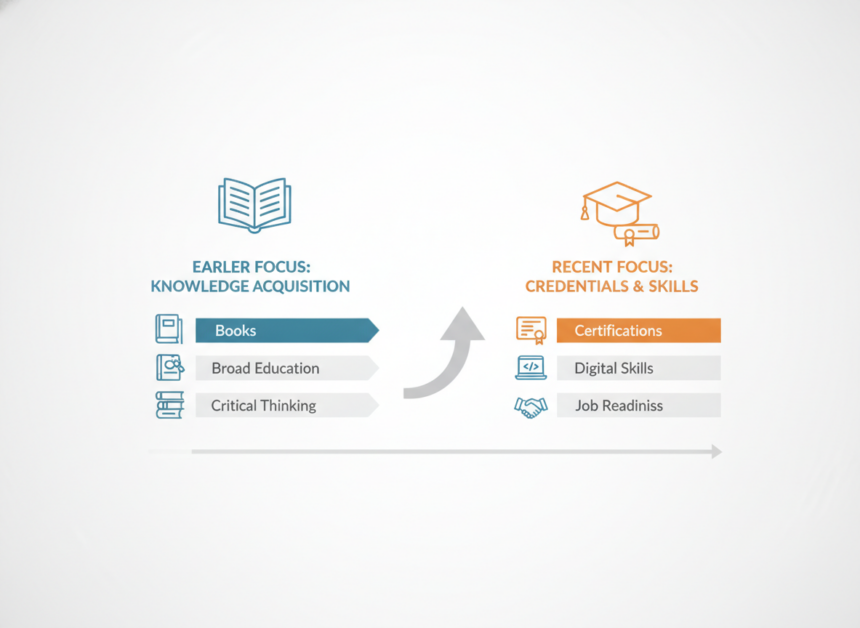
The narrowness is the point. Because a credential that fails to move wages produces no countable outcome before the Foundation closes its doors, the definition operates as a funding filter rather than a slogan — it tells grant seekers in advance which proposals cannot qualify. That is a sharp break from the earlier era, when broad enrolment and completion targets allowed a programme to report success by graduating students regardless of what the labour market subsequently paid them.
Why the Focus Shifted: AI, Degree ROI and a Closing Endowment
The pivot was not a change of heart about education. It was forced by three measurable pressures arriving at roughly the same time — a labour-market shock among young workers, a change in how Gates evaluates institutional performance, and a hard spend-down deadline that eliminated the luxury of open-ended reform.
Driver One: AI Removed the Entry-Level Stepping Stone
The clearest evidence sits in payroll records. A November 2025 analysis from the Stanford Digital Economy Lab, drawing on ADP payroll data, found a 16% relative employment decline for workers aged 22–25 in AI-exposed occupations. The mechanism is straightforward: AI agents now produce slide decks, formatted reports and first-draft analysis at something close to junior-professional quality, which means the task bundle that historically justified a graduate hire has thinned considerably. Because those tasks were also the training ground — the way a new hire learned the business while producing billable output — the ai impact on entry level jobs is compounding. A degree still signals capability, but it no longer purchases the first rung that converted capability into experience.
Driver Two: Output Replaced Input as the Measure of a School
Gates argued through 2026 that the education debate overweights “student input” — admissions selectivity, test scores, acceptance rates — and underweights “school output,” meaning whether graduates actually hold skills employers pay for. That reframing is not rhetorical. Because the Foundation underwrites programmes against measurable outcomes, redefining the measure directly changed what it will fund. Bill gates on college degrees is therefore less a verdict on institutions than a verdict on metrics: he has highlighted pathway models such as those at Chaffey College precisely because they report where completers end up. The resulting bill gates advice to students is to interrogate placement and wage data before enrolment, not prestige rankings.
Driver Three: The 2045 Deadline Forced Faster, Narrower Bets
In 2025 Gates committed the Foundation to spending an additional $200 billion and closing permanently on December 31, 2045. A finite window changes portfolio construction in a predictable direction: long-horizon systemic reform, whose payoff may arrive after the institution ceases to exist, gives way to interventions that produce countable results inside twenty years. That is why a 10-million-learner credential target replaced broader reform language. The same compression logic runs through Bill Gates’ climate tech and AI health investing strategy, where deployment timelines increasingly dictate which technologies attract capital, and where the scale and structure of Gates-linked investment vehicles can be checked against public filings with the U.S. Securities and Exchange Commission. The gates foundation closing 2045 date is not a footnote. It is the constraint that shapes every other decision.
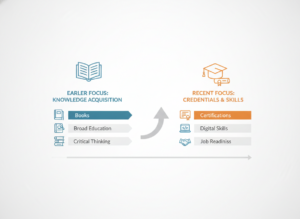
| Dimension | Earlier approach | 2026 approach |
|---|---|---|
| Headline metric | College enrolment and completion | Credentials of value earned |
| Target group | K-12 and college-bound students | Learners aged 18–34 |
| Success test | Degree attainment | Measurable wage gain |
| Primary delivery bet | Institutional reform | AI tutoring and short pathways |
| Time horizon | Open-ended | Closes December 31, 2045 |
The $1 Billion AI Pledge and the $400 Million Tutoring Bet
In September 2026 the Gates Foundation pledged $1 billion to U.S. AI development, of which $400 million — 40% of the total — was earmarked for AI-powered tutoring designed to help learners earn career-advancing credentials.
| Amount | Purpose | Date announced |
|---|---|---|
| $1 billion | U.S. AI development steered toward social infrastructure | September 2026 |
| $400 million | AI-powered tutoring for credential attainment | September 2026 |
| $200 billion additional | Total accelerated Foundation spend-down | 2025 |
| 10 million learners | Credentials-of-value North Star target | July 2026 |
| December 31, 2045 | Foundation ceases operations | 2025 |
[Image: Gates Foundation AI education funding breakdown showing the $1 billion pledge and $400 million AI tutoring allocation]
Tutoring absorbed the largest single slice for a cost reason rather than a technology-enthusiasm reason. Personalised instruction has historically been the most expensive component of credential delivery, because it scales linearly with staff hours — doubling the learners doubles the tutors. Software that reproduces even part of that function at near-zero marginal cost is consequently the only lever that plausibly reaches 10 million learners on a 2045 clock. The Foundation also framed the broader $1 billion as a deliberate steer: machine-learning capability has been pulled toward commercially lucrative applications, and the pledge directs capital instead toward social infrastructure that markets underfund. The gates foundation ai tutoring allocation is the sharpest expression of that intent.
The open question deserves stating plainly. The evidence base for AI tutoring producing credential completion gains at national scale remains thin relative to a $400 million commitment, and federal reporting from the U.S. National Science Foundation on AI research and STEM workforce trends provides a neutral benchmark for how much of this capability is established versus projected. Which means the pledge is best read as a bet on an unproven delivery channel rather than the purchase of a proven one. That is a defensible use of philanthropic capital — risk-taking is what distinguishes it from government procurement — but grant seekers and institutions should understand they are being invited into an experiment.
Micro-Credentials vs Degrees: What the Hiring Market Now Rewards
Gates has not written off the bachelor’s degree. His position is narrower: two-thirds of U.S. jobs will require education beyond high school by the late 2020s, but the credential proving that education no longer has to take four years or carry four years of debt.
| Dimension | Micro-credential | Four-year degree |
|---|---|---|
| Typical duration | Weeks to 12 months | 4 years |
| Typical cost | Low to moderate | High, often debt-financed |
| Employer signal | Specific, occupation-tied | Broad, general |
| Portability across industries | Limited | High |
| Licensure access | Rarely | Frequently required |
| Quality variance by issuer | High | Regulated by accreditation |
“Human Reserved” jobs, defined: In his August 2026 essay Gates describes “Human Reserved” jobs as roles deliberately protected for human empathy, judgement and presence, analogous to nature reserves set aside from development. Care work, teaching, skilled trades and frontline health roles sit inside the reserve because the service itself depends on a person being there.
Pathways Gates’ argument points students toward
- Allied health and frontline care roles, where human presence is the service
- Skilled trades and electrification work tied to energy infrastructure build-out
- Teaching, coaching and early-childhood roles inside the “Human Reserved” category
- AI-adjacent technical work — deployment, auditing and oversight rather than routine output
- Stackable community college certificates with published wage outcomes
The counterweight matters as much as the argument. Degrees still carry portability across industries, alumni networks and licensure access that stacked certificates do not replicate, and clinical pathways in particular remain gated by accredited qualifications of the kind documented in NIH workforce and training guidance. Micro-credential quality also varies sharply by issuer, because the category has no single accreditation standard. The defensible position is therefore sequencing rather than substitution: earn a credential that moves wages now, keep degree completion available as a later option, and treat skills based hiring 2026 as an addition to the hiring signal rather than a replacement for it. That sequencing is precisely what the Foundation’s own wage-gain test rewards.
How Gates Reads: The Method Behind the Recommendations
Gates reads roughly 50 books a year — about one a week — and has recommended more than 240 titles through his Gates Notes lists since the mid-2000s. The volume is a product of method rather than reading speed: he protects long blocks and finishes what he starts, which converts a demanding habit into a routine.
- Block a protected hour or more, so the session is long enough to hold a full argument in mind.
- Read cover to cover — he finishes books he starts, which forces engagement with the weaker sections instead of skimming past them.
- Annotate the margins while reading, arguing with the author in writing rather than passively highlighting.
- Read several books on the same subject before forming a position, so no single author sets the view.
Connect that method to the output and the 2026 list stops looking like a set of unrelated enthusiasms. Because he reads multiple books on a subject before committing to a view, his bill gates reading habits produce lists that cluster around themes — in 2026, AI responsibility and systemic fragility — which means the list doubles as a map of where his attention, and consequently the Foundation’s remaining capital, is heading next. The margin-note discipline matters too: it is why his public summaries tend to name the specific argument he disagreed with.
What the Credentials Pivot Means for Grant Seekers and Institutions
The practical effect of the pivot is evidentiary. Proposals that cannot report wage outcomes and completion data for a named learner cohort no longer fit the U.S. Program’s North Star, which means data infrastructure has become part of the ask rather than an administrative afterthought.
What education proposals now have to show
- Measurable wage gain for credential completers, not completion counts alone
- Employer partners who confirm the credential is recognised in hiring
- Learner-level completion and persistence data the institution can report
- A delivery model that scales beyond one campus or cohort
- A focus on the 18–34 age band named in the North Star goal
- A plan that produces evidence well before the 2045 closure date
The sequence matters as much as the substance. The Gates Foundation does not operate an open education grant window for most programmes; it works through named partners, requests for proposals and intermediary organisations, often alongside research universities such as the University of Washington that supply the measurement capability. Therefore the realistic route for a newcomer is to build a documented outcome record first and partner with an institution already inside the portfolio second. Community colleges publishing verified wage-gain data are the clearest current example of that positioning, and understanding how Gates Foundation funding priorities are set is the difference between a proposal that fits the filter and one that never reaches review.
Frequently Asked Questions
What books does Bill Gates recommend students read in 2026?
The 2026 bill gates book recommendations are Culpability by Bruce Holsinger, 1929 by Andrew Ross Sorkin and Gray Matters by Theodore Schwartz, published on his Summer 2026 list on July 17, 2026. His 6,000-word essay of August 26, 2026, “The turbulent AI era is here,” functions as a fourth item because education analysts treat it as the clearest statement of how AI is reshaping entry-level work.
What does Bill Gates mean by “credentials of value”?
A credential of value is a degree, certificate or industry certification that measurably raises earnings and is recognised by employers in a named labour market. The Gates Foundation applies wage gain rather than completion as the test. Because a credential that fails to move wages produces no countable outcome, the term operates as a funding filter that screens proposals before review.
Why has Bill Gates shifted his focus from college degrees to credentials?
Because AI has removed much of the routine junior work that degrees used to buy access to. The Stanford Digital Economy Lab found a 16% relative employment decline for workers aged 22–25 in AI-exposed occupations in its November 2025 ADP payroll analysis. The Foundation’s December 31, 2045 closure date is the second forcing factor, since it rewards interventions with countable near-term outcomes.
How much has the Gates Foundation pledged to AI in education?
$1 billion, pledged in September 2026 for U.S. AI development, with $400 million earmarked for AI-powered tutoring that helps learners earn credentials. Tutoring took the largest single slice because personalised instruction is the costliest component of credential delivery, and software is the only lever that reduces its per-learner cost at national scale.
Is a four-year degree still worth it according to Bill Gates?
Yes for many fields, but no longer by default. Gates maintains that two-thirds of U.S. jobs will require education beyond high school by the late 2020s, while arguing that proof of skill matters more than programme length. Degrees retain real advantages — licensure access, cross-industry portability and accredited quality control — that stacked micro-credentials do not reliably replicate.
How many books does Bill Gates read each year?
Roughly 50 books a year, about one per week, with more than 240 titles recommended publicly through Gates Notes. The volume comes from routine rather than speed: protected hour-long blocks, cover-to-cover reading, and margin annotations written as an argument with the author. He also reads several books per subject before forming a position.
What are “Human Reserved” jobs in Bill Gates’ AI essay?
Roles deliberately preserved for human empathy, judgement and presence, which Gates compares to nature reserves set aside from development. He introduced the concept in his 6,000-word essay of August 26, 2026. Named examples include care work, teaching, skilled trades and frontline health roles, because in each the human presence is the service being purchased.
Which jobs are most exposed to AI for workers aged 22 to 25?
Entry-level knowledge roles built on routine output — report formatting, slide production, first-draft analysis, basic coding and administrative coordination. The Stanford Digital Economy Lab’s November 2025 ADP payroll study found a 16% relative employment decline in AI-exposed occupations for that age band, because AI agents now deliver that output at junior-professional quality.
When is the Gates Foundation closing and why does that matter for education funding?
December 31, 2045, following the 2025 commitment to spend an additional $200 billion. It matters because a finite window pushes funding toward interventions that produce measurable outcomes inside twenty years. That compression is why a 10-million-learner credential target replaced open-ended system reform as the stated U.S. education goal.
How can colleges or nonprofits get Gates Foundation funding for credential programmes?
Through named partnerships, requests for proposals and intermediary organisations rather than a general open application window. Proposals now need wage-gain data, employer confirmation that the credential is recognised in hiring, learner-level completion records, and a delivery model that scales for learners aged 18–34. Eligibility rules and open calls change, so verify current terms on the Foundation’s own site.
Limitations, Counterarguments and Alternative Views
Readers deserve to know where this analysis stops and where credible disagreement begins.
- A reading list reflects Bill Gates’ personal interests and is not a Gates Foundation programme position; the two should not be read as a single policy statement.
- The Stanford Digital Economy Lab finding measures relative employment decline in AI-exposed occupations and does not establish that AI alone drove it, because interest-rate movements and broader hiring corrections overlapped the same period.
- Evidence that AI tutoring raises credential completion at national scale remains limited relative to the $400 million committed, which means the outcome is genuinely uncertain rather than merely unannounced.
- Higher-education researchers argue micro-credential quality varies sharply by issuer and that stacked certificates do not reliably substitute for degrees in licensed professions, therefore the pivot carries real risk for students who abandon degree pathways early.
- Funding amounts, eligibility terms and announced dates change; readers planning applications should verify current details against the Gates Foundation’s own published guidance.
The Reading List Is the Strategy
The three titles on the 2026 list describe the same world the credentials pivot was built for. Culpability asks who answers when an autonomous system kills someone; 1929 shows how interconnected systems unravel faster than their participants expect; Gray Matters examines what institutional infrastructure must exist before expertise produces an outcome. Read together, they describe a labour market where liability, fragility and delivery capacity matter more than pedigree — which means the reading list functions as a map of where the Foundation’s remaining capital is heading before December 31, 2045.
For students, institutions and grant seekers, the practical takeaway from the bill gates book recommendations is consistent with the funding data: read for the systems argument rather than the plot, build the outcome evidence before you need it, and target credentials with verifiable wage gain in a named labour market. Read more about how Gates Foundation funding priorities are set at billgates.pk.
References
- Gates Notes — Summer 2026 reading list — primary source for the three 2026 titles, their authors and Gates’ stated reasons; published July 17, 2026.
- Gates Notes — “The turbulent AI era is here. The choices we make now are critical” — 6,000-word essay published August 26, 2026, introducing “Human Reserved” jobs.
- Inside Higher Ed — trade press reporting on Allan Golston’s July 2026 announcement of the 10 million learners aged 18–34 credentials-of-value goal by 2045.
- Stanford Digital Economy Lab — November 2025 analysis of ADP payroll data finding a 16% relative employment decline for workers aged 22–25 in AI-exposed occupations.
- U.S. National Science Foundation — federal reporting on the state of AI research, STEM workforce trends and public R&D priorities.
- National Institutes of Health — federal research and workforce context for AI in clinical and biomedical settings and for allied-health training pathways.
- University of Washington — example of the research-university partnership environment through which Gates Foundation education and health funding is delivered and measured.
- U.S. Securities and Exchange Commission — public disclosure filings used to verify the scale and structure of Gates-linked investment vehicles.