
Table of Contents
- What the $118 Million Rwanda Result Actually Measures
- The portfolio-wide numbers behind the headline
- Inside the AI Virtual Agronomist
- Why the tool only became possible in 2025
- The 2026 AgTech Strategy and What Comes Next
- Climate finance and the Netherlands SPV
- Why This Matters for the Gates Foundation's Wider Model
- Frequently Asked Questions
- Limitations of This Analysis
- Conclusion
- References
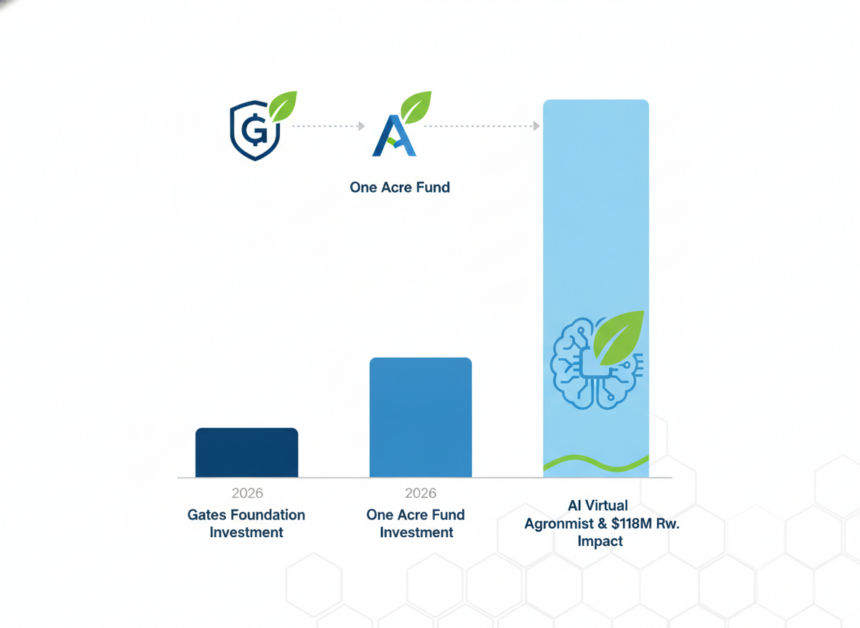
Key Takeaway: One Acre Fund generated $118 million in new profits for Rwandan farmers in a single year (2025), a result driven by connecting its field network to Rwanda’s national digital farmer registry and subsidy system. With Gates Foundation backing, the organisation now runs an AI Virtual Agronomist that answers farmers’ questions over WhatsApp using localised soil and hyper-local weather data. Across all operating regions it served 5.6 million farmers in 2025, with core clients gaining an average of $115 to $120 in new income and assets — roughly 35% more income on planted land than non-client farmers.
When Bill Gates travelled to Rwanda and then wrote up what he saw in July 2026, the number he chose to lead with was not a technology metric. It was $118 million — the new profit Rwandan smallholder farmers generated in one year through their participation in a single agricultural programme. That framing matters, because it shifts the conversation about agricultural philanthropy away from inputs delivered and towards money that actually landed in farmers’ hands.
The mechanism behind that figure is less glamorous than the headline suggests, and considerably more instructive. The profits were not produced by a breakthrough seed or a novel fertiliser. They came from plumbing: connecting an on-the-ground delivery organisation to a government database. Rwanda had already built a national digital farmer registry and a subsidy system. The organisation had already built a last-mile distribution network. Linking the two meant subsidised inputs reached the right farms at the right time, and that logistical precision is what converted into yield and then into income.
This article breaks down both halves of the 2026 story — the Rwanda economics and the AI Virtual Agronomist that the Gates Foundation showcased alongside partners TomorrowNow, iSDA and Aim for Scale — and explains why the two are connected rather than parallel.
About this analysis: This article is produced by the editorial team at billgates.pk, which tracks Gates Foundation and Breakthrough Energy funding, climate technology and AI health investment. Our coverage follows the money and the measurable outcome: amounts, timelines, recipients and deadlines, with the Foundation’s institutional positions kept distinct from Bill Gates’ personal commentary.
Transparency note: All figures here are drawn from reporting on Bill Gates’ July 2026 Rwanda commentary and One Acre Fund’s own 2025 impact and operational disclosures. We have not independently audited the organisation’s accounts or run our own farm-level measurement. Where a number is an organisational self-report rather than an external evaluation, we say so in the text. Nothing in this article is investment or grant-application advice.
What the $118 Million Rwanda Result Actually Measures
The $118 million represents new profits generated in 2025 by Rwandan farmers enrolled in the programme — not revenue, and not the value of goods distributed to them. That distinction is the reason the figure carries weight. Profit is what remains after farmers have paid for seed, fertiliser and labour, which means the number already absorbs the input costs that squeezed margins elsewhere in the portfolio during the same year.
The driver was integration rather than invention. Rwanda operates a national digital farmer registry and a subsidy system that identifies who farms what, and where. By connecting that government dataset directly to localised agricultural support, the programme optimised resource distribution — subsidised inputs flowed to the plots that could use them, in the planting window when they mattered. As a result, crop yields rose, and because the inputs were subsidised and targeted rather than broadly sprayed across a population, the cost side stayed contained. The effect of pairing public digital infrastructure with a private delivery network was a margin improvement at national scale.
This is the part of the story most relevant to anyone studying how Gates Foundation money is deployed. The Foundation did not fund a new product in Rwanda. It funded the conditions under which an existing registry and an existing field operation could talk to each other. Consequently, the return per philanthropic dollar is a function of infrastructure that the Rwandan government had already paid to build.
The portfolio-wide numbers behind the headline
Rwanda is one country in a multi-country operation, and the aggregate figures give the $118 million its context. Across all operating regions, the organisation reported serving 5.6 million farmers in 2025.
| Metric (2025) | Reported figure |
|---|---|
| New profits, Rwandan farmers | $118 million |
| Farmers served, all regions | 5.6 million |
| New income and assets per core client | $115–$120 |
| Income uplift on planted land vs. non-clients | ~35% |
| Year-over-year impact improvement | 10–17% |
The per-farmer figure of $115 to $120 looks modest in isolation and is anything but for the household receiving it. For smallholders living on less than $1 a day, an additional $115 to $120 in income and assets is a change in economic category rather than a marginal gain. Initial impact assessments indicate that core clients earned roughly 35% more income on planted land than comparable non-client farmers — a differential that compounds, because the surplus funds the following season’s inputs.
The honest caveat is that 2025 did not go uniformly well. The 10–17% year-over-year impact improvement was held back by high input costs, driven by inflation, and by low maize prices. Input inflation raises the cost of the package farmers buy on credit; weak maize prices reduce what they earn when they sell. Squeezed from both ends, the margin narrowed even as the operational delivery improved. That pressure is the direct reason for the 2026 strategic pivot described below.
Inside the AI Virtual Agronomist
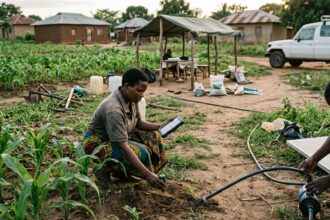
The AI Virtual Agronomist is a generative AI tool that answers farmers’ specific agricultural questions over WhatsApp. It exists because the economics of human agronomy do not scale: a field officer can serve a few hundred farmers, and the organisation serves millions. Therefore the only route to personalised advice at 5.6 million-farmer scale is software.
What separates the tool from a generic chatbot is the data it reaches for. Instead of returning textbook guidance, it pulls real localised data on the farmer’s specific soil conditions and hyper-local weather forecasts before answering. The practical consequence is that two farmers in neighbouring districts asking the same question about fertiliser timing receive different answers, because their soils and their forecast rainfall differ. Generic advice delivered at scale produces generic outcomes; data-grounded advice delivered at scale is what moves yields.
The partner list explains how that data is assembled. The development and deployment of the AI Virtual Agronomist were showcased alongside the Gates Foundation, TomorrowNow, iSDA and Aim for Scale. Each contributes a layer the delivery organisation does not build itself:
- TomorrowNow — weather and climate data for the hyper-local forecasting layer
- iSDA — soil data, enabling field-specific rather than regional recommendations
- Aim for Scale — scaling methodology for proven agricultural interventions
- Gates Foundation — funding and convening power across the partnership
The WhatsApp delivery choice is the quietly decisive design decision. Building a dedicated app would have required farmers to download, learn and retain a new piece of software on constrained handsets and expensive data plans. WhatsApp is already installed and already understood, which means adoption friction collapses to roughly zero. As a result, the distribution problem that typically defeats rural AgTech was solved by refusing to create one.
Why the tool only became possible in 2025
The AI layer sits on top of an infrastructure overhaul that most coverage skips. In 2025, One Acre Fund completed “Project Evolution,” migrating all country programmes onto a unified, highly customisable digital platform and retiring fragmented legacy systems.
That migration did two things. It lowered the per-farmer delivery cost, because one platform is cheaper to run than several incompatible ones. More importantly, it created a single data environment into which AI tools could be plugged. An AI agronomist needs to know who the farmer is, what they planted, where their plot sits and what they bought — and that is impossible when the records live in separate country-level systems that do not share a schema. Consequently, the unglamorous 2025 database work is the precondition for the 2026 AI headline, not a footnote to it.
The 2026 AgTech Strategy and What Comes Next
The 2026 strategy is a direct response to the 2025 margin squeeze. Because high input costs and low maize prices compressed returns, the organisation is prioritising a focused AgTech strategy built around more precise agronomy and weather-informed guidance, including Digital Weather Advisory Services.
The logic is straightforward. When inputs are expensive, precision becomes more valuable than volume — a farmer who applies the right quantity at the right moment extracts more from each costly bag of fertiliser than one following a generic calendar. Weather-informed guidance attacks the same problem from the timing side, because planting or top-dressing immediately before unexpected rain wastes both the input and the labour. Therefore the AgTech investment is not a technology enthusiasm; it is a margin-defence measure against input inflation.
Climate finance and the Netherlands SPV
A second 2026 workstream addresses funding structure rather than farming. The organisation is finalising an off-balance-sheet Special Purpose Vehicle in the Netherlands designed to attract institutional investors, and expects to serve over 50,000 cumulative farmers through carbon projects by the end of 2026.
The structural reasoning is worth spelling out for anyone modelling how impact organisations raise capital. Institutional investors cannot typically deploy into a non-profit balance sheet, because their mandates require defined financial instruments and ring-fenced risk. An off-balance-sheet SPV creates that instrument, which means carbon-project capital can be sourced from pension-scale pools rather than from philanthropic grants. The effect is to free grant funding for work that generates no carbon revenue, while the tree-planting and soil-carbon activity funds itself.
| 2026 initiative | Stated objective |
|---|---|
| Focused AgTech strategy | Precise agronomy, weather-informed guidance |
| Digital Weather Advisory Services | Timing guidance against input waste |
| Netherlands SPV | Attract institutional investors |
| Carbon projects | 50,000+ cumulative farmers by end of 2026 |
Why This Matters for the Gates Foundation’s Wider Model
The Rwanda result reads as a template rather than an isolated success, and the template has three components: existing public digital infrastructure, an operator with genuine last-mile reach, and an AI layer that makes expert advice marginally free to deliver. Rwanda supplied the first, One Acre Fund supplied the second, and the Gates Foundation-backed partnership with TomorrowNow and iSDA supplied the third.
What makes the model replicable is that the expensive component — the national farmer registry — is increasingly common across African governments investing in digital public infrastructure. Where a registry exists, the integration cost is low relative to the $118 million outcome. Where it does not, the sequence has to start earlier, which is slower and considerably less photogenic in a foundation report.
The constraint is equally clear. This approach demonstrates strong results in a country with high state capacity, dense population and a functioning subsidy system. Rwanda scores well on all three. Extrapolating the same per-farmer economics to settings with weaker registries or thinner road networks would overstate what the model delivers, and the research available does not support that extrapolation.
Frequently Asked Questions
What is the AI Virtual Agronomist?
It is a generative AI tool that answers farmers’ agricultural questions over WhatsApp. Rather than offering generic guidance, it pulls localised soil data and hyper-local weather forecasts to tailor each response. It was developed and showcased with the Gates Foundation, TomorrowNow, iSDA and Aim for Scale, and uses WhatsApp because farmers already have it installed.
How did Rwandan farmers generate $118 million in new profits?
The $118 million in new profits was recorded in 2025 and came from integrating One Acre Fund’s field support with Rwanda’s national digital farmer registry and subsidy system. Connecting government data to localised agricultural delivery optimised resource distribution, resulting in higher crop yields and better-targeted subsidised inputs reaching the right farms within the planting window.
How many farmers does the programme reach?
It reported serving 5.6 million farmers across all operating regions in 2025. Initial impact assessments indicate core clients generated an average of $115 to $120 in new income and assets per farmer, representing roughly 35% more income on planted land compared with non-client farmers — a substantial margin for households living on under $1 a day.
What was “Project Evolution”?
Project Evolution was a technology infrastructure overhaul completed in 2025 that migrated all country programmes onto a unified, highly customisable digital platform, replacing fragmented legacy systems. It lowered the per-farmer delivery cost and created the single data environment required for AI tools to function, which means it was the precondition for the AI Virtual Agronomist.
Why is a Special Purpose Vehicle being set up in the Netherlands?
The off-balance-sheet SPV is being finalised to attract institutional investors into carbon projects, with over 50,000 cumulative farmers expected to be served through those projects by the end of 2026. Institutional mandates generally require defined financial instruments, therefore an SPV makes this capital accessible in a way a non-profit balance sheet does not.
Limitations of This Analysis
Research limitations. Several of the headline figures — including the 5.6 million farmers served, the $115 to $120 per-client gain and the 10–17% year-over-year impact improvement — are organisational self-reports and initial impact assessments rather than independently audited or peer-reviewed evaluations. The 35% income uplift on planted land is described as an initial assessment against non-client farmers, and comparison-group construction materially affects such estimates. We have also not seen a published methodology for how the $118 million in new profits was calculated, which means readers should treat it as a credible organisational figure rather than a verified accounting result.
Alternative approaches. Input-and-advice bundling is one model among several. Cash transfers, crop insurance, market-linkage and post-harvest storage programmes each address smallholder income through different mechanisms, and the available research does not establish that any one approach outperforms the others across all contexts. The Rwanda result reflects a country with unusually strong digital public infrastructure, so it is not a general proof that the model transfers unchanged elsewhere.
Professional consultation. This article is editorial analysis, not funding, investment or agricultural advice. Organisations seeking Gates Foundation support should work from the Foundation’s own published eligibility criteria and application processes, and investors evaluating structures such as the Netherlands SPV should obtain independent legal and financial counsel.
Conclusion
The 2026 story is a pivot from traditional agricultural aid to data-driven delivery, and the $118 million Rwanda figure is the clearest evidence so far that the pivot produces measurable household income rather than activity reports. The causal chain is legible from end to end: a national farmer registry made targeting possible, Project Evolution made the data usable, and the AI Virtual Agronomist made expert advice cheap enough to give 5.6 million farmers individually.
The pressures are equally legible. Input cost inflation and weak maize prices held 2025 gains to a 10–17% improvement, which is precisely why the 2026 agenda leads with precision agronomy, Digital Weather Advisory Services and a Netherlands SPV to bring institutional capital into carbon projects. Each of those is a response to an identified constraint rather than a general ambition.
For researchers, founders and funders studying how Gates Foundation capital converts into outcomes, the lesson is that the decisive investment was infrastructure — a registry and a database migration — not the AI that sits on top of it.
Read more of our analysis of Gates Foundation and Breakthrough Energy funding, climate technology and AI health investment at billgates.pk.
References
- Bill Gates, Gates Notes — commentary following his July 2026 Rwanda visit, including the $118 million new-profit figure and the AI Virtual Agronomist. gatesnotes.com
- One Acre Fund programme and 2025 impact reporting — farmers served, per-client income and assets, and operational developments. globalgiving.org
- Google Search news aggregation, October 2026 — “Bill Gates Highlights One Acre Fund’s AI-Powered Virtual Agronomist and $118 Million Farmer Profits in Rwanda.”