
Table of Contents
- Introduction: Two Memos, Thirty-One Years Apart
- What Was the 'Internet Tidal Wave' Memo? (26 May 1995)
- The Five Signals Gates Looked For in 1995
- 'The Turbulent AI Era Is Here': Gates' August 2026 Essay Decoded
- The 20-Year Upheaval: Bill Gates AI Predictions on Work
- What Gates Says Stays Human
- Gates vs Altman vs Nadella: Three Readings of the Same Inflection
- Gates Foundation AI Principles and Where the Money Goes
- How to Apply: Eligibility and Deadlines
- The Same Recognition Pattern in Climate Tech Investment
- Frequently Asked Questions
- Limitations of These Forecasts — and the Alternative Readings
- What This Means for Researchers, Founders and Funders
- References
Key Takeaways
>
- Bill Gates AI predictions rest on the same test he applied in his 26 May 1995 “Internet Tidal Wave” memo: a technology matters when it rewrites the rules of an entire category, not when it improves one product.
- In “The Turbulent AI Era Is Here” (GatesNotes, 26 August 2026) Gates wrote that “this time really is different”, because AI pressures highly educated work rather than creating replacement categories.
- In a Dekoder interview on 24 October 2026 he forecast up to 20 years of severe disruption with clear winners and losers.
- He expects the sharpest shock when AI reaches “nearly error-free work” and runs without human oversight, which is what justifies headcount cuts.
- He reserves childcare, food preparation, art and sport for humans, and expects the transition to end in “true abundance”.
Introduction: Two Memos, Thirty-One Years Apart
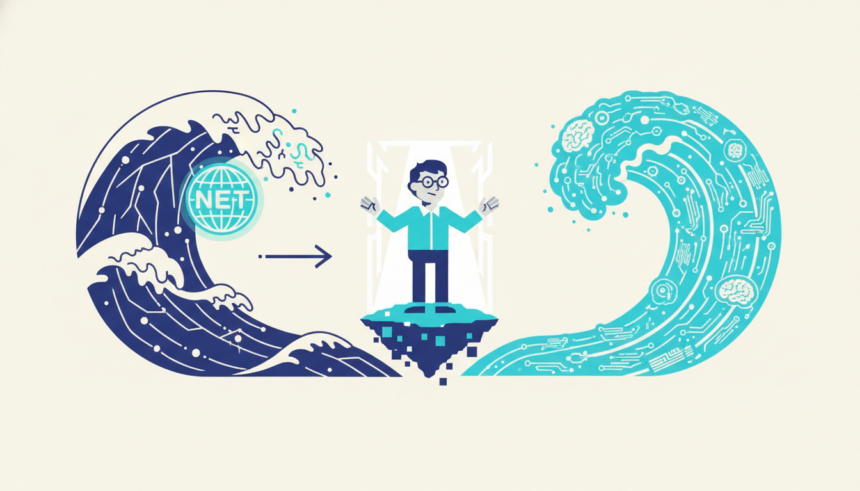
Bill Gates AI predictions follow one consistent test — he judges a technology by whether it rewrites the rules of an entire category. He applied that test to the internet on 26 May 1995 and to artificial intelligence in his 26 August 2026 essay for GatesNotes.
Those two dates matter more than any single quotation, because Gates’ position has moved. The 1995 document was an internal Microsoft memo distributed to executive staff; the 2026 document is a public GatesNotes essay titled “The Turbulent AI Era Is Here”. Undated summaries of his view are therefore unreliable — the man who described AI as the start of a new computing age in 2023 is now attaching explicit conditions to that optimism, and a reader who collapses the two into one position will misread both.
This article works through five things: the recognition framework behind the 1995 memo, the labour forecast Gates set out in August and October 2026, where his reading diverges from Sam Altman’s and Satya Nadella’s, what the Bill & Melinda Gates Foundation published in its 20 October 2026 AI principles, and what each of those means in practice for researchers and organisations preparing funding applications.
About the author
Written by the editorial analysis desk at billgates.pk, which has tracked Gates Foundation grant-making and Breakthrough Energy capital flows across global health, climate technology and AI deployment, including comparative analysis of grant calls and investment criteria for applicants. Method: every claim in this article is traced to a dated primary publication — GatesNotes essays, gatesfoundation.org releases and recorded interviews. Reviewed and last updated 29 October 2026.
Disclosure: billgates.pk is an independent editorial site and is not affiliated with, endorsed by, or operated by Bill Gates, the Bill & Melinda Gates Foundation, Breakthrough Energy or Microsoft. Forecasts attributed to Bill Gates are his stated views, not predictions by this publication. Funding eligibility and deadline details change; readers should confirm details against gatesfoundation.org before applying.
What Was the ‘Internet Tidal Wave’ Memo? (26 May 1995)
The Internet Tidal Wave was a roughly 3,000-word internal memo Bill Gates sent to Microsoft executive staff on 26 May 1995. It carried a single instruction: assign the internet the highest level of importance across every product line, every group and every planning cycle, rather than treating it as one initiative among many.
The consequence came from the mechanism, not the rhetoric. Because Gates reassigned existing engineering resources instead of commissioning a separate internet product alongside the Windows roadmap, browser development moved inside the operating system release process. Internet Explorer consequently shipped within Windows builds, which converted Microsoft’s installed-base distribution — then the company’s single strongest asset — directly into browser share. The lesson for anyone reading his AI commentary is that the memo did not win an argument about technology; it redirected where the engineers sat, and the market outcome followed from that reallocation.
“The Internet is a tidal wave. It changes the rules.”
— Bill Gates, “The Internet Tidal Wave”, internal Microsoft memo, 26 May 1995
The bill gates memo 1995 is routinely called the most important memo in Microsoft history for a narrow and defensible reason: it is the documented case of Gates acting on a category rewrite before market consensus had formed. In mid-1995 the dominant commercial read was still proprietary online services, not the open web. He committed the company’s scarce capacity to the opposite conclusion. That behaviour — early reallocation rather than early commentary — is precisely what to watch for in his 2026 statements, because the test he applied to the internet is the test he says AI now passes.
The Five Signals Gates Looked For in 1995
The memo’s logic reduces to five observable signals, each of which describes a measurable change rather than a sentiment about the future.
The five signals behind the 1995 memo
- Adoption slope — usage is compounding rather than growing linearly, which means projections based on the current year understate the next one.
- Cost curve collapse — the price per unit of capability falls fast enough to open use cases that were previously uneconomic.
- Developer migration — the people who build on top of platforms move first, because their switching decision is a leading indicator of where applications will exist.
- Distribution control — whoever owns the default channel captures the demand, which is why Gates fought over defaults rather than features.
- Rule rewriting — the incumbent business model stops explaining who wins, which is the point at which incumbency becomes a liability.
The order matters because each signal becomes decisive only once the previous one has appeared. A cost curve that collapses without developer migration produces a cheap technology, not a rewritten category — plenty of hardware has become inexpensive without displacing anything. Equally, developer enthusiasm without distribution control produces interesting products that never reach default status. Gates acted in 1995 because all five were visible at once, and the same stacking argument underpins how he reads generative AI three decades later.
‘The Turbulent AI Era Is Here’: Gates’ August 2026 Essay Decoded
On 26 August 2026, Gates published “The Turbulent AI Era Is Here” on GatesNotes, declaring that society has entered an epochal shift and writing plainly that “this time really is different”. The most quotable finding in the essay is a rejection of the standard reassurance: the Industrial Revolution analogy fails in his reading, because earlier transitions created new categories of work to absorb displaced labour, whereas AI’s trajectory targets highly educated work directly. That argument marks a real distance from the bill gates ai predictions of 2023, which emphasised the opportunity and left the transition cost largely unexamined.
The mechanism he describes is narrower than the headlines suggest. Previous waves displaced manual tasks and generated cognitive ones, so displaced workers had an upward route: the factory hand’s child became the clerk, and the clerk’s child became the analyst. AI compresses the cognitive tier itself, which means the reallocation route that absorbed earlier shocks is substantially narrower. Consequently the burden of adjustment falls on exactly the cohorts — graduates, professionals, knowledge workers — whose education was the historical insurance policy against automation.
“This time really is different.”
— Bill Gates, “The Turbulent AI Era Is Here”, GatesNotes, 26 August 2026
He now labels his stance “optimism with footnotes”, and the phrase is more precise than it first appears. Gates continues to expect AI to accelerate disease elimination and climate solutions, which is why the end state in his writing remains positive. The footnotes are conditions: government oversight and social safety nets. He has moved the open risk from the destination to the journey, treating the transition cost rather than the eventual productivity gain as the variable society has not yet solved for.
Where Gates set out his 2026 AI position: the primary sources
| Publication or appearance | Date | Core claim |
|---|---|---|
| “Year Ahead” letter, GatesNotes | January 2026 | Under-five deaths rose from 4.6m (2024) to 4.8m (2025) |
| “The Turbulent AI Era Is Here”, GatesNotes | 26 August 2026 | Epochal shift; “this time really is different” |
| Gates Foundation AI principles | 20 October 2026 | AI infrastructure and data concentrated in wealthy nations |
| Dekoder podcast interview | 24 October 2026 | Up to 20 years of disruption; winners and losers |
The 20-Year Upheaval: Bill Gates AI Predictions on Work
Gates forecast up to 20 years of severe disruption in a Dekoder podcast interview on 24 October 2026. He framed that two-decade window as producing distinct winners and losers, which forces societies to renegotiate the social meaning of work rather than simply retrain around it.
The analytically important detail is the trigger condition, and it is the one most summaries drop. Gates expects the largest economic shock to arrive when AI reaches “nearly error-free work”. The reasoning is a cost argument: while error rates require human review, companies retain reviewers, and the cost of that oversight caps the achievable saving. Once reliability removes the reviewer, the saving becomes large enough to justify cutting headcount. Raw capability therefore does not trigger displacement — audited, autonomous reliability does. That distinction explains why impressive model demonstrations have not yet produced the employment collapse some forecasters expected.
The scope he describes extends well beyond office work, because he pairs software progress with humanoid robotics reaching reliable physical manipulation.
Task domains Gates expects AI and humanoid robots to absorb
- House building and construction trades, as humanoid robotics reach reliable physical manipulation
- Farming and field agriculture work
- Surgery and procedural clinical tasks performed under supervision
- Highly educated white-collar analysis, which he singles out as newly exposed
- Routine clinical decision support, already deployed to frontline health workers
He pairs the forecast with calls for social safety nets and government oversight for a structural reason rather than an ideological one. A 20-year transition concentrates losses on specific cohorts and specific regions while spreading gains across consumers and capital, which means the aggregate productivity gain does not reach the displaced without deliberate redistribution. The policy demand follows directly from the timing of the forecast: twenty years is long enough to wreck individual careers and short enough that generational replacement cannot absorb the shock.
What Gates Says Stays Human
Gates names four domains he argues should remain human as AI and robotics absorb other work: childcare and caregiving, food preparation, art and creative practice, and sport. He raises these in the context of maintaining social cohesion once paid work contracts, rather than as a list of tasks machines cannot execute.
The four domains Gates argues should remain human
- Childcare and caregiving
- Food preparation and cooking
- Art and creative practice
- Sport and competitive play
That distinction is worth flagging, because most coverage reports it as a capability claim. It is not. Gates does not argue that AI is incapable of performing these activities; he argues that societies should reserve them deliberately, because shared human activity is what sustains social meaning and cohesion when employment no longer supplies it. The claim is prescriptive, which means it depends on policy and cultural choice rather than on a technical ceiling — and a reader who treats it as a technical ceiling will draw exactly the wrong conclusion about which careers are protected.
Gates vs Altman vs Nadella: Three Readings of the Same Inflection
Three senior figures read the same evidence and reach different conclusions, and the disagreement is narrower than it looks: Gates forecasts up to 20 years of displacement, Sam Altman walked back his own displacement forecast in May 2026, and Satya Nadella treats the moment primarily as a capital-allocation decision rather than a labour forecast. Reading bill gates ai predictions against those two positions clarifies what is actually contested.
Gates, Altman and Nadella on AI and employment
| Figure | Stated position | Date | Evidence cited |
|---|---|---|---|
| Bill Gates | Up to 20 years of severe disruption | 24 October 2026 | Dekoder interview; winners and losers framing |
| Sam Altman | Walk-back on imminent white-collar job loss | May 2026 | Observed absence of large-scale job elimination |
| Satya Nadella | All-in CapEx cycle; “agentic commerce” | Late 2025 | Invoked Gates’ 1995 memo as precedent |
Altman’s revision is the strongest available counter-evidence to near-term alarm. In May 2026 he noted that AI had not eliminated white-collar jobs at the scale he had initially expected, which led him to retreat from his earlier “employment apocalypse” framing. That retreat does not contradict Gates, because the two men locate the shock at different points on the same curve: Gates places it after error-free autonomy arrives, and by his own account that threshold has not been crossed. The disagreement is about timing and reliability thresholds, not direction.
Nadella’s position is a third thing entirely. Reflecting in late 2025, he invoked the 1995 memo explicitly to justify an all-in AI capital expenditure cycle, describing a future of “agentic commerce” in which ensembles of models intermediate routine business needs. Separately, widely reported accounts hold that Gates urged caution over the scale of Microsoft’s commitment to OpenAI — and that should be labelled as a reported anecdote rather than a documented statement, because no primary publication from Gates sets out the figure or the conversation.
The practical consequence for readers is straightforward. Because the three positions diverge on timing rather than on outcome, planning should be indexed to demonstrated reliability milestones — audited autonomous performance in a specific workflow — rather than to announcement cycles, funding rounds or conference keynotes, all of which move considerably faster than deployment does.
Gates Foundation AI Principles and Where the Money Goes
The Bill & Melinda Gates Foundation published updated principles guiding its AI work on 20 October 2026. These are institutional policy positions of the Foundation, stated as such, and they are distinct from Bill Gates’ personal forecasts discussed above.
The principles begin from a diagnosis rather than an aspiration: compute, training data and model development are heavily concentrated in wealthy nations. That concentration means the default distribution of AI benefit tracks existing income lines, which is why Gates has stressed that deliberate choices are required to prevent AI from widening the gap between rich and poor countries. Left to market allocation, the capability lands where the infrastructure and the paying customers already are.
What the Foundation’s AI principles prioritise
- Preventing concentration of AI infrastructure and data in wealthy countries from widening global health inequality
- Funding AI tools that reach frontline health workers in low-income settings, including real-time clinical decision support
- Requiring that models and datasets reflect the populations they are deployed on
- Holding AI projects to the same measurable health outcomes as the Foundation’s non-AI grants
The outcome this policy targets is measurable, and the recent direction is bad. In his January 2026 “Year Ahead” letter, Gates highlighted that deaths of children under five rose from 4.6 million in 2024 to 4.8 million in 2025 — the first increase this century — and attributed the rise to reduced foreign aid.
Key figures
- 4.6 million deaths of children under five in 2024 — Gates, “Year Ahead” letter, January 2026
- 4.8 million in 2025, the first annual increase this century, attributed to reduced foreign aid — same source
- Up to 20 years of forecast AI labour disruption — Gates, Dekoder interview, 24 October 2026
The intervention logic follows from the nature of that reversal. Aid withdrawal removed trained clinical capacity faster than local systems could replace it, which means the binding constraint in affected health systems is clinician time and diagnostic judgment rather than drug supply. AI clinical decision support delivered directly to frontline health workers targets that specific gap, because it raises the diagnostic ceiling of the staff who remain instead of waiting for new ones to be trained. This is the clearest example of why ai in global health funding has moved toward deployment tools rather than research models.
One caution on sourcing: the Foundation revises these documents, so exact principle wording should be verified against gatesfoundation.org rather than quoted from secondary coverage, including this page.
How to Apply: Eligibility and Deadlines
Eligibility gates everything else, so start there. Most Gates Foundation funding flows through invited proposals, Grand Challenges calls and open Requests for Proposals, which means unsolicited applications from individuals are generally not accepted. Eligible applicants are typically registered organisations, research institutions and non-profits, and the relevant eligibility rule is always the one attached to the specific call rather than a general Foundation policy. Deadlines are call-specific and must be checked on gatesfoundation.org before any drafting begins.
Applying for Gates Foundation AI health funding: the sequence
- Confirm your organisation type is eligible for the specific call, not for the Foundation in general
- Identify the open Grand Challenges or Request for Proposals topic that matches your intervention
- Map your project to a measurable health outcome and the population the data represents
- Check the call-specific deadline and submission portal on gatesfoundation.org before drafting
- Prepare the budget, timeline and evaluation plan the call requires, including data-governance terms for AI tools
- Submit through the named portal and record the confirmation reference
Applicants pursuing climate or energy work should note that the Breakthrough Energy route operates on entirely different terms, which our analysis of climate tech and AI health investing sets out — it is investment rather than grant funding, and the evaluation criteria differ accordingly.
The Same Recognition Pattern in Climate Tech Investment
Breakthrough Energy Ventures differs from conventional venture capital on three dimensions: the time horizon it underwrites, the emissions threshold it applies before diligence begins, and the technical risk it is willing to hold on its balance sheet. Those three differences explain most of what founders find unexpected about the process.
Breakthrough Energy Ventures vs conventional venture capital
| Dimension | Breakthrough Energy Ventures | Conventional venture capital |
|---|---|---|
| Time horizon to return | Extended, beyond standard fund life | Typically within a standard fund life |
| Primary screen applied before diligence | Material annual emissions reduction potential | Market size and growth rate |
| Technical risk tolerated | High, including first-of-a-kind plants | Lower; prefers proven technical approach |
| Preferred sector mix | Hardware, energy and process industries | Software and asset-light models |
| Definition of success | Emissions avoided or removed at scale | Return multiple on invested capital |
The emissions screen operates as a filter rather than a preference. A candidate must be capable of removing or avoiding a material volume of annual greenhouse gas emissions at scale, which excludes otherwise attractive software returns and consequently skews the portfolio toward hardware and process industries that conventional funds decline. Founders who lead with growth multiples rather than tonnes are failing a test that happens before diligence, not during it.
The time horizon follows from physics and permitting rather than strategy. Because first-of-a-kind plants take years to design, finance, permit and commission, capital is held far longer than a standard ten-year fund structure accommodates, resulting in patient capital arrangements that conventional funds cannot underwrite to their limited partners without breaching their own mandates.
AI connects the two halves of this article through electricity. Data-centre expansion raises demand for firm power, and because that demand is continuous rather than intermittent, it strengthens the investment case for clean firm generation and long-duration storage specifically. Readers tracking the energy and emissions framing should work from primary datasets — the U.S. Department of Energy publishes load and generation data, and the U.S. Environmental Protection Agency publishes the emissions inventories against which any reduction claim is measured.
Frequently Asked Questions
What was Bill Gates’ ‘Internet Tidal Wave’ memo?
It was a roughly 3,000-word internal memo sent to Microsoft executive staff on 26 May 1995 that ranked the internet as the company’s highest priority. Because Gates reallocated existing engineering resources rather than adding a side project, Internet Explorer shipped inside Windows builds, which converted Microsoft’s distribution advantage into browser share.
Does Bill Gates think AI is bigger than the internet?
Yes. In “The Turbulent AI Era Is Here” (GatesNotes, 26 August 2026) he called the moment an epochal shift and wrote that “this time really is different”. His reasoning is that earlier waves created replacement categories of work, whereas AI pressures highly educated roles directly, which narrows the usual reallocation route.
How long does Bill Gates say AI disruption will last?
Up to 20 years. In a Dekoder interview on 24 October 2026 he described two decades of severe disruption producing distinct winners and losers. That is why he pairs the forecast with calls for social safety nets and government oversight rather than treating labour-market adjustment as automatic.
Which jobs does Bill Gates say AI will not replace?
He names childcare, food preparation, art and sport. The argument is prescriptive rather than technical: he contends societies should reserve these domains deliberately, because shared human activity sustains social cohesion as paid work contracts. He does not claim AI is incapable of performing them.
What does Bill Gates mean by ‘true abundance’?
A state in which most goods and services no longer depend primarily on human labour, which makes material goods broadly accessible. He treats it as the destination after the forecast 20-year transition rather than a near-term outcome, because the productivity gain must first be redistributed to reach displaced workers.
What are the Gates Foundation’s AI principles?
Published on 20 October 2026, they guide the Foundation’s AI work from one diagnosis: compute and data are concentrated in wealthy nations. Consequently the principles prioritise deployment to frontline health workers in low-income settings, require representative data, and hold AI grants to measurable health outcomes.
How can organisations secure Gates Foundation funding for AI health initiatives?
Through invited proposals, Grand Challenges calls and open Requests for Proposals rather than unsolicited applications. Eligible applicants are typically registered organisations and research institutions. Because deadlines are call-specific, applicants must confirm the current call, eligibility rule and submission portal on gatesfoundation.org before drafting.
How does Bill Gates’ climate tech investing differ from traditional venture capital?
Breakthrough Energy Ventures applies an emissions-reduction screen before diligence and holds capital far longer than a standard fund life, because first-of-a-kind plants take years to commission. That combination shifts the portfolio toward hardware and process industries conventional funds decline. See our climate tech and AI health investing analysis.
Did Bill Gates warn Microsoft against the OpenAI investment?
Reported accounts say Gates urged caution about the scale of Microsoft’s commitment, while Satya Nadella defended an all-in capital expenditure cycle in late 2025 by invoking the 1995 memo. Treat this as a reported anecdote, because no primary statement from Gates documents the conversation or the figure.
Why did child mortality rise in 2025 according to Bill Gates?
Deaths of children under five rose from 4.6 million in 2024 to 4.8 million in 2025, the first increase this century. In his January 2026 “Year Ahead” letter Gates attributed the rise to reduced foreign aid, which withdrew frontline clinical capacity faster than local health systems could replace it.
What does Bill Gates predict about AI in 2026?
The bill gates ai predictions for 2026 centre on three claims. He declared an epochal shift on 26 August 2026, forecast up to 20 years of labour disruption on 24 October 2026, and expects the sharpest displacement shock once AI reaches nearly error-free autonomous work, because that is when oversight costs disappear.
Limitations of These Forecasts — and the Alternative Readings
This article reports and analyses dated statements rather than endorsing them, and nothing here constitutes investment, legal or grant-application advice. The claims below are forecasts by individuals about contested questions, and several of them rest on thresholds no one has defined precisely enough to measure.
What to hold loosely
- These are forecasts by one individual, not measured outcomes; the 20-year figure is an estimate he has not broken down by sector.
- Sam Altman’s May 2026 walk-back shows that displacement timelines from senior industry figures have already proved early at least once.
- The “nearly error-free work” threshold has no agreed measurement standard, which means no one can credibly date its arrival.
- Foundation principles and grant calls are revised; eligibility and deadlines should be verified at gatesfoundation.org rather than from this page.
- The reported Gates caution over Microsoft’s OpenAI commitment rests on secondary accounts rather than a primary statement.
What This Means for Researchers, Founders and Funders
The thread running from 1995 to 2026 is a test, not a mood — Gates acts when a technology rewrites a category’s rules, which is why bill gates ai predictions should be read as statements about reliability thresholds and distribution rather than about enthusiasm.
Three decisive takeaways
- Researchers: align proposals to measurable health outcomes and representative data, because the Foundation’s 20 October 2026 principles make both explicit grant conditions.
- Founders: pitch Breakthrough Energy on emissions volume and commissioning timeline rather than growth multiples, because the screen precedes the diligence.
- Funders and policymakers: plan for a 20-year transition with safety nets attached, because the aggregate gain does not reach displaced workers without redistribution.
The practical consequence is a scheduling discipline. Index your planning to demonstrated reliability milestones and to published funding calls, because announcement cycles move considerably faster than deployment does, and a strategy built on keynotes will be re-written before the first grant is disbursed.
Read more: climate tech and AI health investing analysis
References
- Bill Gates, “The Turbulent AI Era Is Here”, GatesNotes, 26 August 2026 — gatesnotes.com
- Bill Gates, “Year Ahead” letter, GatesNotes, January 2026 — gatesnotes.com
- Bill & Melinda Gates Foundation, updated AI principles, 20 October 2026 — gatesfoundation.org
- Bill Gates, Dekoder podcast interview, 24 October 2026 — coverage summary
- Bill Gates, “The Internet Tidal Wave”, internal Microsoft memo, 26 May 1995
- U.S. Department of Energy — energy.gov
- U.S. Environmental Protection Agency — epa.gov