

Table of Contents
- What the Gates Foundation Nigeria Country Office Does in Abuja
- The $7.5 Million Nigeria AI Scaling Hub, Two Years In
- Why Maternal Mortality Drove the MTN Maternal Health Multiplier
- Horizon 1000: What the $50 Million OpenAI Pilot Puts Inside Nigerian Clinics
- Every AI Health Grant Gates Foundation Nigeria Disbursed in 2026
- The 2027 AI Fellows Program: Who Qualifies and When Applications Close
- Abuja vs Kigali: How Nigeria's AI-First Model Differs
- What Grant Seekers Should Take From the Abuja Playbook
- Frequently Asked Questions
- Limitations of This Analysis
- Conclusion
- References
Key Takeaway: Gates Foundation Nigeria operates from a country office in Abuja led by Uche Amaonwu, and its health portfolio now runs through three AI-first programs. Those are the Nigeria AI Scaling Hub ($7.5 million over three years, launched June 2025 with the Federal Ministry of Communications, Innovation & Digital Economy); the MTN Maternal Health Multiplier (launched 22 September 2026, targeting 5,000 frontline workers and 500,000 women by 2030); and Horizon 1000 with OpenAI, which aims to equip Sub-Saharan clinics with AI health advisors by 2028. The 2026 grant record backs this up: $1,250,000 to Georgetown Global Health Nigeria in October 2026 for AI-enabled disease surveillance, and $150,000 to NAFDAC in August 2026 for AI pharmacovigilance. AI Fellows applications close 11 November 2026.
Gates Foundation Nigeria runs its health work from a country office in Abuja, and as of November 2026 that portfolio is organised around three AI-first programs — the Nigeria AI Scaling Hub, the MTN Maternal Health Multiplier, and Horizon 1000. The headline figures are public: $7.5 million committed to the scaling hub in June 2025, a partnership with OpenAI announced in early 2026 to put AI tools in primary care clinics by 2028, and $1,250,000 awarded in October 2026 to Georgetown Global Health Nigeria LTD/GTE for AI-enabled event-based disease surveillance.
The reason the structure looks like this is mechanical. Isolated AI pilots in Nigerian health repeatedly stalled before reaching national coverage, because a prototype that works in twelve clinics has no route into a federal reporting line, a national drug registry or a mobile operator’s subscriber base. The Abuja office therefore redirected funding toward digital public infrastructure, resulting in programs that integrate with government systems and MTN’s network rather than running parallel to them.
What follows is the full 2026 grant record in table form, the three realistic application routes, the 11 November 2026 AI Fellows deadline, and a decisive verdict on which of these programs have actually left the pilot stage. For wider context on how these health bets sit alongside the energy and agriculture portfolio, see our coverage of Gates Foundation climate tech and AI health investing.
About this analysis: This article is a funding-and-delivery analysis compiled from publicly announced Gates Foundation commitments, Nigerian federal ministry statements, and partner announcements dated between June 2025 and October 2026. It is editorial reporting on grant activity, not medical, legal or financial advice.
Transparency note: Figures, dates and recipient names are drawn from public announcements by the Gates Foundation, the Federal Ministry of Communications, Innovation & Digital Economy, and the MTN Group Foundation. Where public documentation is thin — notably the Horizon 1000 country-by-country allocation — this article says so rather than estimating.
What the Gates Foundation Nigeria Country Office Does in Abuja
The Abuja country office is the Foundation’s operational base for Nigeria, directing health, agriculture and financial-inclusion grants, and it is led by Country Director Uche Amaonwu. Its function goes beyond disbursement: the office negotiates co-delivery with federal ministries and agencies, which means Nigerian government systems carry the programs after a grant period closes. That design choice explains why the 2026 awards went to a federal regulator and a locally registered research institution rather than to foreign implementers.
Nigeria concentrates a disproportionate share of the Foundation’s African health portfolio because of burden arithmetic. The country accounts for close to 30% of global maternal deaths, a figure consistent with WHO maternal mortality estimates drawn from the UN Maternal Mortality Estimation Inter-Agency Group’s multi-country modelling, and with the Global Burden of Disease work published by IHME at the University of Washington, an annual systematic analysis covering more than 200 countries. Consequently the country office’s grant mix is weighted toward maternal, newborn and primary care delivery rather than evenly spread across disease areas.
The pivot has a date. The June 2025 launch of the Nigeria AI Scaling Hub with the Federal Ministry of Communications, Innovation & Digital Economy marks the point at which Gates Foundation AI health work in Nigeria stopped being a set of side experiments and became the core delivery model. Every major health commitment announced from the Abuja office since then has carried an AI component, and each has been structured as digital public infrastructure health plumbing — surveillance tools, decision support, forecasting layers — rather than as standalone services.
Abuja office: key facts
- Location: Abuja, Federal Capital Territory, Nigeria
- Country Director: Uche Amaonwu
- Portfolio areas: maternal and newborn health, disease surveillance, health supply chains, agriculture, financial inclusion
- Year AI became the core delivery model: 2025 (Nigeria AI Scaling Hub launched June 2025)
- Lead government counterpart: Federal Ministry of Communications, Innovation & Digital Economy
- Flagship 2026 corporate partner: MTN Group Foundation
The $7.5 Million Nigeria AI Scaling Hub, Two Years In
The Nigeria AI Scaling Hub (NAISH) is a $7.5 million, three-year commitment made in June 2025 with the Federal Ministry of Communications, Innovation & Digital Economy to move AI tools in health, education and agriculture from prototype into national deployment. The money does not fund new prototype building. It funds scaling support — data access, regulatory navigation, integration engineering — because the bottleneck in Nigerian health AI was never invention. Lagos and Abuja produced working demos for years; what failed was the handoff into systems that serve millions.
| Date | Milestone | Figure or named entity |
|---|---|---|
| June 2025 | Nigeria AI Scaling Hub launched in Abuja | Federal Ministry of Communications, Innovation & Digital Economy |
| June 2025 | Gates Foundation funding commitment | $7.5 million |
| 2025–2028 | Commitment period | Three years |
| June 2025 | Lead government counterpart named at launch | Dr ‘Bosun Tijani’s ministry |
| October 2026 | First mature cohort showcased | Moonshot by TechCabal 2026, Lagos |
| October 2026 | Named health venture in cohort | mDoc |
The October 2026 cohort is the first hard evidence of output. At Moonshot by TechCabal 2026 in Lagos, NAISH presented its first group of mature AI ventures, and the health-focused standout was mDoc, a digital health provider using conversational AI and virtual coaching to help patients manage chronic illnesses outside overburdened public hospitals. The effect is a shift in where chronic care physically happens: follow-up moves off hospital benches and onto phones, which means limited facility capacity is freed for acute presentations. That matters more in Nigeria than in a high-income system, because the binding constraint is clinician hours per patient rather than drug availability.
The hub also functions as a policy filter. Dr ‘Bosun Tijani, Nigeria’s Minister of Communications, Innovation & Digital Economy, has described the hub’s role as a catalyst ensuring AI solutions are “developed responsibly and deployed equitably,” and as a mechanism for moving beyond experimental prototypes into national enterprise production. Read that as a procurement condition rather than a sentiment. Responsible-deployment language in a government-linked hub translates into requirements for audit trails, documented model behaviour and local data handling, therefore vendors who cannot produce those artefacts are screened out before integration engineering begins.
Why Maternal Mortality Drove the MTN Maternal Health Multiplier
Nigeria accounts for close to 30% of global maternal deaths, and that single statistic drove the Abuja office’s largest 2026 health partnership. The arithmetic is unsentimental: no other country offers a comparable addressable share of the global maternal burden, therefore an intervention that works in Nigeria changes the global number in a way that the same intervention elsewhere cannot. Both the WHO’s maternal mortality fact sheet and IHME’s Global Burden of Disease analysis at the University of Washington place Nigeria at the top of absolute maternal death counts, which is why the country office treats maternal care as its highest-return AI target.
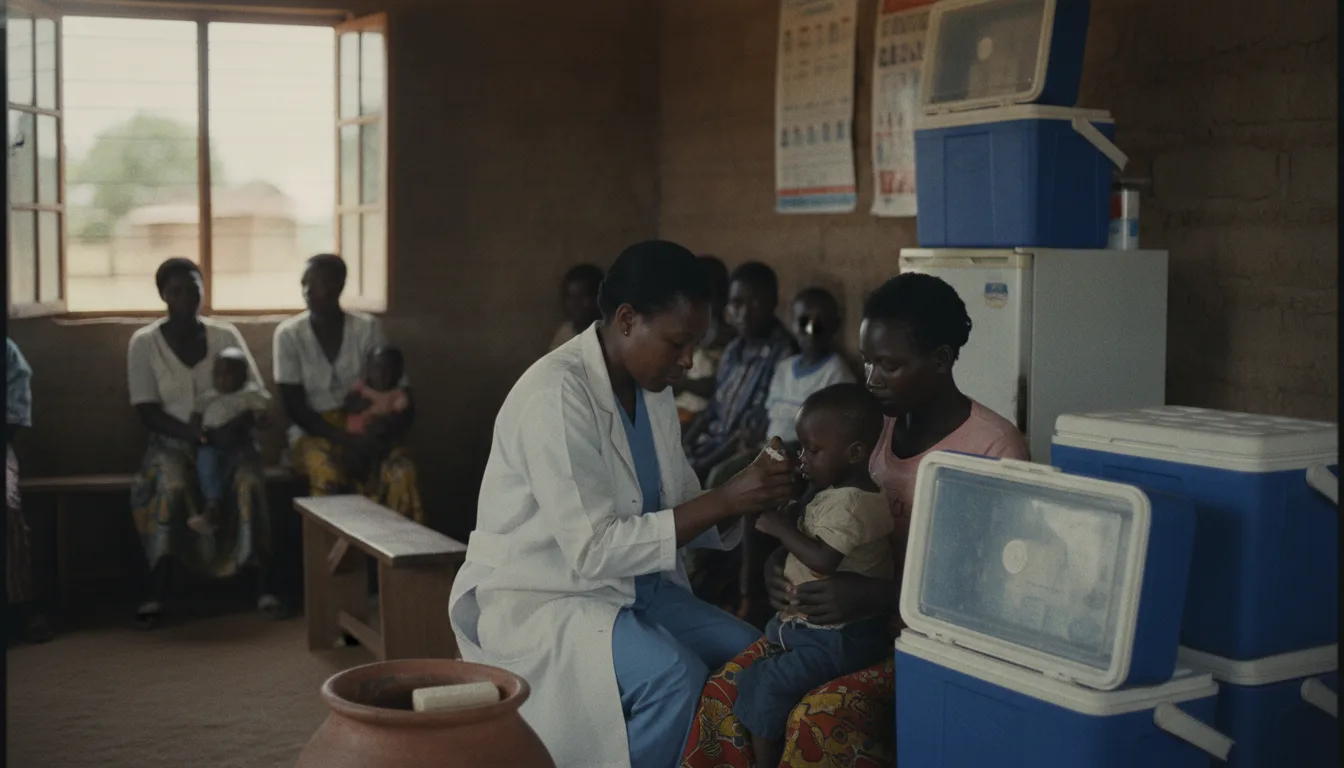
On 22 September 2026, the Gates Foundation and the MTN Group Foundation launched the Maternal Health Multiplier, a digital ecosystem that puts AI-enabled, phone-based decision support in the hands of frontline health workers so they can detect early warning signs of pregnancy and childbirth complications. The platform was built for affordable smartphones and low-bandwidth mobile data because the workers who see these patients first are community health extension workers in primary facilities, not obstetricians in tertiary hospitals. A tool that assumes broadband and a desktop would therefore never reach the point where the clinical decision is actually made.
| Target group | 2030 commitment | Delivery channel |
|---|---|---|
| Frontline health workers equipped | 5,000 | AI decision-support tools on mobile phones |
| Primary healthcare facilities upgraded | 500 | Facility-level programme investment |
| Women reached with trusted health guidance | 500,000 | MTN mobile network and digital platforms |
The mechanism is traceable step by step. A community health worker records blood pressure and presenting symptoms; the tool compares the pattern against guideline thresholds and flags a pre-eclampsia risk; a referral is triggered earlier than clinical intuition alone would have prompted, resulting in hours gained before haemorrhage or seizure. Evidence from NIH-indexed research on clinical decision support systems indicates that structured prompts improve clinician adherence to guideline thresholds, and WHO guidance on digital interventions for health system strengthening, a 2019 recommendation set based on systematic evidence reviews, supports decision-support tools where supervision and referral pathways exist. That condition deserves stating plainly: a detection prompt converts into a saved life only where a functioning referral facility can receive the patient, which is why the program commits to upgrading 500 primary healthcare facilities alongside equipping workers.
MTN’s role is distribution, not cheque-writing. The operator contributes network reach, data bundle economics and device affordability, which means the program inherits an existing subscriber rail instead of building one from scratch. That inheritance is the single largest reason the 2030 target reads 500,000 women rather than a few thousand — and it is also why the Abuja office pursued a telecommunications partner rather than a second NGO.
Horizon 1000: What the $50 Million OpenAI Pilot Puts Inside Nigerian Clinics
Horizon 1000 is a Gates Foundation and OpenAI partnership announced in early 2026 that aims to equip primary healthcare clinics across Sub-Saharan Africa, Nigeria included, with AI “health advisor” tools by 2028. Nigeria is explicitly in scope, and the Abuja country office functions as a delivery node for the Nigerian portion because it already holds the federal relationships and the integration experience built through NAISH.
The tool’s job is narrow and useful. The advisor sits between a frontline worker and a long national clinical guideline, answering the practical question — what do I do next with this patient — in plain language. The effect is that guideline adherence stops depending on whether a printed protocol happens to be in the room, or whether the one staff member who memorised the paediatric dosing table is on shift.
What a Horizon 1000 health advisor is built to do
- Navigate complex national clinical guidelines in response to a worker’s plain-language question
- Support patient triage so the most urgent cases are escalated first
- Generate follow-up plans and recall schedules for patients who leave the clinic
- Summarise patient history for handover between shifts and facilities
- Operate on low-bandwidth mobile connections and affordable smartphones
- Keep a human health worker as the decision-maker on every clinical action
Three constraints dictate the rollout speed, and they are worth naming without euphemism: clinic connectivity, local language coverage, and liability when a suggestion is wrong. Nigeria has more than 500 languages, which means a system validated only in English underperforms in exactly the rural facilities with the worst outcomes. WHO’s guidance on the ethics and governance of artificial intelligence for health, a 2021 report produced by an expert consultation of 20 specialists, recommends documented human oversight and pre-deployment validation for clinical AI, and NIH-indexed work on external validation of clinical prediction models demonstrates that performance degrades when models meet populations unlike their training data. Consequently Horizon 1000 is structured as a staged rollout to 2028 rather than a single national switch-on, and that sequencing is a design decision rather than a delay.
Every AI Health Grant Gates Foundation Nigeria Disbursed in 2026
Two publicly recorded AI health awards came out of the Abuja office in 2026: $1,250,000 to Georgetown Global Health Nigeria LTD/GTE in October 2026 over 36 months for AI-enabled event-based disease surveillance, and $150,000 to the National Agency for Food and Drug Administration and Control (NAFDAC) in August 2026 to strengthen pharmacovigilance systems with AI.
| Recipient / programme | Amount | Duration | Month awarded | Stated purpose |
|---|---|---|---|---|
| Georgetown Global Health Nigeria LTD/GTE | $1,250,000 | 36 months | October 2026 | AI-enabled event-based disease surveillance tools |
| NAFDAC | $150,000 | Not stated | August 2026 | AI to strengthen pharmacovigilance and drug safety data |
| Nigeria AI Scaling Hub (with Federal Ministry of Communications, Innovation & Digital Economy) | $7.5 million | 3 years | June 2025 | Scaling AI solutions in health, education, agriculture |
| Maternal Health Multiplier (with MTN Group Foundation) | Not stated | To 2030 targets | September 2026 | AI decision support for maternal complications |
| Horizon 1000 (with OpenAI, multi-country including Nigeria) | Not stated | To 2028 | Early 2026 | AI health advisors for primary care clinics |
The pattern tells applicants something precise. Both 2026 awards went to entities already embedded in Nigerian public health plumbing — a locally registered research institution and a federal regulator — which means the office is buying integration with national systems rather than novelty. Consequently a proposal whose tool cannot plug into an existing registry, reporting line or regulator workflow competes badly, no matter how strong its model benchmarks look. Grant seekers routinely misread this as a preference for large organisations. It is not; it is a preference for organisations with a live connection to the system that must still be running in 2030.
The two use cases are concrete. Event-based surveillance scans unstructured signals — clinic reports, media mentions, community alerts, rumour logs — to shorten the interval between an outbreak’s first case and its detection, the metric that determines containment cost. WHO’s guidance on early warning, alert and response surveillance sets the standards such systems are assessed against. AI pharmacovigilance does something less visible but comparably important: it cleans, deduplicates and triages adverse-event reports so that NAFDAC’s safety assessments rest on better input data, an application supported by NIH-indexed research on machine learning for adverse drug event signal detection. The effect in both cases is the same — analyst time is redirected from data wrangling to judgement.
The 2027 AI Fellows Program: Who Qualifies and When Applications Close
Deadline: Applications for the inaugural Africa-based AI Fellows cohort close on 11 November 2026. The fellowship runs 12 months and embeds AI practitioners inside Foundation health and development projects at regional offices including Abuja. Readers arriving after that date should check the Gates Foundation careers page for the next cycle.
The program exists because the Abuja office’s AI commitments outpaced its internal AI capacity. Running predictive forecasting across district health systems requires practitioners who have shipped models into production, therefore the Foundation chose to embed talent directly into programme teams rather than contract it out — contracted analysts leave with the institutional knowledge, while embedded fellows hand it to the team that owns the system.
AI Fellows: what the Abuja cohort looks for
- Applied machine learning or data engineering experience shipped into production, not research-only credentials
- Willingness to be embedded with Foundation programme teams for a full 12 months
- Comfort working from or with the Abuja regional office and Nigerian government counterparts
- Domain exposure to health supply chains, forecasting, or public financial management data
- Evidence of building for low-connectivity, low-resource deployment conditions
- Application submitted before the 11 November 2026 close
The first named Abuja workstream is health supply chain AI. Fellows design decision-support tools to cut stockouts of essential medicines at district level by building predictive layers that forecast stock-out risk and flag redistribution opportunities before stock expires. Trace the effect: a district that sees a shortage three weeks out transfers stock from a neighbouring facility holding surplus, instead of placing an emergency order at premium cost or watching the surplus expire unused. The same forecast therefore attacks two losses at once — stockouts and write-offs — which is why this workstream carries a disproportionate share of attention relative to its visibility.
The second core project involves building AI tools to unify disparate healthcare financing flow systems across multiple African countries, so that bottleneck diagnostics can be run periodically rather than reconstructed by hand each budget cycle. Fragmented financing data is the reason a ministry can know its budget was released and still not know which facility never received the money. Readers tracking how this talent strategy fits the Foundation’s broader technology bets will find the pattern repeated across its energy portfolio in our analysis of Gates Foundation climate tech and AI health investing.
Abuja vs Kigali: How Nigeria’s AI-First Model Differs
Gates Foundation Nigeria builds through federal systems and a market of more than 200 million people, which is why its programs are sequenced around scale partners rather than single-country pilots. Kigali-style deployments work differently: a smaller population and a more centralised digital health stack allow national coverage from a single integration, so the sensible sequence there is build first, scale second. Nigeria inverts that. The Abuja office buys distribution first — MTN’s network, federal ministry mandates, NAFDAC’s regulatory reach — and iterates on the tool afterwards, because in a federation of 36 states plus the FCT, a technically excellent tool without a distribution partner reaches nobody.
| Dimension | Nigeria AI Scaling Hub | Maternal Health Multiplier | Horizon 1000 |
|---|---|---|---|
| Announced | June 2025 | 22 September 2026 | Early 2026 |
| Committed funding | $7.5 million | Not stated | Not stated |
| Lead delivery partner | Federal Ministry of Communications, Innovation & Digital Economy | MTN Group Foundation | OpenAI |
| Primary user | AI ventures and their customers | Frontline maternal health workers | Primary care clinic workers |
| Geographic scope | Nigeria | Nigeria | Sub-Saharan Africa, Nigeria included |
| Scale stage, November 2026 | First mature cohort showcased | Contracted to 2030 targets | Staged rollout to 2028 |
One honest limit on the Rwanda comparison: public documentation of Gates Foundation AI health funding in Rwanda is considerably thinner than Nigeria’s 2026 grant record, therefore the contrast drawn here is structural — population scale, delivery partner type, integration path — and not a dollar-for-dollar claim. Anyone presenting a funding comparison between the two countries is extrapolating beyond what has been published.
Data sovereignty is the constraint that quietly decides procurement. By funding locally registered entities such as Georgetown Global Health Nigeria LTD/GTE and Data Science Nigeria, and by hosting the scaling hub in Abuja rather than offshore, the office keeps data pipelines and model training inside Nigerian jurisdiction. Which means a procurement decision turns on where health data physically sits as much as on model accuracy. US National Science Foundation reporting on national AI research infrastructure makes the general point that access to compute and locally held data determines who can build credible models at all — a constraint that applies with more force in Abuja than in Seattle.
What Grant Seekers Should Take From the Abuja Playbook
The verdict is clear on two of three fronts: the Abuja programs have moved past the pilot stage. NAISH ventures such as mDoc were showcased as mature businesses at Moonshot by TechCabal in October 2026 and operate commercially, and the Maternal Health Multiplier is contracted against named endpoints of 5,000 workers, 500 facilities and 500,000 women by 2030. Horizon 1000 remains a staged rollout to 2028 and is therefore not yet at scale. Consequently funding now flows to organisations that can integrate and scale, not to organisations proposing to prototype.
The three routes below are ordered by realistic probability of success, from published open calls through partnership-led entry to unsolicited approaches, which convert least often.
- Apply through a published open call or cohort — NAISH scaling support, the AI Fellows programme (deadline 11 November 2026), or Grand Challenges rounds. Prerequisite: a working product with usage data, not a concept note.
- Join a funded consortium as a delivery sub-grantee — attach to a prime recipient such as a university institute, a federal agency or an MTN-linked implementer. Prerequisite: local registration and an audited financial record.
- Submit an unsolicited letter of inquiry only when your work matches a stated strategy priority exactly — maternal health decision support, event-based disease surveillance, pharmacovigilance or supply chain forecasting. Prerequisite: documented evidence of government counterpart buy-in.
State the constraint honestly: the Gates Foundation does not fund most unsolicited proposals, and the publicly recorded Nigerian health AI money in 2026 went to pre-existing institutional relationships. Therefore a first-time applicant’s fastest route is consortium membership or an open call, not a cold letter of inquiry — and building the government relationship before writing the proposal is better use of six months than polishing the proposal itself.
Frequently Asked Questions
What does the Gates Foundation’s Nigeria country office in Abuja actually do?
Gates Foundation Nigeria operates a country office in Abuja, led by Country Director Uche Amaonwu, that designs and funds health, agriculture and financial-inclusion programs jointly with federal ministries. Since 2025 its health work has run through AI-first programs — NAISH, the Maternal Health Multiplier and Horizon 1000 — delivered inside government and mobile operator systems rather than as standalone projects.
How much has the Gates Foundation committed to the Nigeria AI Scaling Hub?
$7.5 million over three years, committed in June 2025 alongside Nigeria’s Federal Ministry of Communications, Innovation & Digital Economy. The money funds scaling support for AI ventures in health, education and agriculture — data access, regulatory navigation and integration engineering rather than new prototype building. The October 2026 Moonshot cohort, which featured mDoc, was its first visible output.
What is Horizon 1000 and does it include Nigeria?
Horizon 1000 is a Gates Foundation and OpenAI partnership announced in early 2026 to equip primary healthcare clinics across Sub-Saharan Africa, including Nigeria, with AI health advisor tools by 2028. The advisors handle guideline navigation, patient triage and follow-up planning for frontline workers. The rollout is staged to 2028, so it is not yet national in any participating country.
How can organizations secure funding from the Gates Foundation for AI health initiatives?
Through three routes: published open calls and cohorts, sub-grantee roles inside funded consortia, or an unsolicited letter of inquiry that matches a stated strategy priority. Most unsolicited proposals are not funded, and the 2026 Nigerian awards went to organisations already embedded in public health systems. Integration capability therefore outweighs technical novelty in these decisions.
When is the Gates Foundation AI Fellows application deadline?
Applications for the inaugural Africa-based AI Fellows cohort close on 11 November 2026, for a 12-month fellowship embedded in Foundation projects at regional offices including Abuja. The two named Abuja workstreams are health supply chain forecasting to cut district-level medicine stockouts, and unifying healthcare financing flow systems. Check the official Foundation site for later cycles.
Which AI health grants did the Abuja office award in 2026?
Two publicly recorded awards: $1,250,000 to Georgetown Global Health Nigeria LTD/GTE in October 2026 over 36 months for AI-enabled event-based disease surveillance, and $150,000 to NAFDAC in August 2026 for AI-strengthened pharmacovigilance. The MTN Maternal Health Multiplier launched on 22 September 2026 as a co-funded program rather than a single disclosed grant.
Why is the Gates Foundation prioritizing maternal health AI in Nigeria?
Because Nigeria accounts for close to 30% of global maternal deaths, making it the single largest addressable share of that burden. AI decision support on frontline workers’ phones flags complication warning signs against guideline thresholds earlier, resulting in faster referral. The dependency is real: earlier detection converts into survival only where a functioning referral facility can receive the patient.
Does AI in African clinics replace doctors or support health workers?
It supports health workers; none of the Abuja programs make autonomous clinical decisions. Horizon 1000 advisors and Maternal Health Multiplier tools answer guideline questions, assist triage and schedule follow-up while a human retains every clinical decision. The structural reason is straightforward — Nigeria’s constraint is too few trained workers per patient, therefore the return comes from extending their reach.
How does AI reduce medicine stockouts in Nigeria’s health supply chain?
By forecasting stock-out risk at district level and flagging redistribution opportunities before stock expires. Consumption and stock-level data feed a predictive layer, districts see shortages weeks ahead, resulting in transfers between facilities instead of emergency procurement at premium prices and expiry write-offs. This is a named Abuja workstream for the 2027 AI Fellows cohort.
Are the Gates Foundation’s Nigeria AI programs still pilots or are they at national scale?
Two of the three have passed the pilot stage; one has not. NAISH ventures such as mDoc operate commercially following the October 2026 cohort showcase, and the Maternal Health Multiplier is contracted to 5,000 workers, 500 facilities and 500,000 women by 2030. Horizon 1000 remains a staged rollout to 2028 and is therefore not yet at scale.
Limitations of This Analysis
What the public record does not cover. The Gates Foundation has not published a Nigeria-specific allocation for Horizon 1000, and the Maternal Health Multiplier’s total committed budget was not disclosed at its 22 September 2026 launch. This article therefore reports “Not stated” in those cells rather than apportioning multi-country figures to Nigeria. Grant durations for the NAFDAC award were likewise not published. Readers building financial models on these programs should treat only the Georgetown Global Health and NAISH figures as firm.
Outcomes are not yet measurable. The 2030 endpoints for the Maternal Health Multiplier are commitments, not results. No independent evaluation of AI decision-support performance in Nigerian primary care has been published at the time of writing, which means the mechanism described in this article rests on general clinical decision support evidence from WHO and NIH-indexed studies rather than on Nigerian programme data. Strong model performance in validation does not reliably transfer to field deployment where connectivity, language coverage and referral capacity vary by district.
Alternative approaches exist. AI decision support is one route to reducing maternal mortality; expanding skilled birth attendance, strengthening blood supply for haemorrhage management, and removing out-of-pocket payment barriers are others with longer evidence bases. Analysts comparing cost per life saved across these approaches would need facility-level Nigerian data that is not currently in the public domain.
Professional consultation. Organisations preparing a grant application should confirm current eligibility, deadlines and submission formats directly with the Gates Foundation, because open calls and cohort criteria change between cycles. Clinical teams evaluating any AI tool for patient care should seek qualified medical and regulatory advice; nothing here constitutes clinical or legal guidance.
Conclusion
Gates Foundation Nigeria has committed to an AI-first health model and the 2026 record shows it is being executed rather than announced — a $7.5 million scaling hub with two years of operation and a named mature cohort, a maternal health partnership with distribution attached to a mobile network, and $1.4 million in targeted grants to a federal regulator and a locally registered research institution. The common thread is integration: every commitment attaches to a system that will outlive the grant, because the Abuja office concluded that standalone pilots were the reason earlier AI work never reached national coverage.
For anyone seeking funding, the implication is practical. Demonstrate that your tool plugs into an existing Nigerian registry, reporting line or regulator workflow, bring a government counterpart who will say so in writing, and target a published open call before a cold letter. The AI Fellows cycle closes on 11 November 2026; the next visible test of this model will be whether the Maternal Health Multiplier’s 500 facilities come online on schedule.
Read more of our funding analysis to track which commitments convert into disbursements — and which quietly do not.
References
- World Health Organization — Maternal mortality fact sheet
- Institute for Health Metrics and Evaluation, University of Washington — Global Burden of Disease research and analysis
- World Health Organization — Guideline: recommendations on digital interventions for health system strengthening (2019)
- World Health Organization — Ethics and governance of artificial intelligence for health (2021)
- World Health Organization — Early warning, alert and response surveillance guidance
- National Institutes of Health (PubMed) — Clinical decision support systems and clinician guideline adherence
- National Institutes of Health (PubMed) — External validation of clinical prediction models
- National Institutes of Health (PubMed) — Machine learning for adverse drug event signal detection
- US National Science Foundation — Artificial intelligence focus area
- Gates Foundation — Committed grants database and programme announcements
- Federal Ministry of Communications, Innovation & Digital Economy, Nigeria — Nigeria AI Scaling Hub launch announcement
- billgates.pk — Gates Foundation climate tech and AI health investing