

Table of Contents
- What the Bill Gates Nuclear Power Plant Is, in One Paragraph
- Inside the Kemmerer Build: Where Construction Stands in October 2026
- The March 2026 NRC Approval and Why It Was Historic
- What the Natrium Reactor Actually Is: Sodium, Salt and a 500 MW Surge
- How a Natrium Plant Turns Heat Into a 500 MW Surge
- How Much Bill Gates Has Put In, and Who Else Is Paying
- Who Is Funding the Kemmerer Natrium Plant
- The Data Center Bet: Why AI Load Rewrote TerraPower's Business Case
- The Bechtel Exit and the Hyundai Replacement: Execution Risk Priced In
- Chronology of the EPC Transition, August to October 2026
- Natrium vs NuScale vs X-energy vs Kairos: How the Designs Differ
- Can You Invest in TerraPower? What Retail Investors Can and Cannot Buy
- Publicly Listed Ways to Get Adjacent Exposure
- Frequently Asked Questions
- Limitations, Open Risks and the Alternatives to Natrium
- Open Risks as of October 27, 2026
- The Bottom Line on Kemmerer and the Fleet Behind It
- References
The bill gates nuclear power plant is TerraPower’s 345 MW Natrium reactor under construction at Kemmerer, Wyoming. The U.S. Nuclear Regulatory Commission approved its construction permit on March 4, 2026. Nuclear construction began April 23, 2026. TerraPower targets construction completion in 2030 and commercial operation in 2031. Gates has committed over $1 billion of personal capital. On January 9, 2026, Meta agreed to take up to 2.8 GW from a fleet of Natrium plants.
On October 15, 2026, Bill Gates stood at the edge of an excavation pit in southwest Wyoming alongside TerraPower CEO Chris Levesque, Wyoming Governor Mark Gordon and the governors of Idaho and Utah. The pit — the future home of the bill gates nuclear power plant — is roughly halfway to its design depth of 120 feet. That hole matters far beyond Kemmerer, because Kemmerer Unit 1 is the first commercial non-light-water reactor in the United States to win an NRC construction permit in more than 40 years, which means the licensing path TerraPower cut is now the template every advanced reactor developer behind it will follow. The business case changed underneath the project as well, driven by Meta’s January 9, 2026 agreement covering up to eight Natrium plants for AI infrastructure. This article covers the build status, the regulatory milestone, how the reactor works, who is paying, the Bechtel exit, a design-by-design comparison with rival reactors, and whether retail investors can buy in.
About this analysis. Written by the billgates.pk editorial desk, which tracks Bill Gates’ climate technology and global health capital — amounts, timelines, counterparties and measurable outcomes. We separate TerraPower’s corporate statements from Gates’ personal capital and personal views, and we label company targets as targets.
Transparency note. TerraPower is a private company. Figures on cost-to-date, contractor terms and equity ownership are not independently auditable. Every schedule date below after October 27, 2026 is a stated target, not a demonstrated outcome. Nothing here is investment advice.
What the Bill Gates Nuclear Power Plant Is, in One Paragraph
The bill gates nuclear power plant is Kemmerer Power Station Unit 1, a 345 MW sodium-cooled fast reactor designed by TerraPower — the advanced nuclear company Bill Gates founded in 2008 and chairs — now under construction in Kemmerer, Wyoming, next to a retiring coal plant, with commercial operation targeted for 2031.
The shorthand needs unpacking, because Gates does not own a utility and is not building a reactor personally. He founded TerraPower, serves as its chairman, and has put over $1 billion of his own capital into the company. Consequently the popular phrasing describes a corporate project he funded, chairs and publicly champions rather than a Gates-owned generating asset. The distinction matters when you read schedule claims: those come from TerraPower the company, not from Gates the investor.
“Natrium” is the name of the reactor-plus-storage architecture, not the site. The design was co-developed with GE Vernova Hitachi Nuclear Energy, and Kemmerer Unit 1 is its first commercial deployment anywhere. Therefore every later Natrium plant inherits this unit’s licensing record, its construction cost data and its commissioning experience — which is precisely why a single 345 MW reactor in a Wyoming coal town carries strategic weight disproportionate to its output.
Inside the Kemmerer Build: Where Construction Stands in October 2026
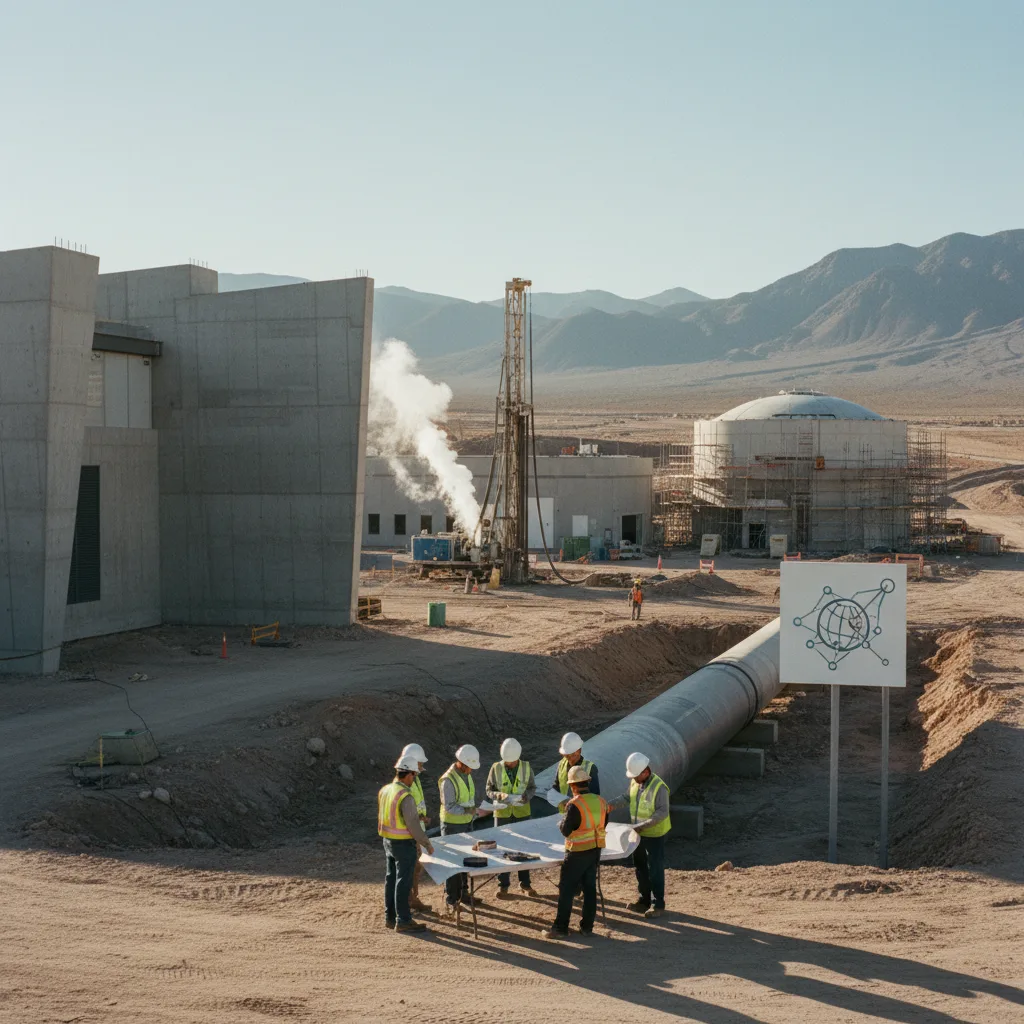
As of October 27, 2026, the project is in vertical nuclear construction, with the reactor excavation roughly halfway to its 120-foot design depth and the Sodium Test and Fill Facility advancing in parallel.
The dated record of how the project reached that point is below.
| Date | Milestone | Status |
|---|---|---|
| June 2024 | Non-nuclear site preparation begins | Complete |
| March 4, 2026 | NRC approves construction permit for Kemmerer Unit 1 | Granted |
| April 23, 2026 | Nuclear construction officially commences | Underway |
| August 31, 2026 | 12 new supplier contracts awarded for long-lead components | Awarded |
| September 15, 2026 | Bechtel WARN filing; EPC partner exits project | Confirmed |
| October 15, 2026 | Gates and three governors tour site; excavation halfway to 120 ft | Confirmed |
| 2030 | Construction completion | Company target |
| 2031 | Commercial operation | Company target |
The 22-month gap between the first earthworks and the construction permit is not a contradiction. The NRC licenses nuclear safety-related structures separately from general site work, which allowed TerraPower to begin grading, roads, laydown areas and the non-nuclear balance of plant in June 2024 while the reactor application was still under review. As a result, the company front-loaded roughly 18 months of earthmoving and consequently compressed the post-permit critical path — the reason excavation reached the halfway mark within six months of the April 2026 nuclear construction start.
The October 15 site tour was a political event as much as an engineering update. Having the governors of Wyoming, Idaho and Utah on the same gravel pad signals regional appetite for replicating the coal-to-nuclear conversion model, driven by the retirement schedules now locked in across Mountain West coal fleets. Kemmerer works as a demonstration precisely because the site already has transmission interconnection, cooling water rights, rail access and an industrial workforce — assets that cost years and hundreds of millions to replicate on greenfield land.
“This project reflects our commitment to reliable energy, good-paying jobs, and a future built on innovation and Wyoming values.”
— Mark Gordon, Governor of Wyoming
Gordon’s framing is the workforce argument in compressed form. Kemmerer’s coal units are winding down, and a 345 MW nuclear plant next door offers continuity for operators, electricians, welders and instrumentation technicians whose skills transfer with retraining rather than relocation. The honest qualifier: construction employment peaks years before operation, and the permanent operating workforce at a single Natrium unit is substantially smaller than a construction peak. The jobs case strengthens materially only if Units 2 and 3 follow.
TerraPower’s position is stated plainly and should be read as a company target rather than a verified schedule: construction completion in 2030, commercial operation in 2031. The company reaffirmed that timeline after losing its primary engineering contractor in September 2026, a claim examined later in this article.
The March 2026 NRC Approval and Why It Was Historic
On March 4, 2026, the U.S. Nuclear Regulatory Commission issued the construction permit for Kemmerer Unit 1 — the first commercial reactor construction approval the NRC had granted in a decade, and the first for a commercial non-light-water reactor in more than 40 years.
The 40-year gap existed for a structural reason. U.S. nuclear regulations, review templates and emergency planning assumptions were written around light-water reactors — water under high pressure, with a well-characterised body of accident analysis behind it. A sodium-cooled design breaks those assumptions. Liquid sodium operates near atmospheric pressure, reacts violently with water and air, and behaves differently in a loss-of-coolant scenario. Therefore the agency had to evaluate coolant chemistry, fire scenarios, containment logic and source-term calculations with no modern commercial precedent to lean on, resulting in a longer, more technically contested and more heavily documented review than a light-water applicant would face.
The consequence extends well past Wyoming. Because the Kemmerer review produced reviewed, docketed methodology for a non-light-water applicant, every advanced reactor developer behind TerraPower inherits a partially cleared path — accepted analytical approaches, settled definitions, resolved generic questions. That lowers regulatory risk across the sector and explains why the approval drew commentary from the American Nuclear Society and the broader energy press rather than the trade-only coverage a single 345 MW project would normally attract.
One licensing mechanic is widely misread. A construction permit is not an operating licence. TerraPower must obtain a separate NRC operating licence before loading fuel, which means the 2031 commercial operation date depends on a second regulatory decision that has not yet occurred. Readers evaluating the schedule should treat the operating licence review — not the concrete pour — as the least predictable item on the critical path.
What the Natrium Reactor Actually Is: Sodium, Salt and a 500 MW Surge
The Natrium design is a sodium-cooled fast reactor paired with a molten salt thermal storage tank. It produces 345 MW of steady baseload electricity and surges above 500 MW for more than five hours when demand or pricing spikes, then returns to baseload while the storage recharges.
Two terms carry the design. A sodium-cooled fast reactor uses liquid sodium rather than pressurised water to carry heat out of the core, operating near atmospheric pressure, which removes the need for the heavy high-pressure vessel and containment architecture that dominates light-water plant costs. Molten salt energy storage means heat is banked in a tank of hot salt and released later to make steam — the same thermal battery concept used in concentrated solar plants, bolted onto a reactor. Baseload here means steady, round-the-clock output as distinct from variable generation.
How a Natrium Plant Turns Heat Into a 500 MW Surge
- The reactor core heats liquid sodium at near-atmospheric pressure, removing the need for a high-pressure containment vessel.
- Hot sodium passes through an intermediate heat exchanger and transfers its heat to molten salt.
- The molten salt is banked in insulated hot-salt tanks, decoupling heat production from electricity production.
- When the grid or an offtaker calls for power, stored salt feeds the steam generator and drives the turbine.
- Output rises from 345 MW baseload to more than 500 MW for over five hours, then returns to baseload while the tanks recharge.
The commercial consequence of that sequence is the whole investment thesis. Because the nuclear island runs flat out at constant power while the turbine island flexes, Natrium monetises peak pricing without cycling the reactor itself. Conventional nuclear economics cannot do this: reactors that throttle output lose revenue on every idle megawatt-hour and incur thermal stress on components designed for steady-state duty. A plant that sells 345 MW continuously but bids 500 MW into the highest-priced hours captures scarcity rents a flat baseload unit forfeits — and that is the capability hyperscale buyers are now contracting for.
| Specification | Detail |
|---|---|
| Baseload electrical output | 345 MW |
| Peak output with storage | More than 500 MW |
| Peak duration | Over five hours |
| Primary coolant | Liquid sodium, near-atmospheric pressure |
| Energy storage medium | Molten salt thermal tanks |
| Reactor type | Sodium-cooled fast reactor |
| First commercial site | Kemmerer Power Station Unit 1, Wyoming |
| Developer and design partner | TerraPower with GE Vernova Hitachi Nuclear Energy |
| Targeted commercial operation | 2031 (company target) |
The trade-off is physical and unavoidable. Sodium burns on contact with water and air, therefore the plant requires a dedicated Sodium Test and Fill Facility — now under construction at Kemmerer — plus specialised cover gas systems, inert handling procedures and a commissioning campaign that light-water builds never undertake. That adds capital cost and an extra sequence of milestones between construction completion and first power. It is one reason the gap between TerraPower’s 2030 construction target and its 2031 operation target spans a full year.
How Much Bill Gates Has Put In, and Who Else Is Paying
Gates has committed over $1 billion of his own capital to TerraPower since founding the company in 2008, and the Kemmerer project’s roughly $4 billion cost is shared approximately 50-50 with the U.S. Department of Energy under the Advanced Reactor Demonstration Program awarded in 2020.
Who Is Funding the Kemmerer Natrium Plant
- Bill Gates, personally: over $1 billion committed to TerraPower since founding the company in 2008; he remains chairman.
- U.S. Department of Energy: approximately 50% cost share on a roughly $4 billion project under the Advanced Reactor Demonstration Program, awarded 2020.
- TerraPower equity rounds: private capital including a 2022 raise co-led by SK Group and Bill Gates, with strategic investors in later rounds.
- Corporate offtakers and strategics: Meta (agreement announced January 9, 2026), SK Innovation (term sheet, August 2026) and Sabey Data Centers (collaboration, January 2025).
- Supply chain partners under contract: 12 supplier awards announced August 31, 2026, including Merrick & Company, BWXT Canada and Mirion Technologies.
The funding structure is more revealing than the headline number. The DOE cost share exists because first-of-a-kind nuclear construction carries schedule and completion risk that no private lender prices cheaply — the sector’s recent U.S. history of multi-year overruns is the reason. Public capital therefore absorbs the demonstration premium so that follow-on units, built with proven drawings and a known licensing path, can be financed on commercial terms. Read correctly, the DOE share is not a subsidy for 345 MW of Wyoming electricity. It is payment for the cost and schedule dataset that makes units two through ten bankable.
That duration tolerance is the structural signature of how Gates deploys climate capital, and it is why his nuclear position looks nothing like a conventional venture bet. A fund with a ten-year horizon cannot hold a reactor from a 2008 founding to a 2031 commercial start; patient balance-sheet capital can. Readers tracking that thesis across his wider portfolio will find further analysis of Gates’ climate tech and AI health investing worth reading alongside this build, because the same evaluation logic — capital-intensive hardware, decade-scale payback, policy-dependent markets — recurs across it.
What is not public deserves equal emphasis. TerraPower is private, so there is no audited cost-to-date disclosure, no published contingency drawdown and no independent verification of how much of the roughly $4 billion has been spent. Consequently total spend and overrun exposure cannot be checked against the original estimate by anyone outside the company and the DOE.
The Data Center Bet: Why AI Load Rewrote TerraPower’s Business Case
The bill gates nuclear power plant was conceived as a grid asset for a coal town, and AI compute demand converted it into an infrastructure product for hyperscalers. That conversion happened inside roughly 24 months, and it changed what TerraPower is selling: not electricity to a utility, but firm capacity to companies whose data centre build-outs are now constrained by power availability rather than capital or chips.
The technical fit is specific, not generic. GPU training clusters swing load hard and fast as jobs start, checkpoint and complete, and operators contract for firm capacity that can follow those swings. Natrium’s salt tank delivers the ramp without cycling the core, which is why TerraPower bids against gas-plus-storage rather than against solar. Department of Energy analysis of rising U.S. data centre electricity consumption is the demand-side evidence buyers are acting on, and it is why firm carbon-free capacity commands premium contract terms in 2026.
| Counterparty | Date announced | Scope | Capacity | First delivery |
|---|---|---|---|---|
| Meta | January 9, 2026 | Up to 8 Natrium plants in the U.S. | Up to 2.8 GW baseload; up to 4 GW with storage | As early as 2032 |
| Sabey Data Centers | January 2025 | Collaboration on Texas and Rocky Mountain deployment | Not stated | Not stated |
| SK Innovation | August 2026 (term sheet) | South Korea’s first commercial Natrium plant | Not stated | Not stated |
| Dedicated data center project (unnamed) | Announcement expected late 2026 | First dedicated data centre nuclear project | Not stated | Groundbreaking expected 2027 |
The Meta agreement’s consequence is the fleet, not the megawatts. Eight plants and up to 2.8 GW of carbon-free baseload — up to 4 GW with storage engaged — gives TerraPower an order book, and an order book is what unlocks serial manufacturing economics: repeat forgings, standardised modules, a learning curve on sodium systems, and supplier contracts large enough to justify dedicated production lines. A single demonstration unit cannot generate any of that, which is why the January 2026 announcement did more for TerraPower’s valuation logic than the March 2026 permit did.
“To successfully address growing energy demand, we must deploy gigawatts of advanced nuclear energy in the 2030s.”
— Chris Levesque, President and CEO, TerraPower
Levesque has described Kemmerer as a “commercial blueprint to mobilize a fleet of Natrium plants across the country,” and in October 2026 he tied the Wyoming site’s own expansion directly to tech demand. “I think this project is going to attract some data center development,” he said during the site visit. “When that happens, that’s when we’ll really be talking about a second or third Natrium plant.” The implication is worth stating flatly: additional units at Kemmerer are now contingent on hyperscaler demand rather than on utility resource planning, which inverts how nuclear capacity has historically been ordered in the United States.
The counterweight is timing, and it is substantial. Meta’s first units are slated for as early as 2032, which means the AI power shortage of 2026 through 2030 will be met by gas turbines, grid purchases, demand response and whatever renewables plus batteries can be interconnected in time. Natrium is therefore a late-decade hedge against sustained compute growth, not near-term relief. Anyone reading the Meta deal as a solution to today’s interconnection queues is reading it wrong.
The Bechtel Exit and the Hyundai Replacement: Execution Risk Priced In
Bechtel and TerraPower parted ways on the Natrium project in September 2026 after failing to agree terms for the next construction phase, and TerraPower states the Kemmerer schedule is unaffected.
Chronology of the EPC Transition, August to October 2026
- August 14, 2026 — Gates and Levesque sign a framework agreement in Seoul naming Hyundai Engineering & Construction as EPC contractor for up to eight future Natrium reactors; a separate term sheet with SK Innovation covers South Korea’s first commercial Natrium plant.
- August 31, 2026 — TerraPower awards 12 supplier contracts covering sodium cover gas systems, control rod drives and other long-lead components for Kemmerer Unit 1.
- September 15, 2026 — Bechtel files a WARN notice citing inability to agree on the next project phase, cutting approximately 200 positions.
- October 15, 2026 — Site tour confirms excavation halfway to 120 feet; TerraPower reaffirms 2030 construction completion and 2031 commercial operation.
Losing an EPC contractor — the engineering, procurement and construction firm that holds the integrated schedule — mid-build normally resets a nuclear timeline, because that contractor owns the sequencing knowledge, the subcontractor relationships and the craft labour pipeline. Therefore TerraPower’s assertion that the Kemmerer timeline is unaffected is the single most consequential claim in the project’s current disclosure, and it deserves scrutiny rather than repetition. The WARN filing itself, reported by Cowboy State Daily, attributed the split to commercial terms for the next phase rather than to technical failure — a meaningful distinction, because pricing disputes on first-of-a-kind work are common where neither party will absorb open-ended risk.
The sequencing of the Hyundai agreement reframes the story. HDEC was signed on August 14, 2026 for up to eight future Natrium reactors, a month before Bechtel’s WARN notice became public. Consequently TerraPower had a credible successor relationship with one of the world’s most experienced nuclear constructors in place before the split surfaced, which argues against the reading that the company was caught without a plan. South Korean contractors bring something the U.S. market lacks: a workforce that has delivered reactors on schedule in the past decade.
Weigh the evidence in both directions. On the progress side, the 12 supplier contracts awarded August 31, 2026 commit real money to long-lead hardware, and an advancing Sodium Test and Fill Facility plus a pit halfway to 120 feet are observable, verifiable physical signals. On the risk side, no EPC contractor has been publicly named for Kemmerer Unit 1 specifically — the Hyundai framework covers future reactors — and that gap remains the open question as of October 27, 2026.
Natrium vs NuScale vs X-energy vs Kairos: How the Designs Differ
Natrium is a sodium-cooled fast reactor with integrated thermal storage, NuScale builds a light-water small modular reactor, X-energy builds a high-temperature gas-cooled pebble-bed reactor, and Kairos builds a fluoride salt-cooled high-temperature reactor.
| Company / design | Reactor type | Coolant | Output per unit | Energy storage | Lead US site |
|---|---|---|---|---|---|
| TerraPower Natrium | Sodium-cooled fast reactor | Liquid sodium | 345 MW baseload; 500+ MW peak | Molten salt thermal tanks | Kemmerer, Wyoming |
| NuScale Power Module | Light-water small modular reactor | Pressurised water | Approx. 77 MW per module | No integrated thermal storage | Not stated |
| X-energy Xe-100 | High-temperature gas-cooled pebble bed | Helium | Not stated | No integrated thermal storage | Not stated |
| Kairos Power KP-FHR / Hermes | Fluoride salt-cooled high-temperature reactor | Fluoride salt | Not stated | No integrated thermal storage | Not stated |
The pattern across those rows reflects a deliberate strategic trade. NuScale’s light-water lineage delivered the sector’s earliest U.S. design certification because regulators already understood the physics, the fuel and the accident analysis. TerraPower accepted a materially harder licensing path — the 40-year gap documented above — in exchange for load-following storage. As of 2026, that bet is paying: the ramping capability is exactly what hyperscale buyers are contracting for, and it is the reason a Meta-scale fleet agreement landed with a sodium reactor developer rather than with a light-water one.
The caveat applies to all four equally. None of these companies has an operating commercial unit in the United States as of October 27, 2026. Therefore every cost per kilowatt, every construction duration and every capacity factor quoted anywhere in this sector is a projection built on engineering estimates, not demonstrated performance. Kemmerer’s value to the entire field is that it will replace one set of those projections with measured numbers.
Can You Invest in TerraPower? What Retail Investors Can and Cannot Buy
No. TerraPower is privately held as of October 27, 2026, has not filed for an IPO, and its shares are not available to retail investors. Exposure is limited to accredited private rounds and to publicly listed companies in its supply chain or peer group.
Before the list below, one caveat governs all of it: a supplier’s revenue exposure to Natrium is a small fraction of its total business, which means these are indirect and diluted proxies rather than substitutes for owning TerraPower equity.
Publicly Listed Ways to Get Adjacent Exposure
- GE Vernova — co-developer of the Natrium plant’s power island and turbine systems.
- BWX Technologies — nuclear component manufacturer; BWXT Canada holds a 2026 Kemmerer supplier contract.
- Mirion Technologies — radiation detection and measurement supplier under the August 2026 awards.
- NuScale Power and Oklo — listed advanced-reactor developers offering sector rather than company exposure.
- Cameco and uranium or nuclear-sector ETFs — fuel-cycle and broad-sector exposure with no Natrium-specific linkage.
There is an asymmetry in what can be verified. Holdings in U.S.-listed companies attributable to Gates’ investment vehicles appear in mandatory filings with the SEC, therefore his listed-equity positions are checkable by anyone. His TerraPower stake is not, because private company cap tables carry no equivalent disclosure obligation. Treat the $1 billion-plus figure as company- and Gates-sourced rather than filing-verified.
This section is information, not investment advice. Private advanced-nuclear ventures carry schedule risk, regulatory risk, fuel-supply risk and the possibility of total loss, and adjacent listed proxies may move for reasons entirely unrelated to Natrium.
Frequently Asked Questions
What is Bill Gates’ TerraPower and what does it build?
TerraPower is the advanced nuclear company Bill Gates founded in 2008 and chairs. It designs the Natrium sodium-cooled fast reactor, and its first commercial unit — the bill gates nuclear power plant at Kemmerer, Wyoming — is a 345 MW reactor paired with molten salt thermal storage. Nuclear construction there has been underway since April 23, 2026, following NRC permit approval on March 4, 2026.
How much has Bill Gates invested in TerraPower?
Gates has committed over $1 billion of his personal capital to TerraPower. He also participated in the company’s 2022 equity round, co-led with SK Group. Separately, the Kemmerer project’s roughly $4 billion cost is shared approximately 50-50 with the U.S. Department of Energy under the Advanced Reactor Demonstration Program awarded in 2020.
When will the Kemmerer Natrium plant start producing power?
TerraPower targets construction completion in 2030 and commercial operation in 2031. As of October 2026 the reactor excavation is roughly halfway to its 120-foot design depth. That date depends on TerraPower obtaining an NRC operating licence, which has not been granted, so treat 2031 as a company target rather than a confirmed start date.
Why did the NRC approval in March 2026 matter so much?
The March 4, 2026 permit was the first commercial reactor construction approval the NRC had issued in a decade and the first for a non-light-water reactor in over 40 years. Because U.S. regulations were built around light-water designs, the sodium-cooled review created reusable analytical methodology, which lowers regulatory risk for every advanced reactor applicant behind TerraPower.
How does the Natrium reactor’s molten salt storage work?
Heat from the reactor is transferred to molten salt, banked in insulated tanks, then released on demand to drive the steam turbine. This decouples heat production from electricity output, which lets the plant run 345 MW of steady baseload and surge above 500 MW for more than five hours before returning to baseload while the tanks recharge.
Why is TerraPower targeting AI data centers?
Because AI training clusters swing load unpredictably and need firm, rampable carbon-free power that renewables alone do not supply. Natrium’s salt storage delivers that ramp without cycling the reactor core. That capability is why Meta signed on January 9, 2026 for up to eight plants providing up to 2.8 GW, boostable to 4 GW with storage engaged.
Why did Bechtel leave the Natrium project and does it delay Kemmerer?
Bechtel and TerraPower could not agree terms for the next construction phase, and a WARN filing dated September 15, 2026 cut roughly 200 positions. TerraPower states the Kemmerer timeline is unaffected, and it had already signed Hyundai Engineering & Construction as EPC contractor for up to eight future Natrium reactors on August 14, 2026.
Can individual investors buy TerraPower stock?
No. TerraPower is privately held as of October 2026 and has not filed for an IPO. Retail investors can take only adjacent exposure through listed suppliers and peers such as GE Vernova, BWX Technologies, Mirion Technologies, NuScale Power or Oklo. Those are diluted proxies. This is information, not investment advice.
How is Natrium different from a small modular reactor like NuScale’s?
NuScale’s module is a light-water small modular reactor of roughly 77 MW per unit; Natrium is a 345 MW sodium-cooled fast reactor with thermal storage. NuScale licensed faster because regulators already understood light-water physics, whereas TerraPower accepted a harder licensing path in exchange for load-following capability that hyperscale buyers now pay a premium for.
What does the Kemmerer project mean for Wyoming coal workers?
Kemmerer is a coal-to-nuclear conversion sited next to a retiring coal plant, intended to retain the local energy workforce. Governor Mark Gordon has framed it around reliable energy and good-paying jobs. The qualifier: construction employment peaks years before operation, and the permanent operating workforce for one unit is considerably smaller than the construction peak.
Limitations, Open Risks and the Alternatives to Natrium
State plainly what is not yet demonstrated. No Natrium reactor has operated anywhere in the world. Kemmerer Unit 1 holds a construction permit, not an operating licence. The 2031 commercial operation date is a company target issued by a private firm whose cost performance cannot be independently audited.
Credible alternatives compete for the same job of supplying firm power to data centres: gas generation with carbon capture, grid-scale batteries paired with wind and solar, enhanced geothermal, and the competing advanced reactors compared above. Several of those reach commercial scale before 2032, which means Natrium’s addressable market depends substantially on how long hyperscalers are willing to wait for carbon-free firm capacity instead of signing gas contracts now.
Fuel is a distinct constraint. Sodium-cooled fast reactors require high-assay low-enriched uranium (HALEU), and domestic HALEU supply remains limited relative to the fleet-scale demand implied by eight Natrium plants. Therefore fuel availability is a schedule risk that runs independent of construction progress — a plant can be finished and still wait for its first core.
Open Risks as of October 27, 2026
- Operating licence not yet granted — fuel loading requires a second NRC decision.
- No named EPC contractor publicly confirmed for Kemmerer Unit 1 following Bechtel’s September 2026 exit.
- HALEU fuel supply for sodium-cooled fast reactors remains constrained in the United States.
- Cost disclosure is limited because TerraPower is private; overrun exposure cannot be independently audited.
- Meta’s first units are slated for as early as 2032, so the agreement does not address 2026–2030 power shortfalls.
- Sodium handling adds commissioning complexity that light-water designs do not carry.
The editorial position follows from that list: the evidence supports calling Kemmerer a serious, funded, regulator-approved build in active vertical construction. It does not support calling it a settled solution to AI power demand.
The Bottom Line on Kemmerer and the Fleet Behind It
After nearly two decades as a design argument, the bill gates nuclear power plant is now a hole in Wyoming ground with concrete scheduled — and the March 4, 2026 NRC permit plus the April 23, 2026 nuclear construction start are the evidence that the argument has become an asset. Physical progress through October 2026, including excavation halfway to 120 feet, is consistent with the company’s stated plan.
The analytical verdict is that Kemmerer’s value to TerraPower was never the 345 MW it will sell in Wyoming. It is the licensing precedent and the first real construction cost dataset for a commercial non-light-water reactor, because those two outputs are what make a Meta-scale fleet financeable on private terms rather than on federal cost share.
Two variables decide the outcome. First, whether the post-Bechtel construction schedule holds without a publicly named EPC contractor for Unit 1. Second, whether HALEU fuel and an NRC operating licence arrive in time for a 2031 start. Watch those, not the press releases.
References
- U.S. Nuclear Regulatory Commission — Kemmerer Unit 1 construction permit documentation and advanced reactor licensing records: nrc.gov
- TerraPower — Kemmerer construction announcements, Natrium design specifications, Meta agreement (January 9, 2026), Hyundai E&C framework agreement (August 14, 2026) and supplier awards (August 31, 2026): terrapower.com
- TerraPower — schedule reaffirmation following the September 2026 EPC transition: terrapower.com
- Cowboy State Daily — coverage of the October 15, 2026 Kemmerer site tour, excavation depth, Levesque’s data centre comments and the Bechtel WARN filing: cowboystatedaily.com
- American Nuclear Society — commentary on the significance of the first non-light-water commercial construction permit in over 40 years: ans.org
- U.S. Department of Energy — Advanced Reactor Demonstration Program cost share and data centre electricity demand analysis: energy.gov
- U.S. Securities and Exchange Commission — mandatory disclosure filings for listed-equity holdings: sec.gov
- billgates.pk — ongoing analysis of Bill Gates’ climate technology and AI health investment strategy: billgates.pk