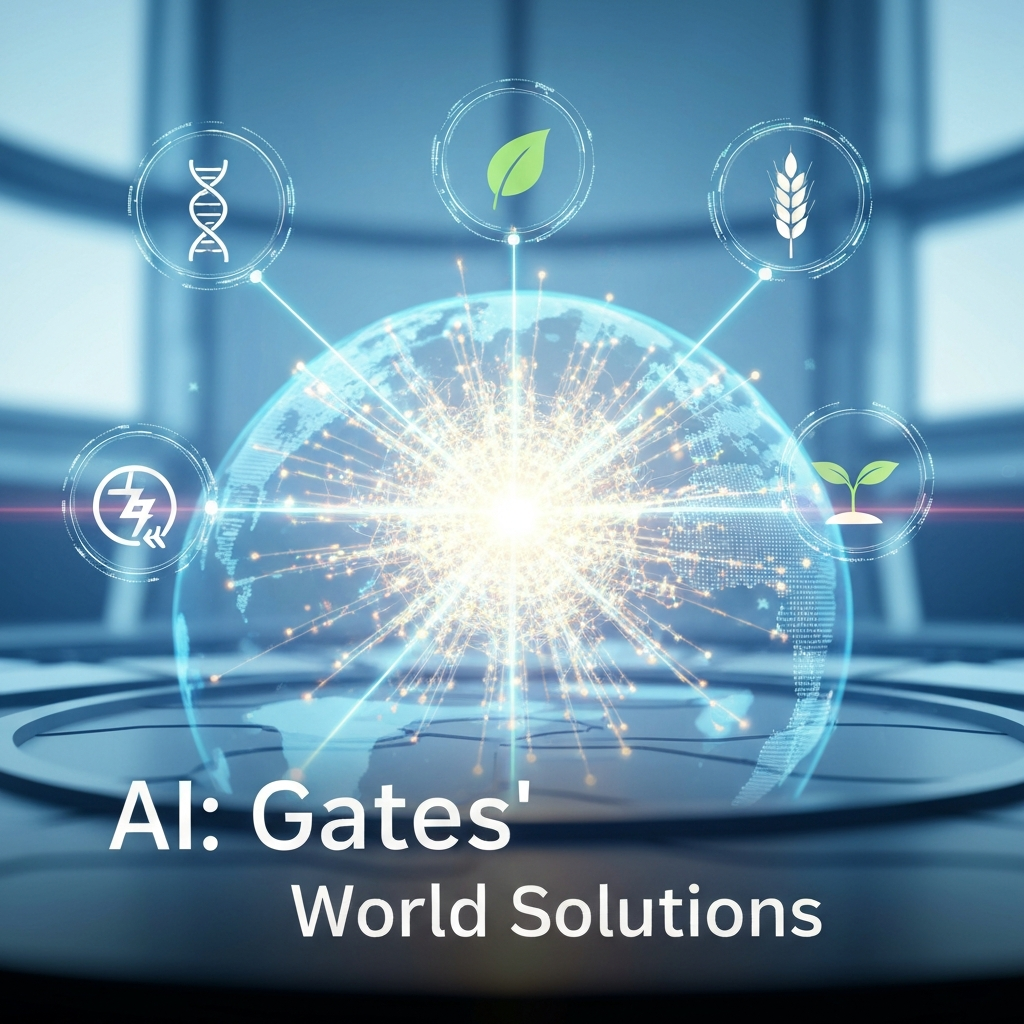
While headlines often focus on the financial scale of Bill Gates' AI investments, the real story lies in their strategic deployment against humanity's most daunting challenges. This isn't just about funding the next tech unicorn; it's a calculated effort to architect solutions for systemic global problems. Where others see only market opportunities, the Bill & Melinda Gates Foundation and Gates' related ventures see a chance to rewrite our future in global health, climate change, and food security. This article moves beyond the investment news to reveal the 'why' and 'how,' showcasing four critical areas where these AI-powered startups are already making a tangible, real-world impact. We will explore the specific problems being addressed and the innovative AI solutions designed to solve them, providing a clear picture of a technologically-driven philanthropic vision.
Tackling Global Health Crises with AI
The landscape of global health is fraught with challenges, from the slow pace of medical research to inequitable access to basic diagnostics. The Gates Foundation has long targeted these issues, and the integration of Artificial Intelligence represents a monumental leap forward. By funding specialized AI, the goal is to make healthcare more predictive, accessible, and effective for the world's most vulnerable populations.
Combating Climate Change and Ensuring Food Security
The dual crises of a changing climate and a growing global population demand radical new approaches to how we manage our planet's resources. Bill Gates' strategy involves investing in AI companies that can optimize our environmental footprint while simultaneously boosting agricultural productivity.
Analyzing the Broader Impact and Inherent Challenges
Investing in AI solutions is not without its complexities. A comprehensive strategy requires a clear-eyed assessment of not only the potential benefits but also the ethical and logistical hurdles that must be overcome for these technologies to be deployed responsibly and effectively.
Measuring the Real-World Impact of Gates' AI Investments
Problem: The true success of these investments cannot be measured in financial returns, but in tangible human and environmental outcomes. How do we quantify the impact of Bill Gates AI investments?
AI Solution: Success is defined by metrics like reduced child mortality rates, lower carbon emissions per capita, and increased crop yields in developing nations. The goal is to create scalable, replicable models that can be adopted by governments and NGOs worldwide. Each investment is a component of a larger ecosystem designed to create a compounding positive effect on global well-being. To understand the full scope of these initiatives, it's helpful to look at the complete portfolio. For a detailed breakdown, you can review our comprehensive list of Bill Gates' strategic AI startup investments.
Navigating the Ethical Maze: AI Bias and Environmental Concerns
Problem: AI is only as good as the data it's trained on. If historical data reflects societal biases, the AI will perpetuate them. Furthermore, the computational power required to train advanced AI models carries its own environmental footprint.
AI Solution: Acknowledging these risks is the first step. Gates-backed startups are actively working to mitigate AI bias by curating more diverse and representative datasets, particularly in healthcare applications. Simultaneously, there is a strong focus on addressing the AI environmental impact. This includes funding research into more energy-efficient algorithms and hardware, ensuring that the technology used to solve environmental problems doesn't inadvertently contribute to them. The challenge is to balance technological advancement with a steadfast commitment to ethical and sustainable practices.
Frequently Asked Questions
What is the main goal of Bill Gates' AI investments?
The primary goal is not financial return, but to fund and scale innovative AI-driven solutions that address systemic global problems, primarily in the areas of global health, climate change, and food security. The focus is on creating tangible, positive real-world impact.
How is AI helping solve climate change?
AI is being used to create smarter energy grids, optimize industrial processes to reduce emissions, develop more accurate climate prediction models, and enhance carbon capture technologies. These applications provide the data-driven insights needed for effective climate action.
Is AI biased in global health applications?
AI can be biased if it is trained on data that is not representative of diverse global populations. This is a significant risk, and organizations like the Gates Foundation are actively working to mitigate it by ensuring datasets are inclusive and by developing methods to test for and correct algorithmic bias.
What are the biggest challenges for these AI startups?
The biggest challenges include ensuring equitable access to the technology, mitigating inherent data biases (AI bias), addressing the environmental impact of large-scale computation, and navigating complex regulatory landscapes in different countries to deploy their solutions effectively.